Behind
the Veil
of Arabia
the Veil
of Arabia
E. P. Dutton & Co., Inc.
NEW YORK 1962
NEW YORK 1962
On my journey I used various cameras according to the conditions under which I had to photograph. For choice I use a Canonflex with a Super-Canomatic 1 : 8 standard lens and Cano wide-angle and telephoto lens. Under conditions where large cameras could not openly be used I employed a Minox miniature camera sewn into a fold of my clothes.
J. B.
The River Bahr el Asrek is called the Blue Nile but is more like a muddy-brown ditch. There is not a spark of romance about it, as its poetic appellation would imply—not, at any rate, the stretch of it which runs through Khartoum, the capital of the Sudan, where the river is humbly swallowed up by the true Nile.
The Bahr el Asrek flowed lazily by me. I sat on the terrace in front of my hotel, and anchored at the opposite bank lay three rusty Nile vessels. Nobody sails on these any more, but in an emergency, when the hotel is full up, they are used for sleeping in.
All day long the sun beats down on the wan land, making men and animals crawl into the slightest suggestion of shade. The air is oppressively hot. You cannot move even two steps without the clothes sticking to your back, and so you prefer to sit perfectly still. It is only towards evening, when the sun drops down behind the desert horizon, that Khartoum begins gradually to stir.
I decided that seldom had I been in a city more dead: and had just sent a drowsy and sympathetic thought to General Gordon for sacrificing his excellent head to defend so dreary a place when I was roused by a long row of trucks rattling past the hotel, all packed with people. At the same time I observed that the street had become full of pedestrians. Most of them looked tired and exhausted; they almost crawled past the houses, singly or in small groups—all going in the same direction.
At that moment the waiter sauntered up with a beer I had ordered. He, too, was reluctant to move in that heat. When he had served me he flopped on to a chair at a nearby table; not because he wanted to be familiar, only because he was dead-tired after his walk from the hotel buffet. With an incredibly dirty handkerchief he wiped the sweat off his brow.
There was nobody but the two of us on the terrace, and I asked him if he would like a beer.
‘Thanks,’ he said, ‘but I’ll wait till I go in. Or I shall have to run backwards and forwards once more.’
I couldn’t be bothered to reply, and he took my silence for consent. A little later, having refreshed my throat, I remarked:
‘We’re well off, we who can have a beer! Look at all those gasping on the road. By the way, what’s going on? There isn’t usually so much traffic!’
‘We’re getting near to Ramadan, the month of fasting. All those poor fellows are pilgrims, on their way to the Moslem sacred cities: you know, Medina and Mecca. The poor devils don’t know what they’re letting themselves in for. It can be bad enough with this heat, but it’s a lot worse in Saudi Arabia; many of them snuff out in the Arabian desert, and a lot of those that are left get sold into slavery. A third of the pilgrims who come through Khartoum here—maybe more—never go home again. So they say, anyway.’
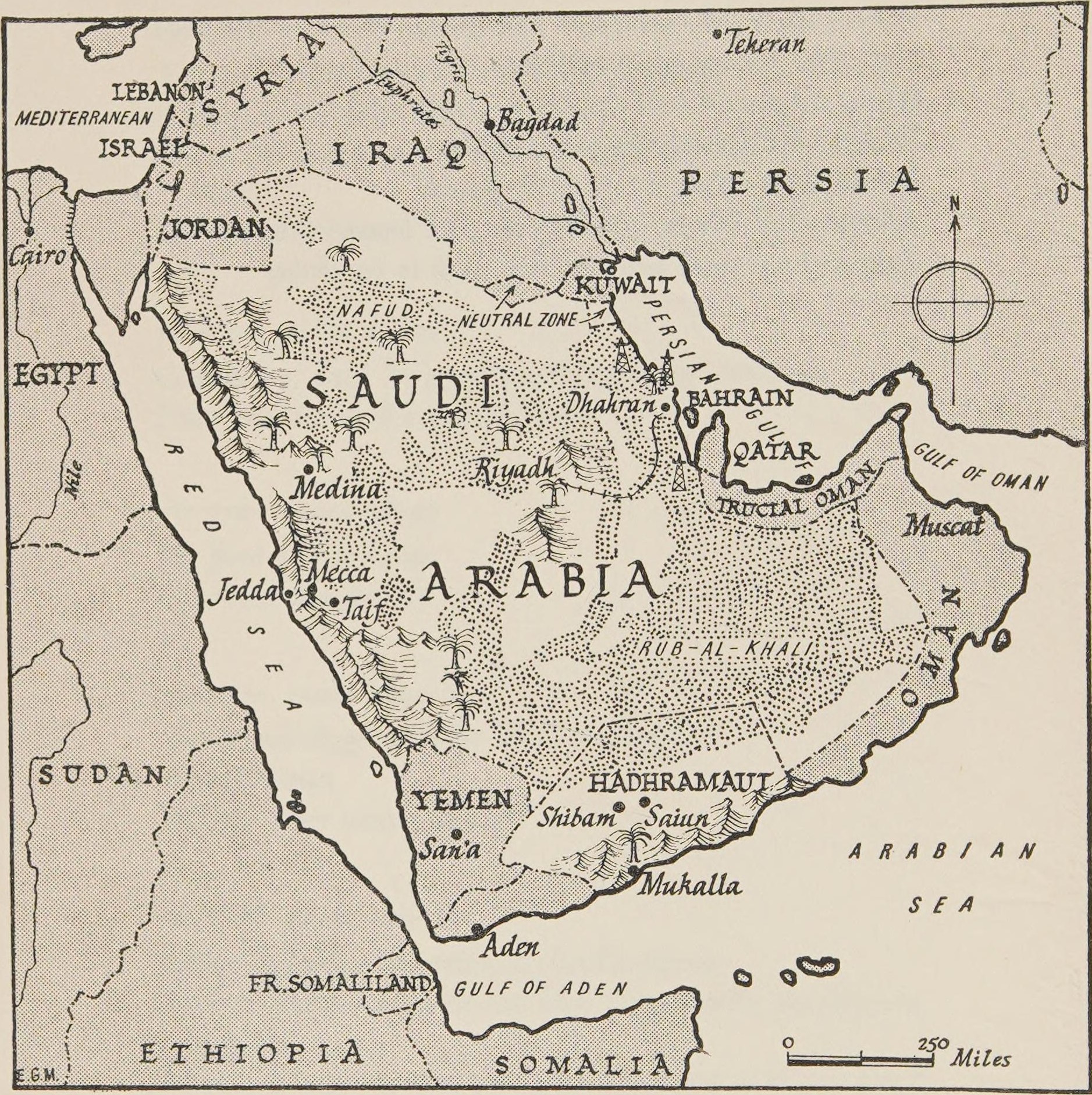
The waiter’s words gave me something to think about. Slaves? I had heard a fair amount about the slave markets of Saudi Arabia. What was it like there, I wondered, in the country where the women still have to be veiled, the country which is itself surrounded by a veil, closer even than the Iron Curtain.
It was the sight of the tired and dusty pilgrims, the brief conversation with the waiter in front of the hotel, and the accounts I had heard and read from time to time about the slave markets, which brought my long-cherished plan of an Arabian journey to fruition. And it was symbolic that this plan should ripen in Khartoum. It is one of the crossroads where pilgrims from many parts of Africa meet when, in the sacred month, secs the Red Sea to Saudi Arabia—on hadji, as the pilgrimage is called.
Official reports from Saudi Arabia say that in 1958 alone 32,669 pilgrims arrived there from Egypt and 16,850 from Nigeria. No doubt the figures quoted are some of the highest recorded, but the annual variations are not very great; the corresponding figures for the previous year were 37,444 and 15,037.
The pilgrims, then, number many thousands—when they start out, that is. For, as the waiter said, a good deal fewer return. During the journey many die of starvation or exhaustion, some of disease and others again of heat-stroke. For example, in one week of July 1959, 462 of those on
SLAVE-HUNTING AMONG PILGRIMS Ey pilgrimage to Mecca perished. The authorities in Saudi Arabia attributed this to heat-stroke, age, and poor health. To a faithful Moslem death for Allah is always a fine death—and finest when it occurs during a journey to his sacred cities.
Nevertheless, as the waiter also said, there are thousands of pilgrims who fail to return for other reasons. They simply disappear. Carried off by slavers, they are sold in slave-markets in the closed Arabian towns, where they must spend the rest of their lives behind the palace walls of rich sheikhs.
A reputable Danish encyclopaedia states that ‘in Khartoum they did a lively trade in the products of the Sudan, especially slaves,’ thus doubtless confirming honest people’s belief that ‘such things don’t happen nowadays, as slavery has long since been abolished’. Reports to the Anti- Slavery Committee of the United Nations tell another tale; and in every one of its many publications the Anti-Slavery Society in London can give well-documented examples to show that in certain Oriental countries the slave trade is carried on just as intensively asin centuries past.
A French Protestant clergyman, M. Emanuel la Graviére, after thorough investigations, prepared a report dated November 17, 1955. In this he testifies that hundreds of Africans are sold into slavery in Saudi Arabia every year. The transports goby various routes to Lith on the Arabian coast south of Jedda, and soto slave markets in Mecca and Riyad. Even the names of the leading slave dealers are given: in Mecca, where one of the markets is openly called Dakkat al A bees (Slave Platform), they are Al Garra, Mimish, and Ibn Nazir. In Riyad, according to la Graviére, Abdullah Ibn Marwan monopolizes the market.
United Nations reports state that a number of natives of Senegal have been specially naturalized in Arabia and sent back to Africa by the slave traders of Jedda and Mecca to kidnap their victims. These slave agents pose as missionaries, whose ostensible purpose is to assist their fellow- Moslems with the practical arrangements of a pilgrimage to the shrines of Islam and to teach them the doctrine of the Koran. Asa rule it is fairly easy to find enough willing believers and pack them off. Men, women, and children are taken by truck to the Red Sea coast; from there they go by specially chartered Arabian ships to Lith. Here the pilgrims are accused of entering the country illegally; and while their case is pending, they are put into a prison from which they are quietly removed by a slave dealer. Those who are not immediately sold are ‘stored’ against better times.
A few years ago the New Statesman sent a correspondent, Brian Carney, on a tour of the Middle East, and his fact-filled articles clearly demon- B strated that the business of slave trader was (in March 1957) a fairly common and respectable one in Saudi Arabia. Everybody knew the slave routes from Dubai, Muscat, Buraimi, Al Hassa, and Riyad, Mr Carney wrote. The traders’ names were also known; they were respectable people like Ibn Gruraib and Al Mirri. If the opportunities for buying slaves were poor, they did not stop at paying chance tribesmen to catch a pretty girl or strong young man. The police never interfered in these purchases; the slave traders were licensed. Every month the slave traders collected their booty and travelled to Mecca. There men and women were exhibited, often two or three at a time, to those interested.
An investigation by French colonial authorities revealed the number of ‘pilgrims’ who in 1954passed through the town of Abéché on the borders of French Equatorial Africa and the Sudan. The outward-going numbered 21,907; only 9,011 returned. The explanation for this appalling discrepancy was as follows: “The European habit of carrying jewels which can be sold if one runs short of currency when travelling abroad has been adopted by the Orient, but of course at the same time adapted! Rich Moslem pilgrims, making their pious journey to Mecca, will nowadays take with them three or four more servants than they need, and these they will sell to slave traders on their route if they run short of money.’
In connection with a debate in the House of Lords in 1956, the Anti- Slavery Society submitted a report whose authenticity it guaranteed. The report stated that the tribes involved in the Saudi-Arabian slave trade were the Al Dowasir, which operates in the southern desert and Qatar; the Al Murra, on the border between the Buraimi oasis and the southern desert; the Al Manasir, whose province is the Buraimi territory; and the Al Uhaiba, Al Dohm, Al Nabit, and Al Habbah tribes. The biggest dealers in these parts are the above-mentioned Ibn Gruraib, of the Al Murra tribe, Jabu Ibn Hadfa, and one Ibn "Abd Rabbo. They make seasonal journeys to Dubai and Muscat and return with batches of 50-60 slaves at a time. The slaves are first offered for sale in the town of Al Hassa, and, if they cannot be sold there, at Riyad.
According to this report, one dealer who condescended to be interviewed described how he kidnapped slaves in the Qatar and Buraimi areas. He made contact with itinerant musicians who performed near a town or village, and there arranged for them to give a concert on a certain day. He then persuaded a neighbouring tribe to make a raid on the gathering and carry off the girls, for whom he afterwards paid the tribe’s sheikh a certain sum per head. The slave trader would take his victims to the auctioneer of the slave market at Al Hassa or Riyad, who would meet him and take over the haul outside the town.
Once they have reached the auctioneer, the slaves are sold quite openly in the markets. In Riyad they are led round the streets by the dealer, tied six and seven together like cattle. Outside ‘business hours’ they are kept shut up in small basement rooms, where they have to live on bread and water; but the dealer will always bring them out and ‘demonstrate’ them to likely fanciers.
The report of the Anti-Slavery Society gives many other examples. In September 1955 the Iraqi police arrested one Mohammed Husain, a slave trader who supplied King Ibn Saud with juvenile male and female slaves from Iran and Iraq, where he and his helpers chiefly operated inthe Najag and Kerbala regions. With him when arrested were over fifty girls he was taking for sale at Riyad.
In 1954 a number of girls were abducted from Qatar, among them a niece of a well-known merchant, Ibn Maktoum. She was sold twice at Al Hassa and afterwards at Riyad, where through intermediaries she was bought for the royal family. Her distracted parents sent scouts into the desert to search for her. They traced her to Al Hassa, and her family then dispatched a force of 120 men on camels with a demand that the Saudi- Arabian authorities should immediately release her. They succeeded in getting a telegram through from Al Hassa to Riyad, and asa result she returned safely to her parents.
There is also the case of the twelve kidnapped Baluchis (one of whom was the personal property of King Ibn Saud) who agreed to escape together. They collected enough money to buy two camels to carry their supplies of food and water through the desert. But their flight was soon discovered, and an expedition dispatched by the governor recaptured them. All were beheaded on the spot except for three who were taken back to Riyad and publicly executed in the palace square, asa deterrent to others.
Many more examples could be given of the way in which slaves are captured for the markets. Occasionally, however, young girls from poor desert tribes run away from their families of their own accord and offer themselves to a slave trader. A shapely girl, bought by a rich Arab, can count on a relatively carefree existence, and many prefer slavery amid luxury to a free life in the poverty of the desert.
When a girl is displayed in the slave market she is dressed, but her face will not be veiled as a woman’s face should be in Saudi Arabia. If a would-be purchaser wishes, the slave dealer will readily take her to a tent for ‘private inspection’. The buyer may also demand a medical certificate to the effect that she is free from infectious disease.
Thanks to the oil wells, money has poured into Saudi Arabia, with the t 20 BEHIND THE VEIL OF ARABIA result that slaves will now fetch very high prices. A pretty girl may bring in about £400, a strong man £150, and even old women can be disposed. of for £35 apiece if they are sound in mind and limb.
In March 1960 a beautiful young Egyptian woman, Raga Yassin, applied for a divorce in Cairo. The case led to so much publicity and revealed such disgraceful conditions that it shook even the hardened Arab world to its foundations. A rich sheikh from Saudi Arabia, Omar Yassin, who lived in Egypt, had asked Raga’s father for the girl’s hand against a sum of £500, and the girl, who was still at school, agreed, because—as she afterwards frankly said in court—she had always dreamt of ‘a life of luxury and her own limousines’. She had been married a month when her husband told her that he had sold her to an emir of the small shiekh-dom of Qatar. Omar Yassin had received £2,000, and offered the girl a quarter of the sum if she would enter the emir’s harem without fuss. ‘T’ve made a good deal,’ Omar said. “The market price is £1,000, but the emir paid double that because you look like Queen Saraya.’ Omar Yassin also told her that he had previously sold sixty-five of his wives to various Arab princes.
But Raga turned out to be a girl of mettle. She had managed to tape-record the conversation with her husband; the tape was produced as evidence, and a divorce was immediately granted. Meanwhile Sheikh Omar had fled from Egypt. It is said that he now lives at Beirut.
It is not only from Africa and neighbouring countries that Saudi Arabia gets its slaves. It is said that every year in France alone between 12,000 and 15,000 women disappear, leaving the police without a clue, and the British police could produce similar figures. There is every reason to believe that some of these women arrive by inscrutable ways behind the veil of Arabia.
The French authoress Claire Fayein, in her book Une Frangaise Médecin au Yémen, says that King Saud once sent an ambassador to the Yemen to buy a white girl for 700,000 francs (then about £700), in order that one of his young sons might ‘enjoy’ her. “White women slaves fetch considerably higher prices than Arab or black ones,’ the author writes. ‘Not because they make better lovers: on the contrary. But it is intriguing, novel, and a rarity to have a white female slave.’
The problem of the slave trade has been raised internationally time and again. In 1956 a conference was held at Geneva to which fifty countries sent delegates. France and Britain wanted a convention whereby the transportation of slaves by sea (they had the Red Sea particularly in mind) would constitute piracy. This would have given the right to intercept and search any ships under suspicion.
‘Slaves,’ sneered the Lebanese observer, Jamil M.Baroody (who did not deny that slavery existed in Arabia), ‘what are slaves? It would be more correct to call them servants. They live well. They are allowed to call their masters “Uncle”.’ He added a few disparaging remarks about imperialism and colonialism.
The United States kept well in the background, being unwilling to offend the ruler of Saudi Arabia, King Ibn Saud, because to do so might have endangered the air base at Dhahran and American oil interests in Saudi Arabia. The only result of the conference was a mild declaration expressing agreement that ‘slavery is an ugly thing’.
Yes, slavery is indeed an ugly thing; yet something which is surrounded by so much excitement and Oriental mystery that the idea of journeying behind the veil of Arabia to see what conditions were really like appealed to my love of adventure and sense of romance. Even as I sat on the hotel terrace at Khartoum opposite my sweating waiter I began to lay plans: there would be a couple of months’ preparation in Denmark, and then the expedition itself, with the small sultanate of Mukalla as the starting-point. From former visits I had certain connections there that I hoped would assist me with further arrangements...
When a few days later I left Khartoum my source of inspiration, the waiter, received a generous tip. He put it sleepily into his pocket—without looking at it, and with no idea of what his chance remarks about the passing pilgrims had set in train. Perhaps just aswell! For he would have thought me mad had he guessed that I meant to go of my own free will on an adventure into the dangerous, barbaric country of Saudi Arabia...
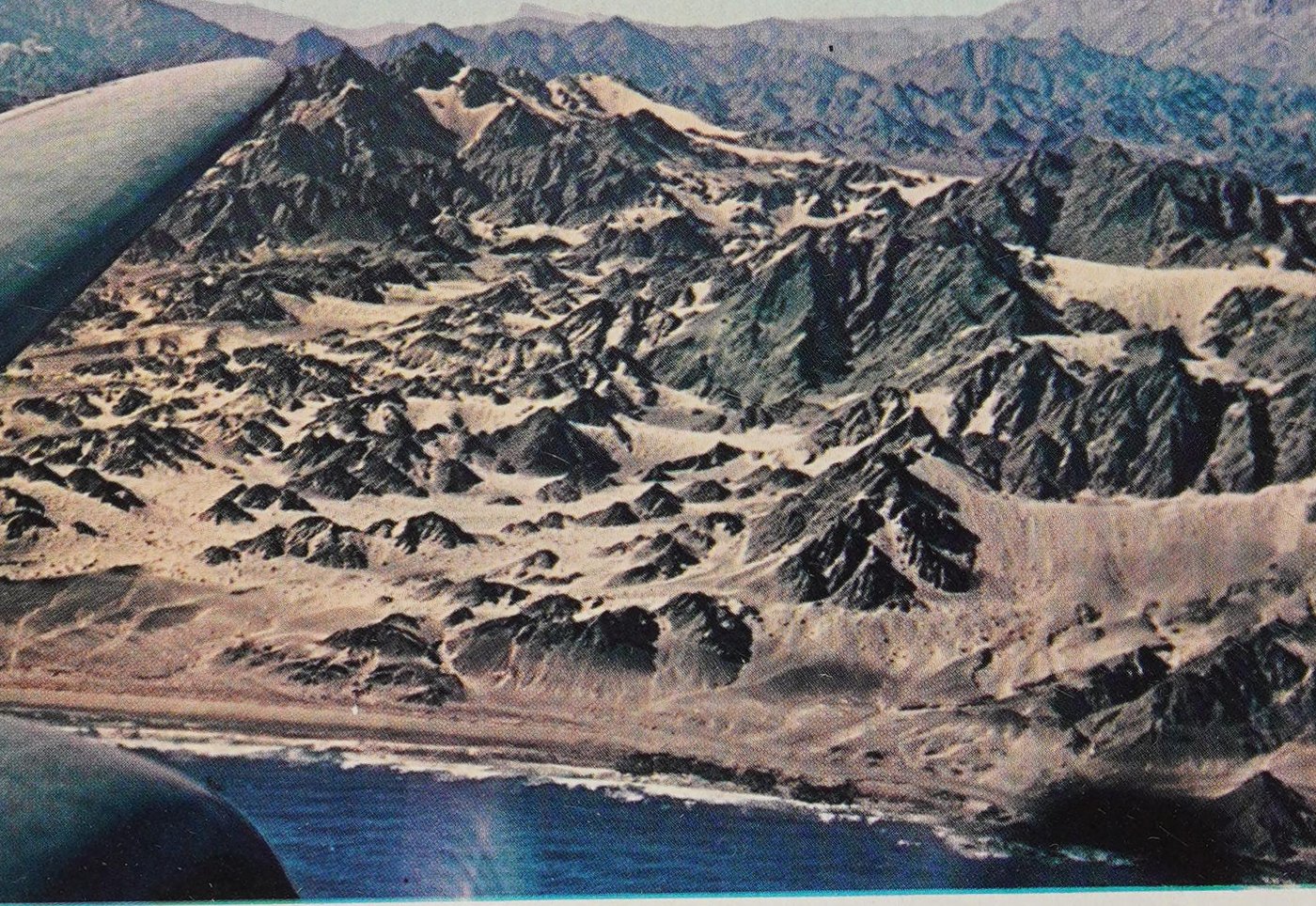
The voyage along the rugged south coast of Arabia through the Gulf of Aden does not enjoy the best of reputations among sailors. When a storm blows up and a yellow mist of sand swirls out from the desert it is wise to keep well away from the dangerous coastline, whose lava reefs are like the teeth of a saw, so hard and sharp that they can rip open a ship’s belly in a trice.
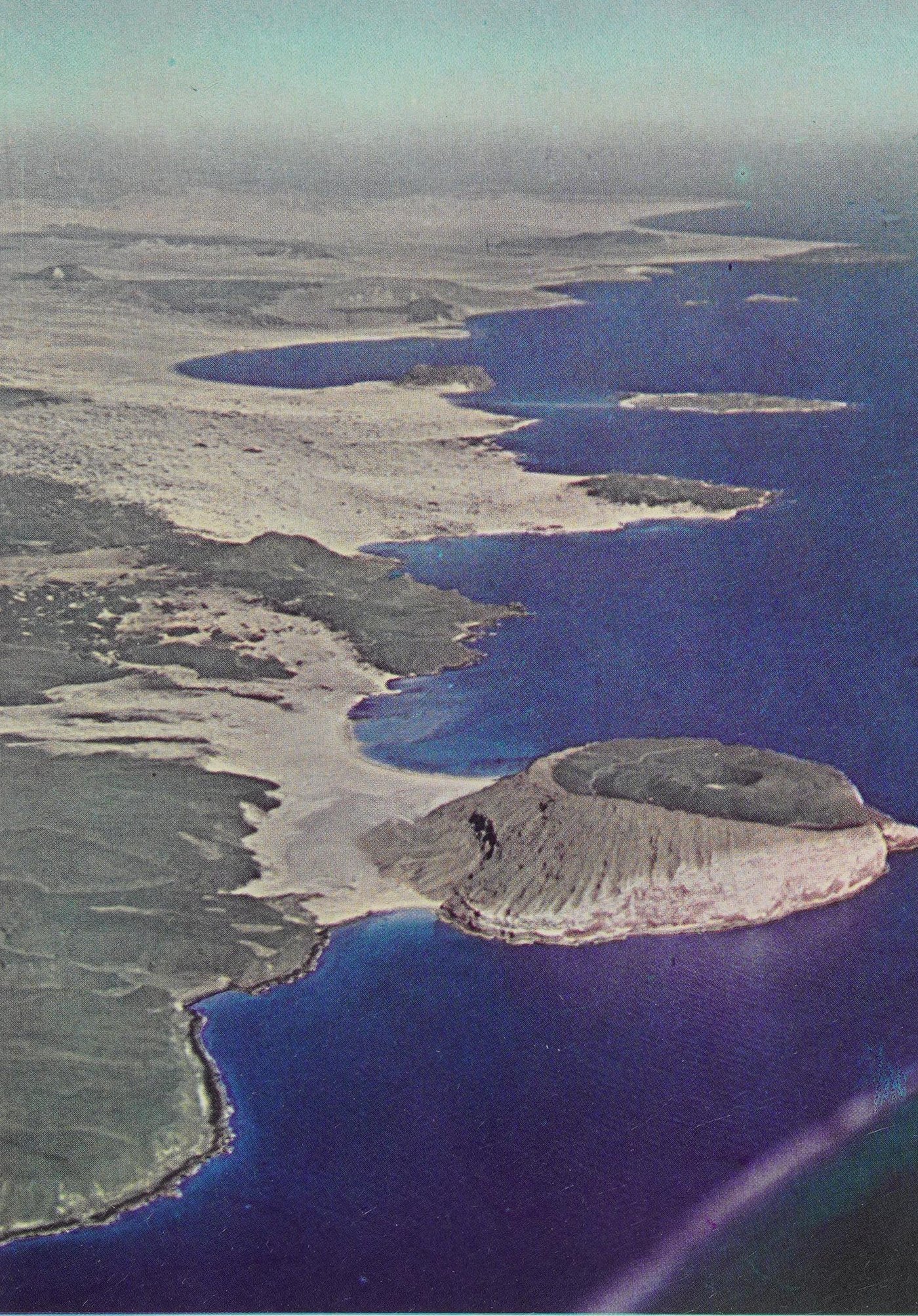
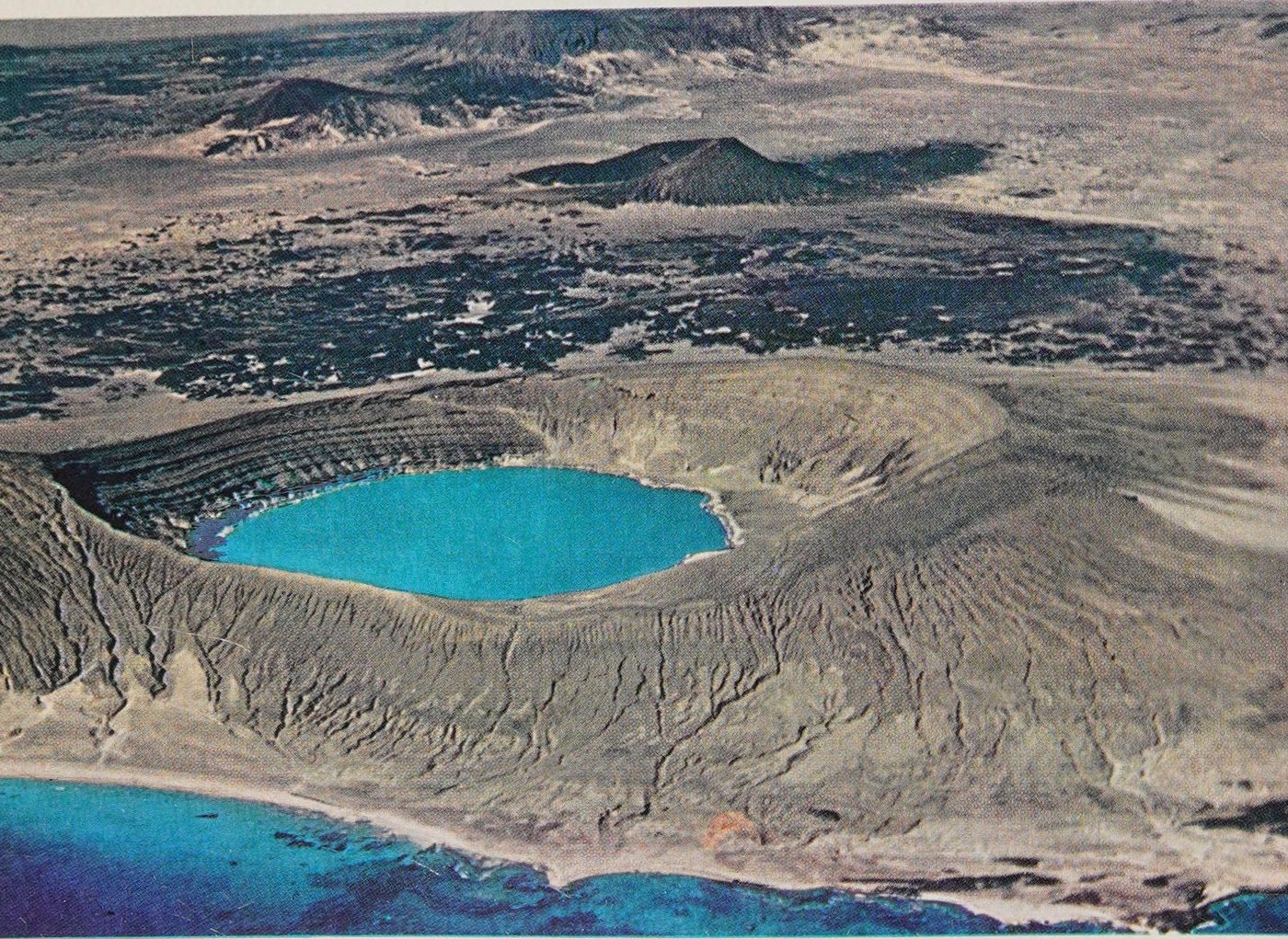
Nature herself seems to warn mariners not to approach too near. The rocks have such grim and grotesque shapes that they look as if they have solidified during an exceptionally painful process in the earth’s evolution, and there may be something in this. They were formed, thousands of years ago, at a time when the volcanoes here were active. Now the volcanic cones which rise at the meeting point of sea and land seem not to belong to our globe at all but to be part of a lunar landscape.
At many points the foot of the rock extends far out into the sea and the cone leans over as though about to overturn, As you sail past it you feel that you can almost look down into its crater. Some volcanoes are black; others are formed from a strange red lava, a colour which makes the crater look red hot. Although they have doubtless been extinct for thousands of years, you feel that they could become active again, belching forth their deadly lava at any moment. Perhaps, millennia ago, people lived on this coast. Perhaps they were wiped out when in wild fury the volcanoes poured flow upon flow of lava across the land—down to the day when the whole landscape was transformed, coagulated into the desolate wilderness of rock which faces what we now call the Gulf of Aden or the Arabian Sea. A large part of the land was for a long period submerged, and this has enhanced its distinctive character.
If a ship runs aground on the sunken reefs, or is wrecked against the steep rock face, the seamen will invariably be lost beyond rescue. The coast in many places has no beach and the sea swarms with sharks. Supposing a few men did get ashore after a shipwreck, it is almost certain that they would land where there would be no bush, nor even a blade of grass, to afford shade against the pitiless sun, and the heat of the sand and the rocks which can exceed 150° F. Nor would they find a drop of fresh water anywhere. They might live for a few hours, or days at the most.
When as a newly fledged globetrotter I visited Mukalla for the first time, ten years ago—in 1949-50—I was told that, shortly before, a yacht had been stranded about sixty miles to the south-west. A passing Bedouin tribe had killed all on board and looted everything movable. So the crews of dhows, the small Arab vessels, breathe freely again when, sailing up the coast, they have passed the small promontory that conceals Mukalla. The dhows, which are very like Chinese junks, carry spices from Zanzibar and other African ports to Mukalla and Muscat.
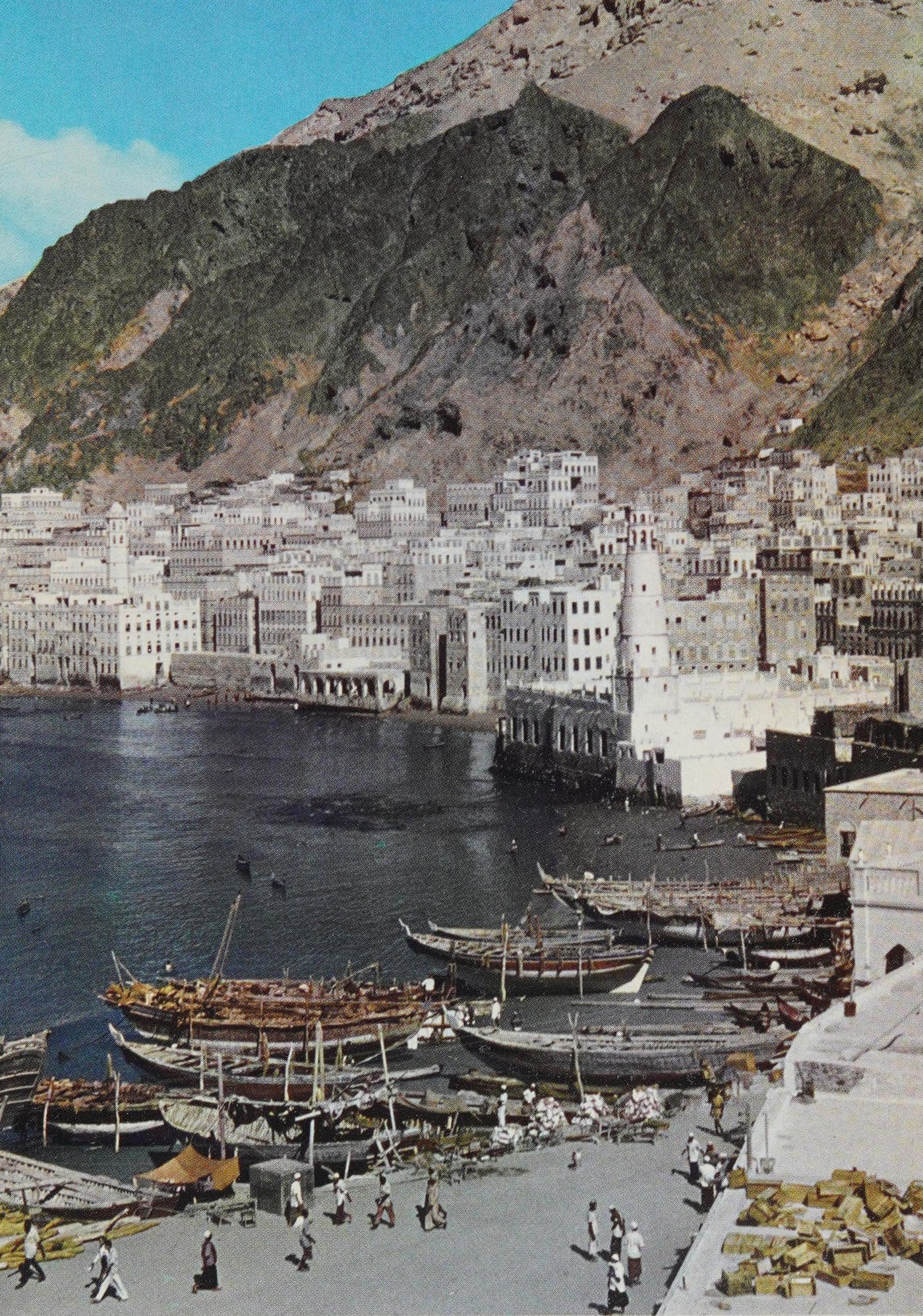
Once past the promontory the dhows are safe and Mukalla reveals itself like a mirage to their crews. If one approaches it on a moonlit night the sight of the white town of Mukalla is even more fantastic than it is by day. It can look almost spectral.
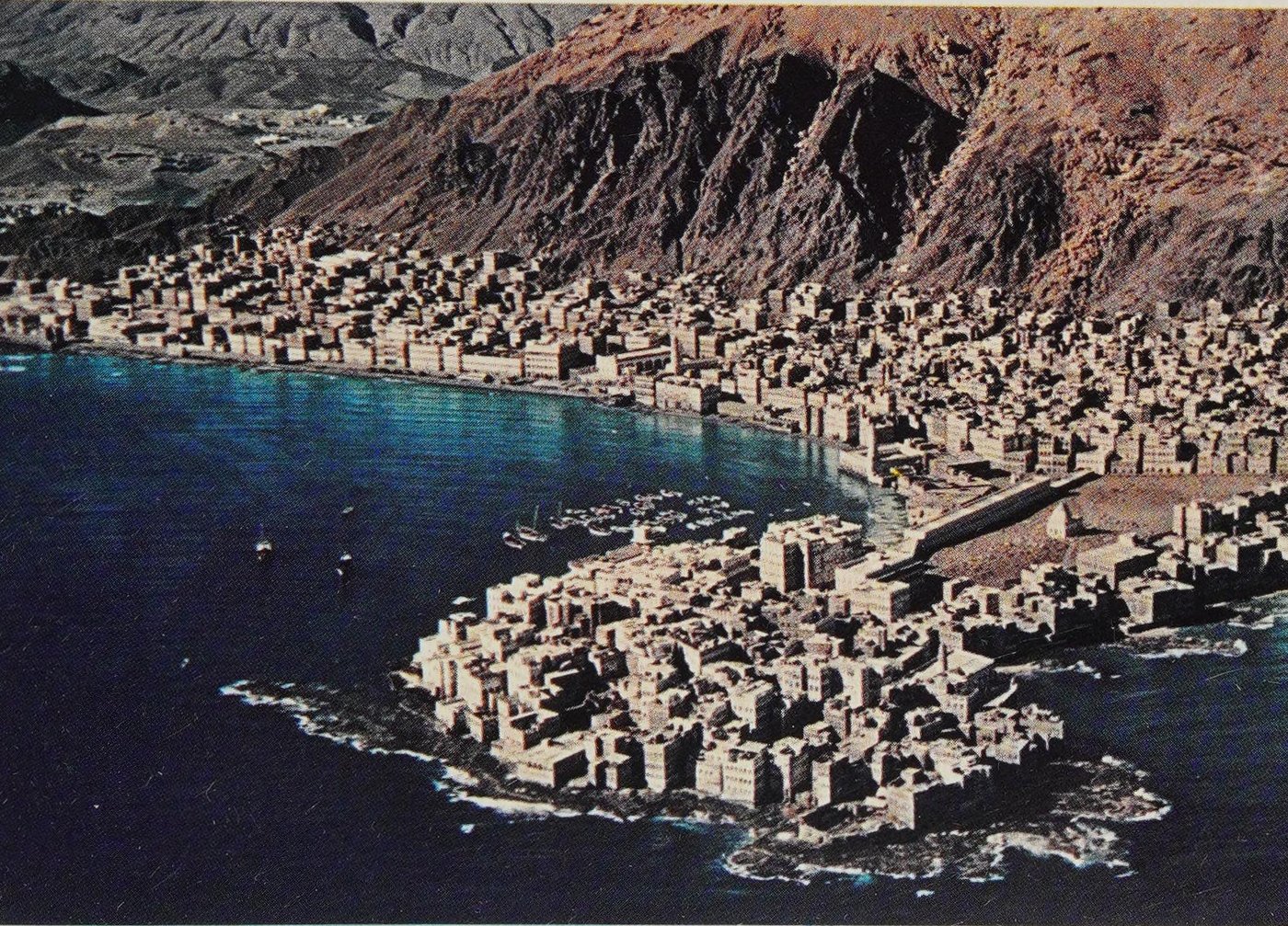
But Mukalla is real enough—improbable though it may seem—built as it is on a narrow strip of land behind the promontory. The sea, however, has withdrawn just sufficiently from the rock face to give the town a foothold. The houses seem to contend with one another to maintain their position, while the mountains behind them appear to be trying their hardest to push them into the sea.
Originally Mukalla was only a little fishing village; but as there are few harbours along the coast it gradually acquired importance, the more so since it is easier to get ashore there than at most other points. Thus the town became a trading centre, flourished, grew, and one day stood hemmed in between sea and mountain. There is no room for a single new house. The houses are built so far out over the sea that the spray dashes in at the windows when there is an onshore storm; and on the other side they are set so close to the mountain face that occasionally great boulders crash down on the houses and pass clean through three or four of them before coming to a halt.
To the south-west the narrow strip of land is bordered by the wadis: vast dried-up river beds which are the only negotiable roads in the region. In the north-east the town extends to a point where the rocks drop down to the sea, forming an impassable barrier. Thus a limit isset to the possibilities of expansion. The only remaining alternative is to build upwards—and thatis what they do. Mukalla has houses of seven and eight storeys high.
Mukalla, no doubt, chiefly owes its origin to the fact that a small sheltering peninsula protrudes from the coast at this point; one is reminded of New York’s Manhattan—in miniature, of course. And as a counterpart to the Statue of Liberty, at Mukalla the slender white minaret of the mosque welcomes those who approach it from the sea. The difference is that Mukalla has very little with which to welcome anyone. It is no gateway to a promised land. Not in our time, at any rate. But several centuries ago Mukalla gained renown as an exporter of incense and myrrh; both were popular ingredients of perfumes and were also used in religious ceremonies. Nowadays the goods are not so exclusive: the town exports a few dates, and for the rest makes its living by fishing and by building the distinctive little dhows.
The number of inhabitants is uncertain. Quoted figures fluctuate between 25,000 and 45,000, but so far nobody has succeeded in carrying out a proper census in this overcrowded labyrinth of a town.
Mukalla’s harbour is a tiny one, and normally there is not much life there. When a steamer of any size arrives it has to anchor in the roads, and then scores of small dhows and lighters will swarm about it, like bees that have smelt honey, to bring in the cargo. Nearly all goods arrive by dhow, so that on the rare occasions when a steamer comes in sight the inhabitants all come out to watch it anchor up.
The first time I arrived at this town I was on a small Swedish vessel, the Spica. My motor-cycle and I were on our way from Mombasa to Mukalla, from where I was to venture through the Arabian desert. As fellow-passengers I had two ostriches, which the Sultan of Mukalla had wanted for his private zoo. He was a keen collector of animals from foreign countries. Having originally collected women for his harem, he had found as he grew older that wild animals were more relaxing.
From the Spica’s deck we saw thousands of people gathered along the shore and on the quayside. They had come pouring out in such numbers that Captain Svensson of the Spica more than once had occasion to bawl out his unceremonious: ‘A thousand devils and split my topgallant sails if I’ve ever seen the like of it!’ Captain Svensson was a man of few words. I thought once that this was all he had learnt to say.
At Mukalla’s modern landing stage, which local patriots rather pretentiously call ‘the harbour’, the town dignitaries were assembled, with the sultan’s prime minister and chief bodyguard at their head. The official reception, however, was intended rather for the ostriches than for us. They had come from Somaliland, had been shipped at Mogadishu, and had now, at last, reached their new home. Such strange animals had never been seen before in these parts, and so the immense curiosity they aroused was understandable. The ostriches were just as inquisitive. So it seemed, at any rate. When the long-necked birds were taken ashore from the dhow to which they had been transhipped they thrust their heads out through the slats of their crates, looking like periscopes as they turned this way and that to survey the horizon.
So far all had gone well, but now pandemonium broke out. An Arab on board the dhow threw a mooring rope ashore, and the ostriches must have taken it for a python or some such dangerous reptile, for they were terrified and began to lash out at their crates. Ostriches are well known for the strength of their legs, and the result was that in a moment the crates had been smashed to matchwood. Now if the animals had not been so stupid as to keep their heads stuck out through the slats of the top, they could easily have got out through the holes in the sides. This, however, they made no attempt to do, and a couple of sailors sprang forward, swiftly threw tarpaulins over the crates, and tied them fast with wire.
But on the quay the little episode had had far-reaching consequences. The spectators in front were terrified and tried to escape, but those behind pressed forward in order to see what was going on. The result was dreadful chaos, and in a moment a dozen Arabs were splashing about in the water. They were all successfully hauled ashore again, but it was a long time before things settled down.
During the next few days there was talk of nothing else but the wonderful birds. The local population quite forgot about the sailors from the foreign ship who had come ashore in Moslem Mukalla, where Europeans were then in bad odour. In the eyes of fanatical Muslims they were ‘infidel dogs’, whom the faithful ought rightly to persecute and stone for defiling the sacred land of Arabia by their presence. The ostriches were led in triumph through the town and duly installed in the sultan’s zoo, which had been ‘established as an extension of the harem. The old sultan was so delighted with his acquisition that he informed Captain Svensson and me that the next time we came to Mukalla we were welcome as his guests.
From Mukalla I continued my journey through the Arabian desert, and Captain Svensson, who had loudly and solemnly declared that ‘a thousand devils and split my topgallant sails’ he would come back and shake the sultan’s fist, stood to sea on new voyages along the east coast of Africa. Perhaps the Spica’s asthmatic engines have long since made their last piston stroke. Perhaps she has ended her days on a coral reef or a white-fringed lava coast. Or perhaps Captain Svensson forgot the invitation. For nobody knows whether he has ever visited Mukalla again.
But I did not forget my invitation. I had no ostriches when—in 1952—I visited Mukalla for the second time, and perhaps that was why it took longer to get through the police controls; but my obstinate statement that I had been invited to visit Sultan Awadh bin Salih bin Ghalib himself at length had effect, and a few hours later I eventually succeeded in obtaining an audience with the ruler of the faithful. We
I had already begun to see myself metaphorically in the same position as the ostriches. I imagined myself in the town prison, sticking my head out through the bars—though unable to kick a hole in the wall. Instead the police interrogation room, with its iron bars for windows, became a small palace with eight rooms which the ruler of the sultanate placed at my disposal. And instead of being confined in a dark and unsavoury room with few prospects, I could now enjoy from the finely curved window arches the view of the white town and the glistening blue sea below. Truth to say, the sultan was a little surprised to see me and be reminded of his two-year-old invitation. But he took it like a man.
His prime minister, a well-read man who had studied in Cairo, confided in me that one should not normally attach too much importance to invitations of that kind. They were to be taken merely as an expression of common hospitality. I did not think it wise to reveal that I was fully aware of this. The invitation gave me an excuse to visit an interesting part of the world, and when the sultan at least remembered me from the episode of the ostriches and pretended that he remembered his invitation, then all had gone as I had hoped.
To my sorrow I learnt that the two ostriches had not shown the same vitality as the old women in the sultan’s harem. One had died of disease soon after being placed in the zoo. The other had taken its own life in an attempt to swallow a bodyguard’s turban.
During my second stay at Mukalla I was one day invited to visit the sultan in his palace. Sultan Awadh bin Salih bin Ghalib was advanced in years and presented the appearance of a quiet, tired ruler. He had many interests (besides his taste for harem women and foreign animals), and he pursued them all with great enthusiasm. Thus he had written several scholarly papers, some of which had even been published. A few years before, he had been a keen athlete, but he now had rheumatism and walking was difficult. Public film shows were still prohibited in Mukalla then, but the sultan himself liked to take films and enjoyed showing them to his friends. As sultan he was to some extent above the law and could permit himself this modern hobby. Perhaps it was our common interest in films which gained for me an audience and enabled me to spend some time with him in the palace. With my own camera I took a number of films both of the sultan, of the crown prince, Amir Awadh, and of the baby prince, Ahmed. The prime minister, who was responsible for attending on me, was also present. He looked after me like a father and helped me to avoid offending against the involved court etiquette.
Thus it was he who indicated that it would be proper if I went round the town in order to pay my respects to a selection of the prominent sheikhs. Of course I followed his advice; but after calling on the first of them I told myself that the visit would be the last for that day! The other leading sheikhs would have to go without my visit for the time being. The fact is that at the first sheikh’s I was given a stiff cup of ‘coffee’ which consisted chiefly of grounds and a very strong spice: ginger or cardamom. There was very little water in it. Out of courtesy I dared not refuse two more cups, so that I accomplished the sacred number of three. It was like dynamite: so ‘hot’ that the tears rolled down my cheeks. To avoid further torment I hurriedly took my leave after the third cup. Rushing home to my guest palace, I fell on my goatskin bag of water. Later I was to appreciate the strong cups of coffee.
The next day I thought I would visit a mosque, as I have often done elsewhere. On entering I took off my shoes, as one should when one treads on holy ground, and assumed that all was thereby in order. But I did not know Mukalla. It turned out to be the first time that a non-Moslem had profaned the town mosque, and when I was discovered it took only two seconds before I felt myself being pushed, dragged, chivvied, and lifted out of the building. I never found out where all the people had suddenly come from. I only knew that all those who flocked round me were very angry. I did not understand the words which the excited throng shouted, but there was no mistaking the meaning.
Expelled from Paradise, but still the focus of attention, I saw the sun flash on a couple of curved knives. A broken brick came flying. Intended for me, it hit somebody else on the temple and he sank to the ground with a quiet sigh. There was murder in the air. The house slave, Niangara, who had been my companion, had made himself scarce at the approach of trouble. He hated any form of brutality.
Suddenly I felt a strong hand grasp my arm. By then I could hardly see a thing. They had thrown dirt and grit in my eyes and spat in my face. In my dazed condition I could only let myself be led by the man who dragged me off. I was pulled into a dark room. A door slammed and I reckoned that it was all up with me. But the blows I had expected did not come, and when at length I had got the sand out of my eyes and accustomed. myself to the dark, I recognized Sheikh Salim—the man I had called on the day before, and by whom I had been given the awful coffee. 28 BEHIND THE VEIL OF ARABIA
When I had collected my thoughts I of course thanked him most heartily, and felt greatly indebted to him. It seemed so kind of him to intervene in the disturbance in order to save me. It never occurred to me then that according to Arab custom it was his bounden duty. To an Arab hospitality is sacred, and if you have had a guest in your house, even though it is only for a cup of ginger or cardamom coffee, you are obliged to give him protection, not only while he is in your house, but during the following three days. A ‘life insurance’ such as this, in a country where a white man’s life is worth less than a dog’s, I of course could not afford to be without.
The next few days, therefore, I was kept very busy visiting all the sheikhs in the town. At each house I swallowed the obligatory three cups of coffee, Altogether it came to nearly eighty cups, and though they were only egg-cup size, my stomach suffered abominably—but I consoled myself with the thought that it is better to risk one’s health than one’s life.
It was some years before I was able to pay my third visit to Mukalla. This time I arrived by plane, which was just able to land on the airstrip twenty-five miles from the town that had been marked off in the sand. The strip consisted of a single, extremely primitive runway.
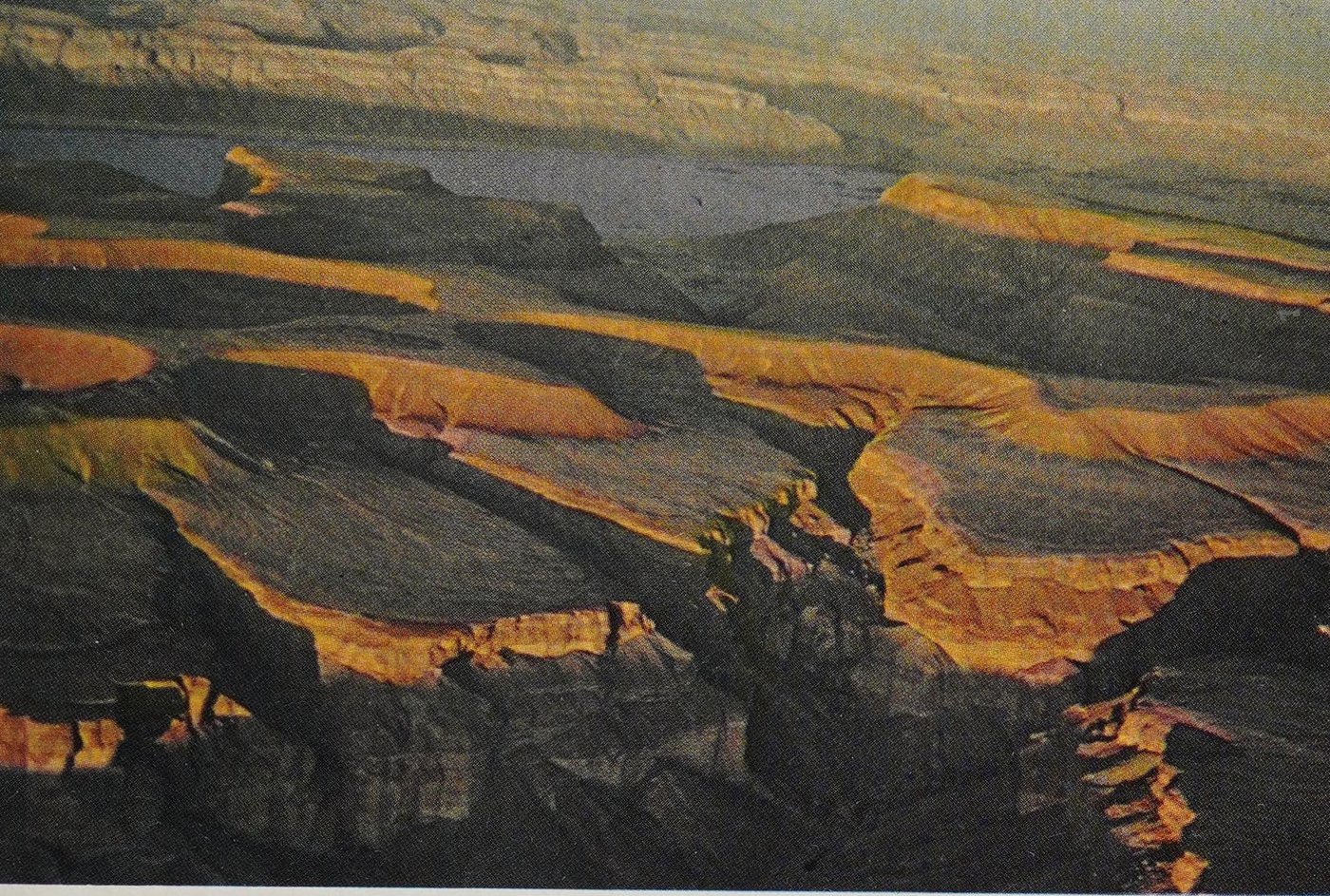
In the aircraft I relived my experience of travelling up the coast to Mukalla. Seen from the air the landscape was even more fabulous than from the sea. In many of the deep lunar craters of the volcanoes there were small lakes which looked like blue, yellow, brown, and green twinkling eyes. Deep gorges cut their way like anxious furrows through the scarred features of the landscape. Here and there were areas of desert, where the sand undulated in long streaks. From the air it looked like a vast washboard. I could appreciate how difficult it must be to travel overland from Aden to Mukalla. A more inhospitable desert than the Arabian hardly exists. For the first forty miles from Aden there is only sand. At most points it is possible to drive along the shore, if one avoids the quick-sands where the wadis run out. But later come the mountains: so steep and forbidding that they are hard to envisage. One could well believe that an imaginative artist had here created a model of hell.
It is bewildering to consider how much time it has taken nature to shape this fabulous landscape. The fact is, the deep gorges and canyons in the rocky mountains were created by water. The drops have worn away the rock; yet here in the Arabian desert there may be decades between the rainfall. In a generation less than a millimetre is eroded. The landscape’s furrows have taken millions of years to form.
Most fantastic of all, however, is the ‘mixed’ landscape, consisting of black lava, flaming red sandstone, and gleaming yellow sand. The shades of colour are most fascinating, when one’s eyes have accustomed themselves to distinguishing them. The mountains sparkle in every possible colour, ranging from ashen white with a strangely warm tinge through ochre to the deepest dark red, which in places breaks into jet black. Asa contrast there is the turbulent sea with its dazzlingly white spray beating against the rock face, and in the sea the colour symphony continues, passing from the lightest sea-green through the multi-coloured corals of the sea bed to the bluest azure of the depths.
On my flight across the lunar landscape of Arabia I sat literally with my nose to the window. I had never seen anything so remarkable as this arid primeval landscape—not a living creature, no vegetation anywhere. And still the landscape changed character.
There are gorges as steep and colourful as the Grand Canyon in America—but less overrun! Even from the air one clearly sees the stratification, which is itself a geological history book—with millennia between the pages. One crosses plateaux so flat and big that one thinks that an aeroplane could easily land there.
Below one is a rasp of small serrated rocky peaks. There are solitary, towering mountain peaks in between—and the entire coast is fringed by the timeless blue ocean, dashing its breakers against the rugged lava rocks. It must have looked almost like this when the land rose out of the sea in the dawn of history.
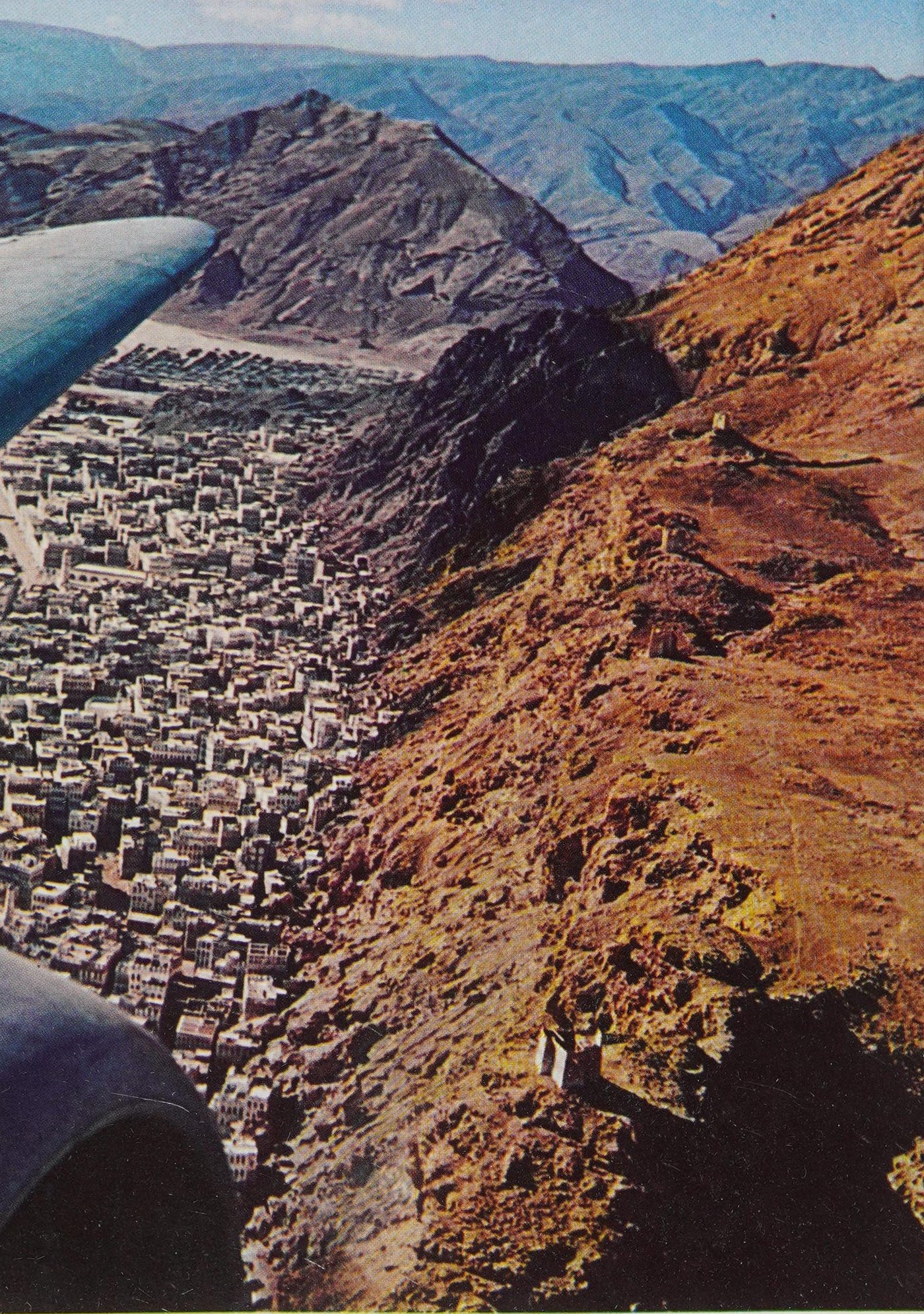
Mukalla now loomed ahead, easily recognizable. On along ridge I saw the old watch-towers which stand there at intervals of a few hundred yards. They were built not only as observation posts against hostile tribes that might advance on the town from the desert, but also as look-outs for the sentinels whose duty it was to prevent the escape of slaves from Mukalla. The watch-towers were set on the highest points in the landscape; in order to find strategically the best positions their builders did not shrink from erecting them on a sloping rock. It almost looks as if the towers are floating in mid-air.
Today the towers are in ruins; or at any rate most of them. No hostile tribes threaten Mukalla. The town has grown too big for anybody to dare to attack it. For a long time it has been left in peace, and it is claimed that there is no longer any need to be on the look-out for absconders, as slaves at Mukalla nowadays are so well provided for that they have no desire to run away.
After landing at the ‘airport’—as the authorities rather bombastically call it—I was driven into town in a four-wheel-drive Land Rover. The driver, of course, was an Arab, by name Ahmed Bazara. Apparently he had not forgotten that he had once let his Arab thoroughbred streak across the desert sand, for now, too, he let his ‘steed’ go all out. Occasionally he broadsided at a turning, so that the vehicle very nearly overturned. At other times he would try to play polo with the boulders which lay across our path. Each time he would shoot a swift side look at me, chiefly, I have no doubt, to see if I was still holding on, and if I appreciated his performance. He would give a beaming smile, as if to say: ‘Look, we made it again!’ When the danger was passed, he would throw himself forward again over the driving-wheel, as over the neck of a horse, and apply the ‘spurs’ once more.
Now and then I thought that my last hour had come; but Ahmed Bazara was clearly indifferent to his own fate aswell as to mine. He risked his life with the same fatalism as the soldiers of Mohammed when conquering the Middle East, North Africa, and Spain. If anything happened to him, he doubtless assumed he would go straight to Allah’s palmy Paradise, where lots of pretty young girls have nothing to do but spend eternity entertaining the brave.
Soon we turned in to Mukalla’s narrow, dusty streets, into alleys and down lanes where the sun never manages to penetrate between the lofty buildings. The street behind us was swallowed up in a cloud of dust; the town scene vanished in the way chalk vanishes when you wipe the blackboard with a dry sponge.
Ahmed. Bazara had now reduced speed, but still people jumped for their lives when we cruised our way between them and their nervous camels. At last we had to slow down to a crawl, because it was so narrow that it was almost impossible to get through; the pedestrians had to press themselves against the walls as we edged past. The town’s sole traffic sign proclaimed that the maximum speed was ten miles an hour.
In traffic, too, Mukalla is becoming a modern town. The traffic in its streets has undergone a rapid development in recent times. Ten years ago the sultan was the only person who possessed a car; apart from this, there were only two or three lorries and jeeps. Now there must be fifty or so cars in the town.
I was invited to stay at the same guest palace as before. The inside of the house had changed little in the interval: there were the same furnishings; the same faded picture of old Sultan Awadh bin Salih bin Ghalib, who in the meantime had died and had been succeeded by his son, Amir Awadh; the same Bedouin carpets on the floor. Not many feet had trodden on them; for when I entered my name in the visitors’ book, I found that I did not have to turn back many pages to find my own name.
There was one other feature that remained unchanged: the house slave, Niangara. Soon after I had been installed, he came rushing in and, throwing himself at my feet and kissing them, said, in a voice which seemed to tremble with joy:
‘Bwana, bwana, mzuri sana cap is a. Jambo, jambo, bwana m’kubwa. (Oh, master, it is good you have come. Greetings, welcome, great white master.) All that rejoicing for a set of underwear! On my previous visit I had made him happy by giving him my own underwear asa parting gift. He had nearly forgotten his native language, Kiswahili, but remembered a ragged vest and a pair of underpants with holes in them. So perhaps there was an ulterior motive in taking a little extra pains over the reunion. Perhaps he hoped for a new large baksheesh from the strange bwana m’kubwa who could speak a little of his own language.
I was up early the next morning. I had to go down to the coast to relive the scene when the small fishing craft put out. The canoes are rather narrow, so narrow that it is essential for the fisherman to have narrow hips; otherwise he cannot squeeze into his boat. The clouds in the eastern sky had just begun to turn gold from the sunrise, and it was only six o’clock when some fifty of the vessels took the water. The sea was still black, but soon the morning light drew glittering strips in the swell. The little fleet went under in an immense wave but reappeared on the next crest. A few had rigged up a small square sail—scarcely three feet wide—but most of them had to make do with their double paddles, which are rather like large lollipops. In an hour’s time they were on the fishing banks.
The gulls also sailed over the sea, but closer to land. Here the water is shallow; occasionally a threatening wave will rise, and a few will break in thundering cascades. But the birds have a wonderful sense of timing. They never make a mistake; if a flock of gulls take wing, one may be sure that the next wave is about to break.
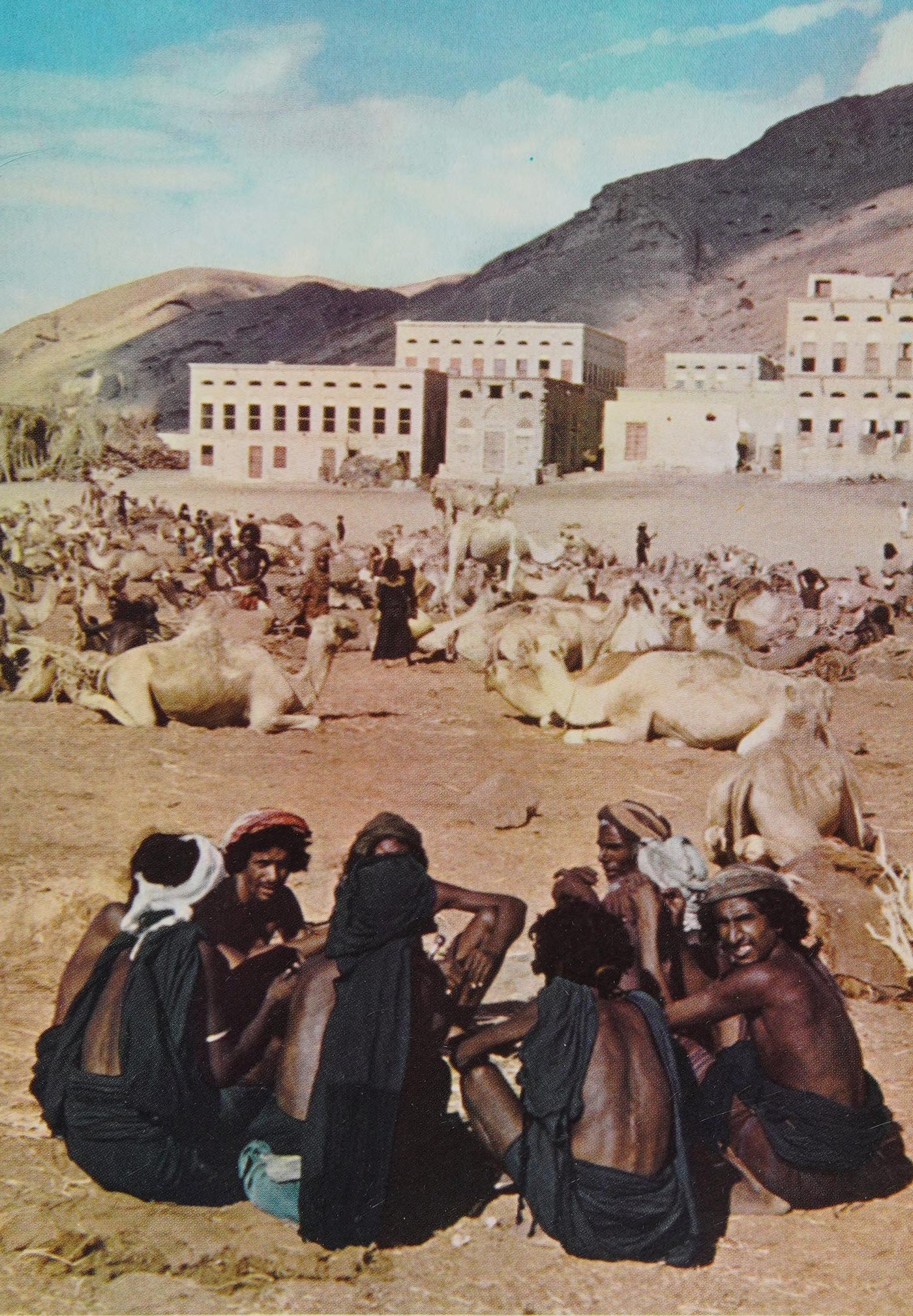
Soon after sunrise the people from the neighbouring oases began to arrive in the town. They are long-haired, long-bearded Bedouins, with bare, black- or blue-painted torsos. In their belts they carry a large curved knife, their most cherished possession. Usually, the silver scabbard isa miniature work of art, set with pearls and coloured stones, the weapon being used more often for eating than for defence. In some of them the top can be screwed off; and in a small container inside the Bedouin will keep some khol, which is used for blackening the surroundings ofthe eyes.
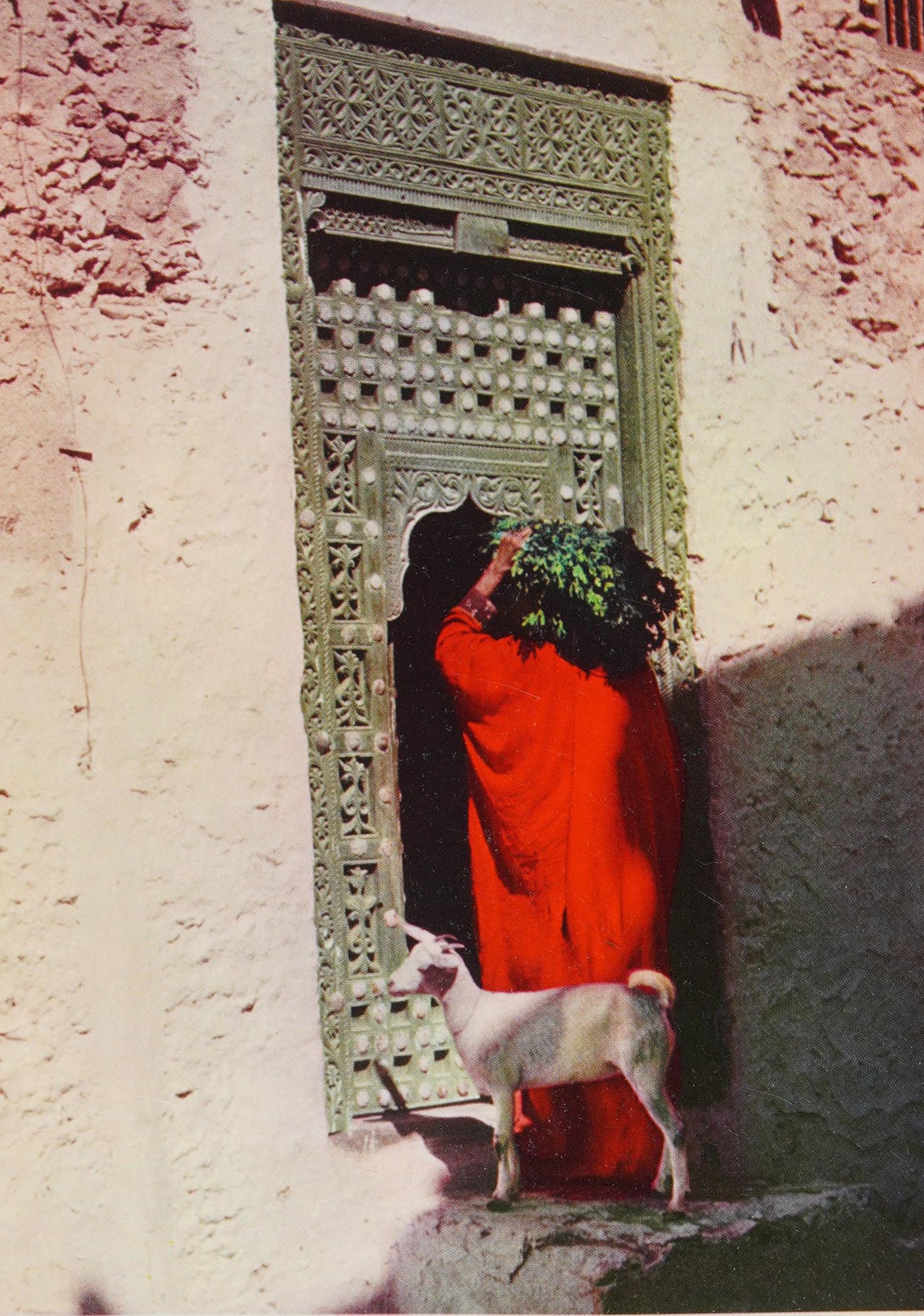
The women who come to town wear black drapery, a few having red or yellow veils. Even their arms are veiled so that, when they walk, you see only their feet. There are some, however, who have peep-holes in their veils. All carry something or other. Most have a tuft of vegetation from their desert garden; others carry what looks like a straw rope, but is hay for their goats.
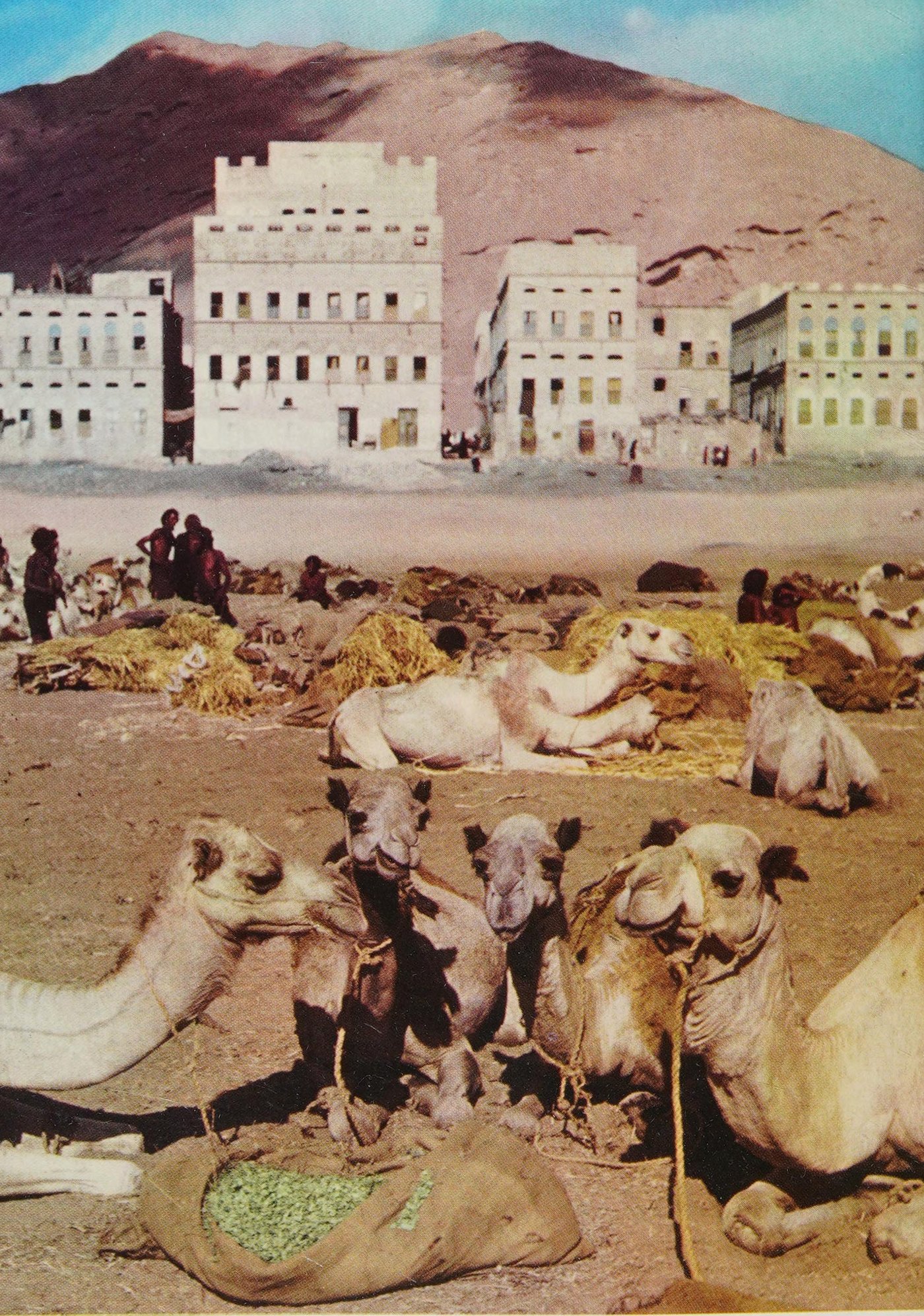
The camel ground had also begun to wake up; there was shouting and yelling from the camel drivers when their stubborn animals would not respond. The camels wheezed in their morning grumpiness. Nothing can be so bad-tempered in the morning as a camel. Whatever its master does, it is always spiteful. It will not have the pack fastened to its back. It will not get up. It will not have people near it. It not only snarls when anyone approaches it, it bites and lashes out; its kick is exceedingly strong and can easily break a man’s leg. Its bite, too, is most unpleasant, and many Bedouins prefer to muzzle their camels. Even when dying, says the Arab, the camel does so out of sheer spite, in order to be avenged on its master. But although the camel is such a beast, the Bedouin has an unrequited love for it, for it is the camel which takes him safely through the desert. Moreover, it is a handsome animal, with its large eyes and its majestic bearing. In spite of everything, therefore, the Bedouins refer to it in tones of praise—and perhaps that is why it looks so conceited.
The camel driver will forgive it the shindy it makes in the morning when it is to be loaded. It will then emit a strange whimpering bleat that reminds one of an animal’s death rattle. But it is of no avail; the Bedouin goes on unconcerned. The work is performed with minute exactitude, for there must be an equal weight on either side. If the burden is unbalanced or too heavy, the animal simply refuses to rise.
Amid the throng at the camel ground water sellers dash to and fro with fresh water in goatskin bags. A crowd of boys will have gathered and will be talking as loudly as the grown-ups, and Arabs talk very loud. Their inflections often lead one to think they are quarrelling, so fiercely that at any moment they will come to blows. But that is just their way of talking.
Walking through Mukalla with Niangara, I could not help noticing that there was a far less hostile feeling towards foreigners than formerly. But then Mukalla had had a lot to do with Europeans since my last visit. The sultanate is part of the protectorate of Aden, and there is a British Resident in the town. Still, I kept well away from the mosque.
Niangara accompanied me everywhere. He was with me when I had a look round the streets. He gave me good advice when I went shopping. He glided after me like a shadow through the eight large rooms of the palace. He was hardly to be driven out of my bedroom when I retired, and I was sure to find him with me when I opened my eyes in the morning. But his loyalty and solicitude had their limits.
One day when we were strolling in the quarter near the mosque, I could not help reminding him of the little episode on my previous visit.
Cc
‘Do you remember the row at the mosque the last time I was here, Niangara?’ ‘Oh, bwana, V’ll never forget it as long as I live! I still dream of it at night. Something might have happened to me as well!’
“Yes, But as a matter of fact it was only me. How did you manage to escape? I can’t really remember how brave you were.’
‘Bwana! I had to run. My life was in danger. If my fellow-Moslems had found out that I hadn’t done anything to stop you from going into the mosque I should have been dead now. Very dead!’
‘Isn’t it better to be dead than a slave?’
‘No, no, I’m all right, bwana! I get my wages, I get my food, I get my sleep. All I want is a little more clothing.’
‘What would you do if I bought you and gave you your freedom?’
‘Well, bwana, what should I do? I couldn’t get better work than here, and I shouldn’t have anybody to look after me. I’d have to sell myself and become a slave again.’
There are many Niangaras at Mukalla. They live and die as slaves. They cannot change masters or work; they cannot marry whom they like, and their children willbe slaves after them. But they are free to move about. They even get wages—or pocket money, rather. Their position in general has not much to do with what we associate with the word ‘slavery’. They are almost to be regarded as trusted servants; they are not free, but they are better off than many people who are, for they constitute a value to their master and consequently are looked after. That is why they are nursed in sickness as considerately as a farmer will care for his cows. But if an ordinary workman—a free man—is taken ill,he will at once lose his job and may starve to death. No one bothers about his life; for there is always another ready to take his place.
There are slaves whose only task is to carry water in goatskin bags so that the fifty dusty palm-trees by the sultan’s palace can get enough moisture. Palms must be watered daily in order to thrive in the dry desert sand. There are slaves who are nannies, slaves who cook, slave boys to satisfy their masters’ abnormal lusts, and slaves who serve as bodyguards. The last are the finest. When men of rank are out walking with their bodyguards, the latter will often carry weapons under their long white cloaks, To be a bodyguard is one of the most trusted positions that a slave can attain to.
There have been reports of the discovery of oil in the interior, so it is understandable that the British are interested in maintaining friendly relations with the population in order to exploit it. Similarly, it is understandable that the Arabs should overlook the fact that the foreigners are infidels; for if there is oil there, then Allah will doubtless understand that it may be worth while to collaborate with the enemy.
There are other advantages in the collaboration. For example, British experts have introduced cotton plants into eastern Arabia, at the few points on the coast where there is any rainfall. Theoretically, it is impossible to grow cotton here because of the extremely low precipitation, but not only do the plants grow, they give record crops. The reason is that the humid atmosphere reduces leaf evaporation sufficiently for the plants to make do with less water than in other areas.
Elsewhere, where the rainfall is too little, water is pumped up from deep wells. The interior of Arabia is filled with large underground lakes, where the few showers of rain which fall at ten-year intervals are stored. By subterranean rivers the water flows towards the sea, and the thing to do is to bore down to these rivers and pump there. But it is important, also, to pump just enough to procure all the fresh water which flows to the sea and no more. If all of it is not pumped up, then of course some is wasted and flows out to sea. This would be bad policy in an arid country. But if too much is pumped up, the sea water will flow in and there will be a risk of getting salt water in the wells.
On my present visit to Mukalla I came without animals; the new sultan was less interested in zoology than his father. But I did not come empty-handed. I brought a really good present, so I thought; a present that I assumed would be accepted with pleasure. It was a copy of the colour film I had taken on my previous visit—and it was a good deal easier to transport than a couple of ostriches. I thought that this film-strip would be my visa to the land of the thousand and one nights; I hoped that it would enable me to break through the wall of mystery which surrounds the country.
One day I received the expected invitation by messenger to visit the sultan.
‘Remember to bring your gift,’ the messenger said.
I suppose that he had said this on his own account, and not on the sultan’s. The whole town knew already that I had brought a colour film of Mukalla. Several times I caught myself wondering what the sultan would think of giving me in return. In the Near East it is common to exchange princely gifts; bringing a costly present myself, I might hope for something of similar value.
It flashed across me that he might present me with a prince’s robe. Such things had been heard of. It would be an attractive souvenir of the visit. But a proper princely robe with all its gold edgings and gold-inwoven threads doubtless represented a value which even a sultan would think twice about, so perhaps that was rather a lot to expect. On the other hand, it would have cost the sultan hundreds of pounds to commission a cameraman to take a film like the one I had brought with me. I also envisaged other gifts, and had gone so far in my imaginings that perhaps I should have remembered the fable of the woman with the eggs.
My beautiful dreams were broken, however, by the arrival of a smart limousine in front of my lodging. The sultan’s pennant waved from the bonnet, and it was not long before a respectfully admiring crowd had gathered round the car. It also caused a stir on the way to the sultan’s palace; the people of the town bowed down in the dust before it. Drawing myself up in the seat, I edged to the side of the car which caught the sun. It was not that I felt cold. The temperature was a hundred degrees. Nor was it what you might call hauteur. But it could never do any harm to let as many as possible of the inhabitants know that the bearded European was the sultan’s guest. I had still not forgotten the episode of the mosque on my previous visit.
As we turned into the palace square the guard stood drawn up in European-style uniforms, but with garish red turbans—and bare feet. They presented arms, and I climbed the numerous broad steps and entered the palace with its maze of corridors. The storeys were staggered, so that sometimes you had to go up and down several steps in order to get from one floor to the next.
At length I was shown into a huge room with furnishings that had been bought rather by weight than according to good taste. It was crammed with gigantic furniture of the most diverse styles; and while waiting for the sultan to appear I counted up to forty-five lamps, no two of which matched. There was everything—from unshaded electric bulbs and green bedside horrors to strawberry-coloured bead pendants, drop chandeliers which resembled upturned fruit dishes, and arrangements of coloured bulbs of the sort that might be used at an evening garden party. Much of the furnishing was obviously influenced by snobbery for European ‘taste’; it was all doubly depressing against the pointed embrasures with their fine glass mosaics and the pure and noble architecture of the balconies. All this I managed to note while waiting for the sultan.
At first I did not recognize him. He was stooping and rather flabby; his face was dominated bya pair of very large horn-rimmed glasses, and he was wearing a light-coloured suit. He seemed strangely agitated as he motioned me to a seat on a gigantic sofa and seated himself beside me. It was a long time before the conversation got going. His nervousness transmitted itself to me, and the first quarter of an hour passed with the exchange of conventional remarks. Tea was served for us; we drank it from odd but rather pretty miniature glass mugs.
Later I was invited into another room, of which the whole length and half the width were laid out with the most delicate dishes. At such ceremonial Arab meals one sits on the floor outside the carpet on which the food is set out, thrusts one’s plate into a mountain of oiled rice and draws it out again full, then helps oneself—with one’s fingers—to the many different dishes: hunks of meat, peas in oil sauce, and a multitude of spiced delicacies. All this one mixes up—still with one’s fingers—in the rice, whereafter one eats the whole: hotchpotch—with one’s fingers! It is difficult to eat the meat, because it is not permitted to use the left hand, which is considered ‘unclean’. Nor is it‘the thing’ to bite the meat while holding it; the only well-bred manner is to press a piece out of the lump with the right hand and eat it without dropping the rest on the floor. It is also an art to eat rice without getting it and the oil down one’s sleeves. I managed so successfully, however, that a minister who was present asked where I had learnt to eat rice with my fingers. But I hardly thought I could tell him that I had learnt it from coolies in Bangkok—who, indeed, are far more skilful than the Arabs at shaping the little ball of rice, holding it between the three middle fingers of the right hand, placing the thumb under it, and adroitly tipping it into their mouths.
In due time I rose, and with both hands presented to the sultan the tin box containing the Mukalla film—as carefully as if it had been a precious diamond. He thanked me in few words, and it was only when I asked him if I might take a photograph of him that the conversation began to get going. At long last the ice was broken between us, and he suggested I should also take a picture of the minister and then one of his servants; and finally he even asked me to photograph some of the house slaves.
When at length I had finished acting as snapshot man, I tactfully asked if I might photograph from the flat roof of the palace, where there was a magnificent view of the town and the sea. Permission was granted, but before I was admitted a major-domo ran on ahead, clapping his hands and shouting ‘Yellah, yellah’ (Go away, go away): a warning meant for any harem women who might be about, so that they could hide before I caught sight of them. It might have had the most dreadful consequences if they had been seen bya stranger, especially.an infidel, even if only inadvertently. The shouts ofYellah clearly had their effect. I did not see as much as the corner of a skirt.
The view of Mukalla from the palace roof was an experience. In the streets between the tall houses the town can appear grey and dirty, but when viewed from above it is perfectly white. In the glittering tropical light the buildings are so dazzling that one must screw up one’s eyes. Here and there slender minarets thrust into the air above the house tops is pe shaped fingers. And when the white town is seen against the background of the blue sea or the brownish rock, the colour effect is perfectly fascinating. It was hard to tear myself away, but I consoled myself with the thought that I had brought plenty of colour film, and so could later endeavour to give others an impression of the beautiful scenery.
It was a long time before I had photographed all I wanted and—still with the persistent major-domo shouting his Yellahs before me—had returned to the sultan. The leave-taking was short—and there was no gift. All right, I thought. It will be so big that the sultan will be sending it to me, to save me the trouble of carrying it. The sultan’s car, which also drove me back to the guest palace, seemed capacious enough to have held a whole wardrobeful of princely robes.
During the night I dreamt that the gift consisted of twenty-five fat harem women, whom he insisted on my taking home to Europe. If my wife objected, she was welcome to join him, he said. There were none beside my bed when I awoke—but who could tell? Perhaps this was a warning of domestic conflicts to come!
It was the afternoon of the next day before I heard from the sultan. I was in the bathroom, standing under a bucket with holes in it which served as a shower, when Niangara shouted to say there was a messenger with a gift from the sultan. In my excitement, I was ready to rush out just as I was, but I controlled myself and replied that Niangara could accept the present and place it in my bedroom.
It did not take me many minutes to get dressed, and as I entered the room I looked round for the gift. But there was neither a princely robe nor harem women. Finally, I had to ask Niangara.
‘Oh, that, bwana! I put it in bwana’s case.’
I tore the case open. A strange greasy substance had run out over my nice tropical clothes. I sniffed. A scent of honey?
It was honey. Two flat tins, such as we can buy at home for a few shillings. And Ido not care for honey!
With the gift I found a piece of paper, torn from a minute book, and dated: The Palace, Mokalla. 5.12.1959. And I read:
‘Dear Mr Jørgen Bisch,
His Highness Sultan Awadh has the pleasure of sending you per bearer two tins of honey, in the hope that you will like it and accept the same.
Yours sincerely,
Mosellan Awedh Balala
Manager of the Palace Affairs.’
I sat down in a deep chair, threw my legs up on the table, and laughed. Niangara looked at me in surprise. Then he vanished from the room, to return with a jug of water.
‘Mingi motu, bwana m’kubwa. Iku hapa kidogo maji baridi! (It is very hot for you, great sir. Here is a little cold water.)’ he said, with touching solicitude. And I promptly forgot that his kindness was to a large extent calculated, in view of my spoilt clothes. Apparently he had also found out that my mood invited familiarity, for he had brought two cups, which he afterwards filled with kidogo chai motu (steaming hot tea)—one for himself. Then settling in a chair he tried to live up to the white man’s example, by putting both feet on the table opposite me. The aroma of his dark toes mingled with the fragrance of my tea-cup.
I do not think he wanted to show off. It was just that he thought that this was the way to behave among white men. It is true that in towns like Mukalla they complain of trouble with house slaves, and say they get more and more insolent and provocative both with strangers and their own masters, giving the impression by their conduct that it is they who run the house. But Niangara was not like that. In fact he would probably have been more comfortable if he had squatted on the floor. But he liked to show that he had trust in me and regarded himself as my confidant.
Consequently, it was easy for me to talk to him about many problems. He was not afraid of me and was proud that he could answer the questions I put to him. It was a change from the previous guest he had looked after, a sultan from a neighbouring district. Then he had practically had to creep in and out without uttering a word, so as not to offend the distinguished visitor. The guest he now had to serve had his peculiarities, but they were of a pleasanter kind.
‘Niangara,’ I said, when I had swallowed a couple of mouthfuls of tea, ‘in my country there are no slaves.’
“Are you very poor, then?’ he asked in surprise.
‘No, but the idea of keeping slaves does not enter our heads. White men have no slaves, and they are not slaves for others.’
‘That’s not true, bwana.’
‘Not true?’ ~
‘No, because there are white slaves in this country.’
“White slaves? What do you mean by that?’
“Well, I have not met any myself, but I have heard from guests who have stayed in this house where bwana is staying that there are white people who are slaves. In harems there are many white women, but I have also heard of white men. It is not long since a distinguished prince told of a man with white skin who worked as a slave in a town with houses that are taller than the ones here in Mukalla. They were so tall that I think they went up into the skies.’
‘Can you tell me where this town lies”
‘Bwana, I think it is called Shibam, and it is many days’ journey from here, in through the wadis.’
I tried to find out more, but Niangara did not know any more, though he was plainly dying to help me. But what I had heard was enough; for if I followed the wadi caravan routes I should come to the town he had mentioned, and immediately afterwards I began to prepare for the onward journey. It lay outside the route I had originally thought of following, but that was unimportant. Niangara was sent into the town to procure four vehicles for a desert journey. Astonishment that I wanted so many was depicted on his face, but he was accustomed to acting without question, and the next day he succeeded in getting what I had asked for. I examined each of the vehicles very carefully, and chose aLand Rover as the one best suited. The other three were returned with payment for their owners’ trouble.
“When shall I bring the car and drive for you?’ the owner of the Land Rover asked. 7
‘Leave it here,’ I replied, ‘and come tomorrow when the sun is rising.’
Then taking a chain and padlock from my film trunk, I fastened the Land Rover to the iron grate of one of the palace windows. Only thus could I feel fairly certain that it would be there when I wanted it the next day.
When the sun rose above the horizon the Land Rover, to be sure, was there, but there was no sign of the driver. I looked up and down the road at intervals and gradually got into a bad temper. I then decided, with Niangara’s help, to load my gear on to the vehicle, and went up to it.
A pair of long black legs protruded from the back. The driver had chosen to stay with his Land Rover. The white man was suspicious of him, but he in turn was suspicious of the white man, who might run off with his car. He had therefore decided to sleep in it.
After this little interlude we soon loaded the baggage, and shortly after I set course through the wadis, together with the driver and Niangara, whom the sultan had placed at my disposal. That I should actually succeed in finding a white male slave at Shibam I hardly believed. But I had heard accounts of this skyscraper town in the middle of the desert and was anxious to see it with my own eyes.
By tortuous roads we had made our way across the mountains behind Mukalla. We had bumped along in our Land Rover, leaving a trail of dust, towards the heart of the Hadhramaut, towards a region unknown to Europeans only a few decades ago.
Here there are no roads, only at best a camel track following the wadis, which in these parts have cut a hundred yards or more deep into the mountain plateaux, though they carry water for only a few days when rain falls at ten- or twelve-year intervals. From the air the landscape had seemed to be full of small cracks and furrows, but these now proved to be deep gorges. The only way into the interior is commanded by these wadis. This is true whether one travels by jeep or on a camel—and they are the only possible means of transport. Before the camel was tamed, the interior of Arabia was totally unpopulated.
At a few places in the wadi we had seen ghaf-trees and acacias, which with their immensely long roots can survive in spite of the dryness. Similar toughness is required of the people who live there. But in a few years’ time modern civilization will also make its entry into this part of the world; in the coastal villages trucks are already becoming more popular than camels. But cars call for better roads, and at several points in the wadis they are improving the camel tracks so as to make them serviceable for both jeeps and lorries.
We had driven through a number of dried-up river beds and had zigzagged our way through the mountain crests along what, with a little generosity, could be considered the beginning of a road. Occasionally, we had driven on the plateaux through volcanic ash, so fine and so heavy that it spattered like water under our wheels. Time and again I had had to take my bearings by compass. That could sometimes be difficult enough because of the tortuous drive, which was why the day’s journey had been longer than I had envisaged.
The night landscape was altogether unreal and moon-like and the quarry we had stopped at had taken us by surprise; we had not expected to find one here. We had alighted to investigate if it was possible to get through at this point, or whether we should have to find away round.
It was my driver who first caught sight of the tent pitched close to a boulder. He suddenly grasped my arm—so violently that I nearly shouted out. But I checked myself when he pointed to what he had seen. We were anxious to know if the tent was occupied. Apparently it was empty: we did not feel ourselves observed. But if anybody did live there we wanted to have a little time in which to reconnoitre before meeting him. It is always wisest to do that in these parts; you can never tell whether a tent belongs to a Bedouin tribe that is averse to unexpected visitors.
For a few minutes nothing happened, but then we heard a faint rustling at the tent door. Three rifle barrels appeared. Standing there in the moonlight we were a sure target for those inside the tent, and for some time we did not stir. But at length the tension got on my nerves.
‘Shout and tell them to take those rifles away,’ I said to Niangara. ‘They might hit us!’
Niangara was not slow to obey orders. The reply from the tent came in the form of laughter which seemed to spring from a relief as great as our own. A man came out and began walking towards us. He had not put away his rifle, but it was no longer aimed at us. We held our hands out at our sides, so that he could see we were unarmed and had no designs on him.
His first words were:
‘Aren’t you afraid when I aim at you?’
‘Yes, very,’ I replied through Niangara’s translation, ‘and that’s why I want you to take that rifle away, so you don’t accidentally shoot us.’
For another moment the man looked suspicious. But clearly finding us undangerous, he lowered his rifle and signed to us to go with him to the tent. At the most this was meant to hold four people, but there were five in it already, and they now had to squeeze up even closer to make room for Niangara, the driver, and me. The tent wall consisted of very thin sacking, and the desert wind blew straight through it; you had to sleep there with your coat and boots on. In desert regions the difference between day and night temperatures is very great. The day temperature can be over a hundred degrees, the night temperature only a little above freezing point, and in Sahara oases I have seen ice on pools in the morning.
Wishing to show a little friendliness, I fished out some cigars. They were damp; we had a job lighting them, and it was plain to see that our hosts did not care for them. Yet they were smoked down to the last scrap—out of politeness. And out of politeness I afterwards had to eat part of a dry and half-rotten fish which they handed to me. Arab hospitality is never-failing; it is shown both by rulers and by roadmen—like those we had encountered in the desert night. The only difference is that the ruler can afford to place the most elaborate dishes on his table, while the roadman, who earns a shilling or two a day, can only offer the stranger a very spartan dict. I succeeded in putting half the fish in my pocket without being noticed.
The workmen boiled some water and served a very bitter tea mixture which tasted of brackish water, mint, and various strong spices. The teapot circulated repeatedly, and inside the ragged tent there was soon an atmosphere of great cordiality. The road workers live for months on end without any connection with the outside world to speak of. Only when a rare caravan or jeep passes by can they barter a few provisions and so supplement the rice which is their daily dict. Unless they are fortunate enough to procure a little water at the same time they will have to walk miles to the nearest well and carry the water on their backs. Understandably, the roadmen we met had not washed with water for a month.
One has to admire the toughness and extreme frugality of these desert people; it is astonishing that they can put up with such monotonous work, day in and day out, in this godforsaken region. Yet they do not feel godforsaken; it touched us the following morning to see how they had cleared away a number of small stones outside the tent and placed a large stone on end. This was their place of prayer when, five times a day as prescribed in the Koran, they turned towards Mecca.
After an hour’s genial conversation we were at length able to retire. I was frozen in the tent, even though there were so many of us packed into it and I kept all my clothes on; I even wore my light polar jacket, which I always find useful on expeditions—even in the tropics. I often use it to insulate films against heat in the daytime and as a blanket or pillow at night. I pulled its hood well over my head and fell asleep.
When I awoke the next morning our Arab hosts were already standing outside the tent. I shivered with cold when I joined them. It appeared that the tent was pitched in a rather deep gorge. The sun had not yet risen high enough above the mountains to warm the little camp site between the steep mountain sides. The roadmen were washing—with sand: an emergency measure recommended by Mohammed when there is no water about. They then knelt on the small prayer place with their faces turned towards Mecca and. began their prayers. Only then could they start their day’s work.
I now discovered that I had slept on the side with the pocket containing the remains of the half-rotten fish. They had been squashed well into my clothes, so that it was no use my trying to empty the pocket unseen behind a boulder. The road workers’ two dogs never left me. They were touchingly loyal to me for the rest of the visit and could hardly be driven off when we got into the Land Rover in order to continue our way into the interior. They followed us for a long way, and only gave up when the vehicle increased speed. When I turned to look back at the little camp, it seemed to me that the dogs were still slavering at the thought of the feast they had missed.
It was no better in the oasis we reached six hours later. Here again the fishy smell of my clothes held a magic attraction for the dogs. In this oasis we were assigned a mud-built house, and when I had managed to slam the massive wooden door in the dogs’ faces I climbed up to the flat roof. Here at long last I was in peace. Here no mongrel should get me to change my trousers out of season! For that matter, my clean ones were packed round the cameras to insulate them.
I was able to sit down to my first meal of the day at leisure. The bread was as hard as stone. But years before I had learnt the knack of breaking such bread with a blow that would not send it flying in all directions. And I had trained myself to lap up a tin of sardines in oil without getting the liquid down my beard or cutting my tongue on the sharp edges. The drinking water was no pleasure. It was warm, brown, and brackish, and tasted abominably. All in all it was anything but a Lucullan meal, and yet it was a satisfying one.
I then went to the edge of the roof and looked out across the valley of the oasis. I found myself face to face with one of those enchanting views which always make me feel like a privileged being, with no desire for an immediate return to civilization. My lecturing can sometimes take me into something of a luxury life, but at that moment I would not have exchanged my dirty mud house, brackish water, and dry bread for the Raffles Hotel in Singapore, the Nile Hilton in Cairo, or the Waldorf Astoria in New York. It is true that I usually prefer a well-sprung bed to wooden frames and two courses of well-cooked food to emergency rations—but not at a moment like that.
Far off in the shimmering heat of the desert was a blue-green massif: one of the plateaux which frame the fertile wadi oases. The whole area in that direction was full of date-palm groves. Where the mud houses of the grey town began, a wall snaked down from the nearest mountain; no Bedouins could cross the mountain, and the wall helped to give protection against enemies from other directions..
Just then it was hard to imagine this idyllic place as the scene of violence. A couple of shepherd boys came running with a flock of goats, followed by two baying reddish-yellow dogs, and veiled in a great cloud of dust which enabled me to follow their path along way in the direction of the town wall. In the shade of a large clump of palms, a family of slaves was working at the well. I heard their brittle, monotonous singing and the creaking of the well wheel. Then there was apurling sound, and from a small reservoir the water flowed like long, gliding silver belts into the many vegetable beds. Brown barelegged boys ran about regulating the small canals, as the water spread out over the yellow, thirsty earth. All the fields I could see beneath me from the flat roof were divided into rectangular sections, each with its own colour—dusty yellow, yellowish brown, mud-brown, from pale green to the darkest dark green.
Other visitors came to the oasis that day—a small caravan; when it was still on the horizon I could see the camels walking like silhouettes in a fine well-ordered row, each tied to the tail of the one in front. I went down to have a look at the caravan when it eventually arrived. There were close on fifty camels in all shades of yellows, browns, and greys.
There were many women with this caravan. Usually there are only a few, but at first I did not give much thought to this. It was only when I had got out my film camera and the leader of the caravan began almost to snarl at me—rather like a camel snarling at its driver when it is in a bad temper—that I began to suspect something. Niangara advised me to be cautious. In his opinion it was a slave caravan, and the women, he thought, would be on their way to a slave market—or else had been bought by a merchant, perhaps even a sultan, and were bound for his harem. It was the caravan leader’s task to bring them safely to their destination, and he would regard my desire to photograph them as a threat to his master’s interests.
From the oasis we continued through a rocky desert towards Shibam, the skyscraper town of the desert. We followed the desert track through a lane of yellow sand—‘singing sand’. When the wind erodes a layer of sand from the rather harder subsoil a series of bars will often arise, and when fresh sand blows over these the resultant vibrations sound like singing. The sand looks firm and solid, but the fine dust of the top layer is nevertheless as volatile as liquid and in many places treacherously covers deep holes into which one is constantly falling.
It was astonishing how the Land Rover’s springs and our kidneys stood up to it. When a wheel suddenly sank in, the volcanic dust could not absorb the shock. It spattered out like water when one drives through a flooded road. Sometimes it almost felt as if the vehicle was a ship in a swell. The drive was a test of our nerves; we were in a continual state of tension, for if our Land Rover got stuck in one of the sandy holes it might be difficult to get any further. We could not count on assistance from passers-by. When on a rare occasion we were lucky to have firm ground underfoot and could let the Land Rover show its paces a long cloud of dust would billow out behind us. One such cloud caught up with us the first time we stopped for a rest. It came as a total surprise, for it had not occurred to us that the wind was behind us; in a moment everything was covered in dust. It was impossible to escape from the cloud. We could not even see our own hands. It was five or ten minutes before the cloud dispersed; thereafter we always took care to turn aside into the wind before we stopped.
It was fortunate that we were only overtaken by the cloud of dust we had raised ourselves, and not by one of the violent dust storms that are nature’s own work. In such a storm the desert dust will come rolling towards you like a wall, blotting out both the sky and the configuration of the landscape. The powerful sun instantly becomes a pale globe, and is soon obliterated by the dense sand ‘fog’.A livid, spectral light descends on the landscape; a feeling of dread comes over one, and when the wall hits you a moment afterwards it is well to be wrapped up in all the clothing you have so as to filter off the sand.
Camels have slit-shaped nostrils which they can close almost entirely, and which are filled with fine hairs. They thus have considerably greater chances of surviving desert storms than other animals. Man, unfortunately, is not equipped with such a nose filter, but it is in this situation that the flowing draperies ofthe Bedouins prove their practical value. It is the only dress which provides an effective protection.
Driving in the desert isstupefying. Perhaps that is why—when I was beginning to fear we had lost our way—I got a sudden shock.
For hours we had wound our way through deep wadis. Several times I had wanted to climb up the high banks in order to take my bearings and find out how far we had got on our mole-like journey. At long last we entered flat country—and there, straight in front of us, without warning, a lofty white town rose from the sea of sand.
Was it a mirage? A phantom from the Arabian nights? No, the fairytale town was real enough. We were outside Shibam, the skyscraper town of the Hadhramaut.
When you stand facing Shibam—at Bathat Shibam, which means ‘Shibam’s sand with wells’—it seems a mystery that you did not see it first miles away, this colossus of a town whose houses are ten or twelve storeys high. But it is only when you have come through the wadi to Shahill Shibam—the oasis of Shibam—that it emerges, unexpectedly and preposterously, as though it had sprung from the ground that very moment. It is a little while before you realize that this miracle, too, has its explanation: the yellow, brown, and white colours of the houses merge to such an extent with the sand and the surrounding mountains that in certain lights the town is almost invisible.
Shibam is in every way a fantastic town—a New York of the desert which existed centuries before New York was built (paradoxically, the name Shibam means ‘young’ or ‘new’).Its houses rise from the sand in huge, rectangular blocks; it looks like, not one, but hundreds of desert forts, and indeed every one of the buildings is in itself an almost impregnable fortress. Unlike many other Arab towns, Shibam has no town wall; but the massive outsides of the houses form a closed shell which it would be practically impossible for hostile Bedouin tribes to penetrate. The openings on to the outside world are embrasures and many feet high; only the upper storeys have real windows. The few gates form the only possible entrance to the town. The steep outside face of the buildings, looking towards the desert, is supported below byasloping wall, or by buttresses; and though all these tall houses are built of sun-baked clay a a of concrete, they appear more solid than the skyscrapers of New York.
There is good reason for each of these houses—both in Shibam itself and in the oasis—being a separate stronghold, for in times past many feuds have raged hereabouts. Tribe fought with tribe, family against family; one had to entrench oneself in order to survive. When an enemy attacked, it was safest for the men of the town to stay indoors until they had gauged their opponents’ fighting power and could launch a counter offensive. The women, however, were free to move outside the houses, for it is an old Arab rule that women can never be attacked. So they could go out in safety to the wells in the oasis to fetch water, and generally ensure that their men got the necessary provisions while the siege lasted.
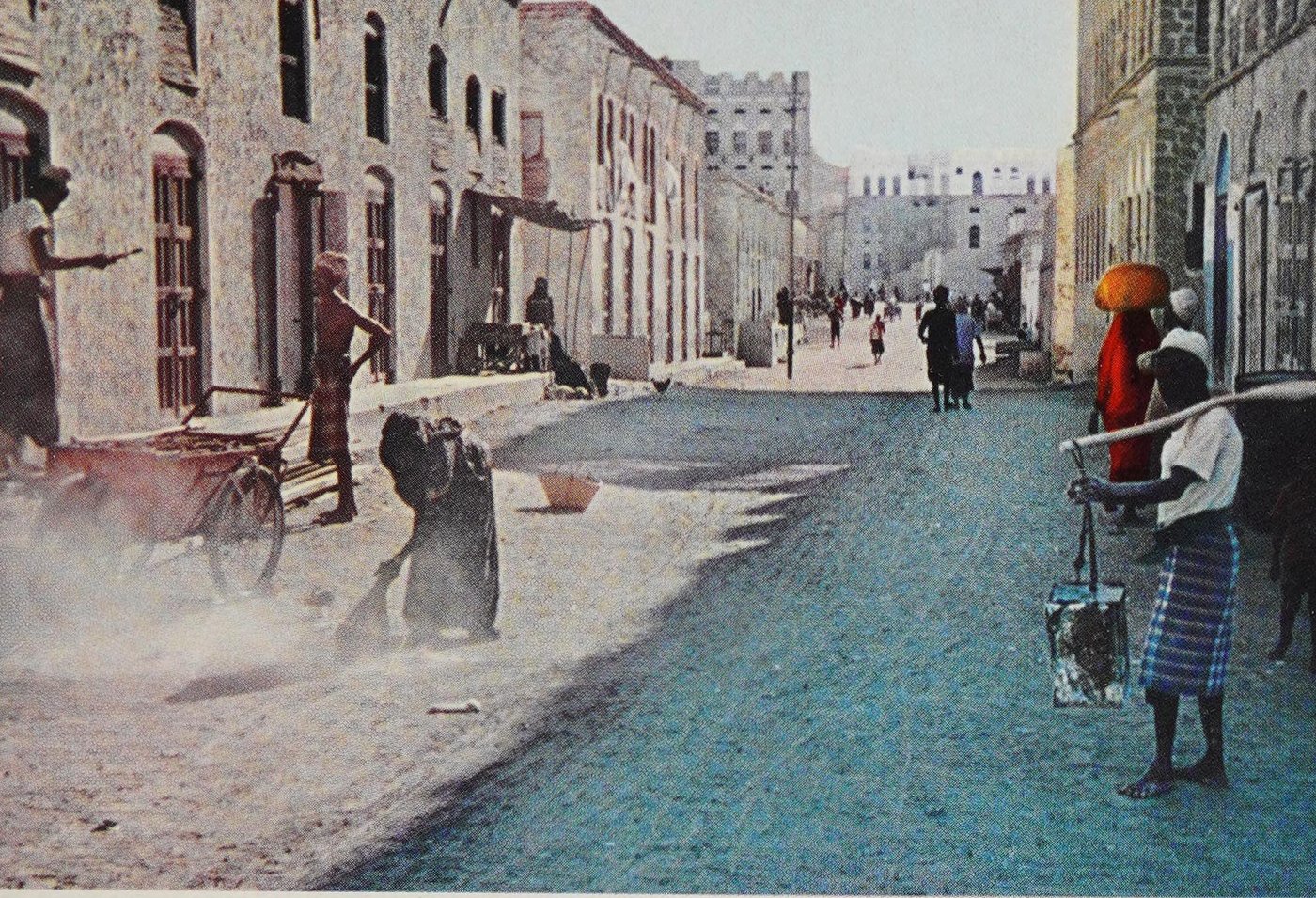
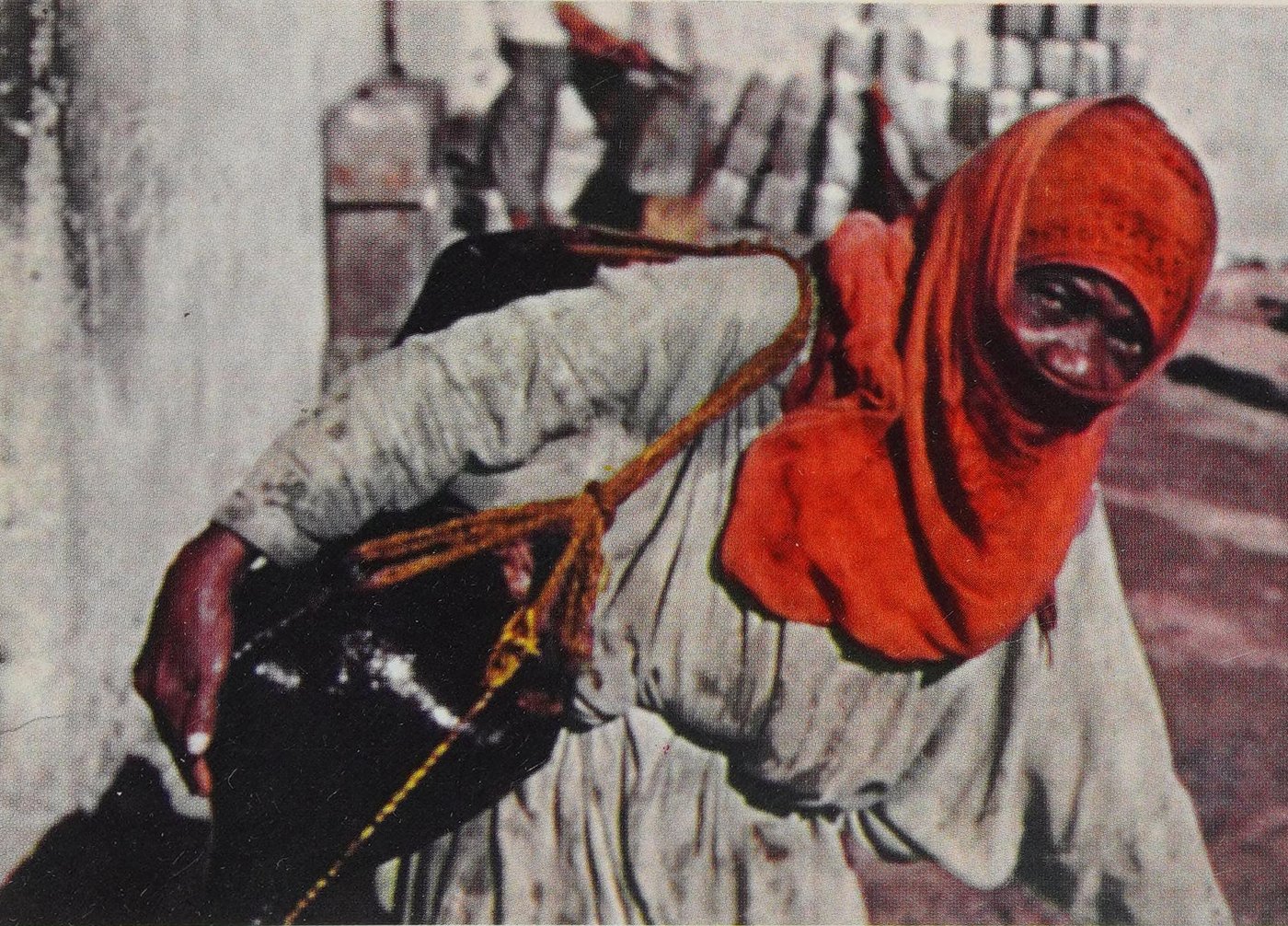
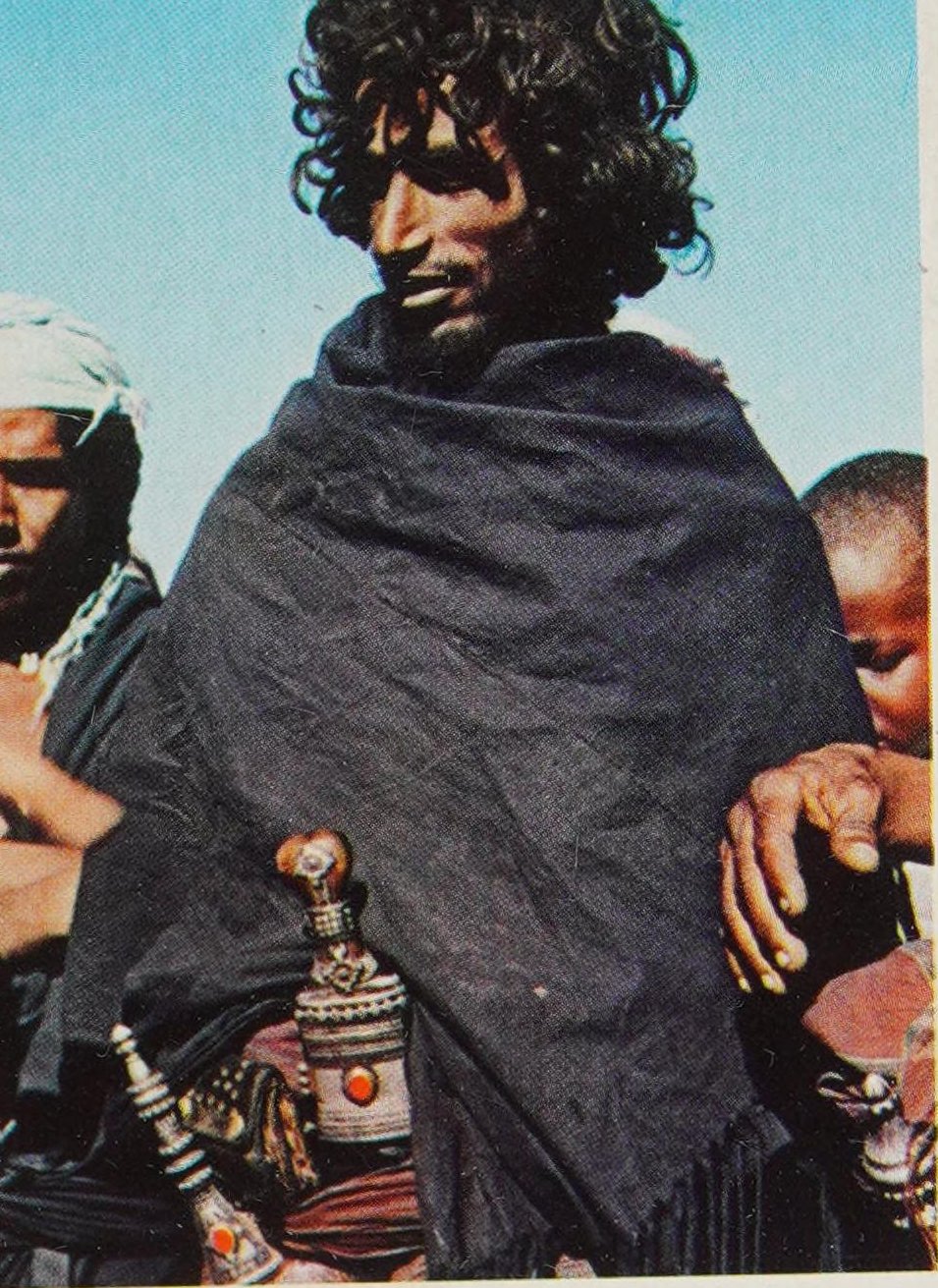
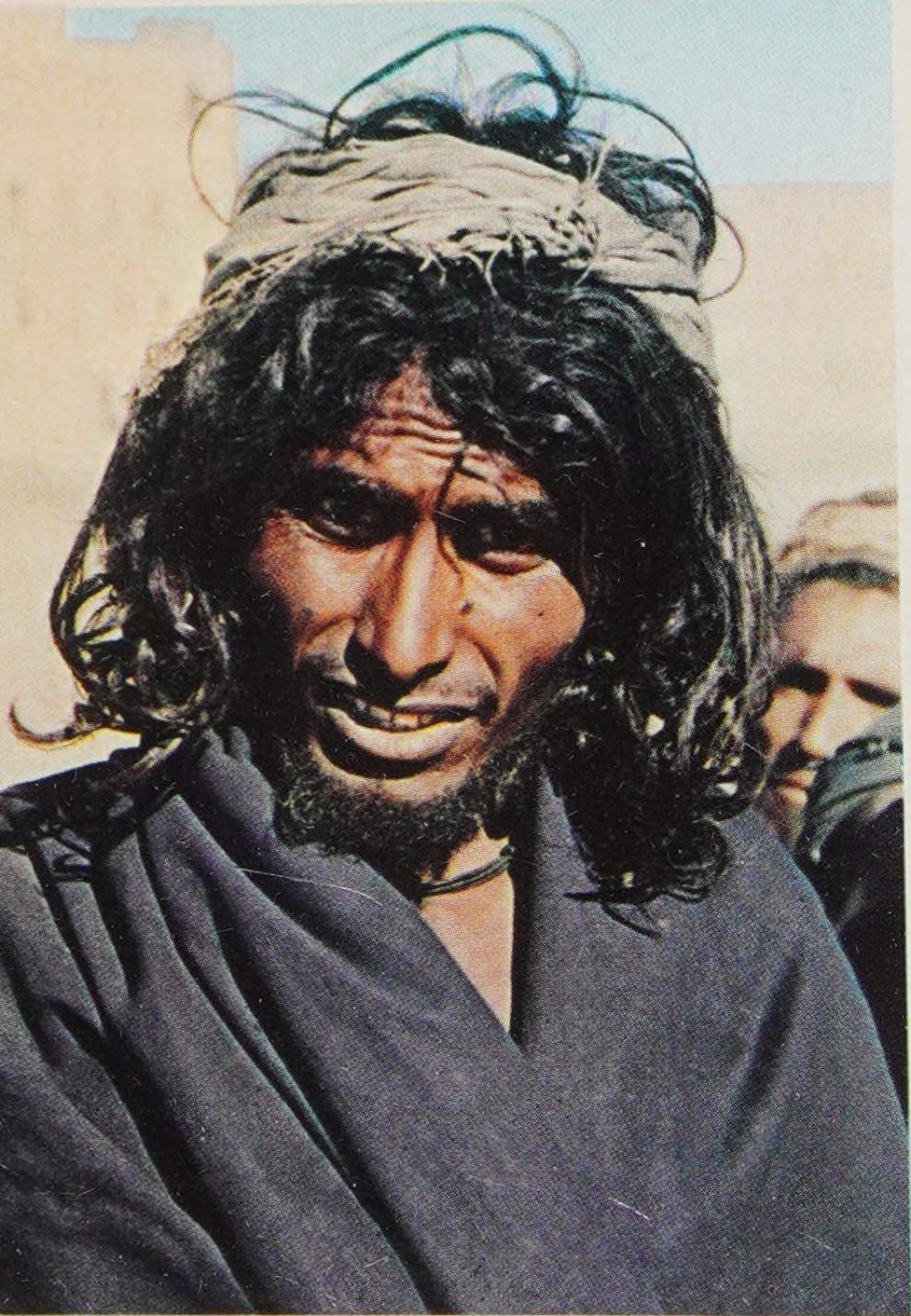
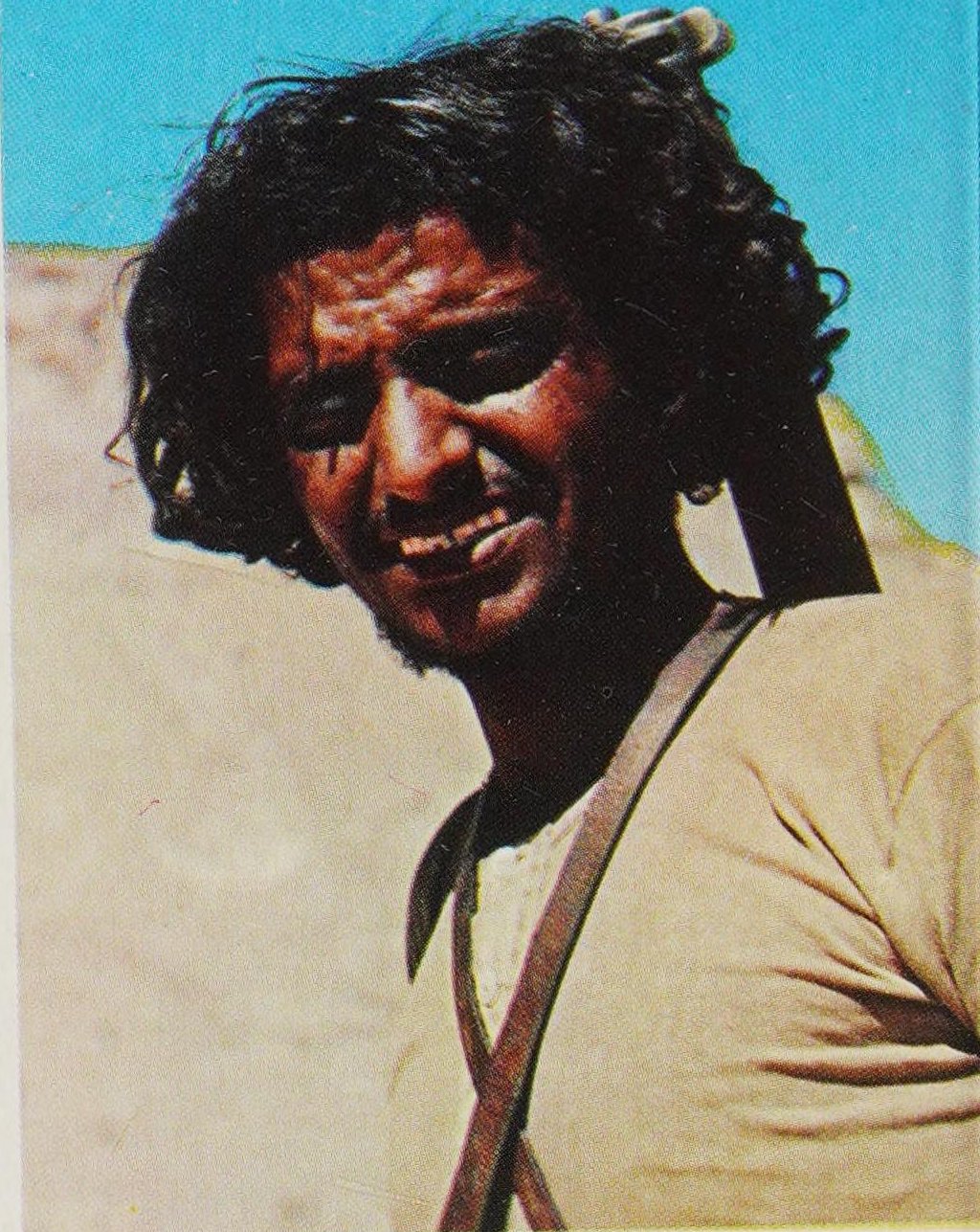
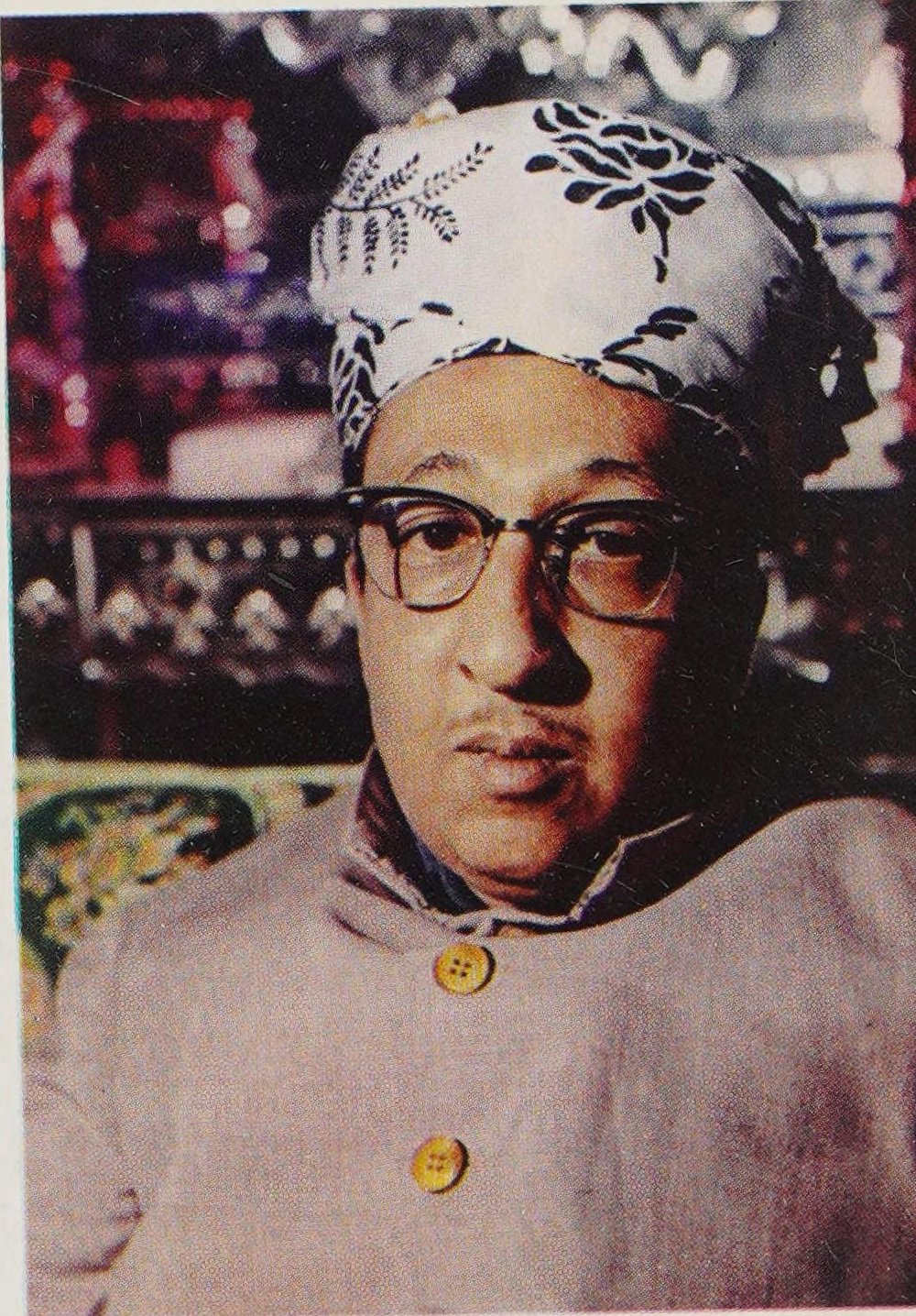
A remarkable feature of Shibam are the strange spikes which stick out from the houses at various levels, and which give the town an even more unapproachable appearance, bristling like a hedgehog. Once their function is known they are calculated to deter not only an enemy but also the peaceful traveller, who will give them a wide berth.
They are the house drains. In the streets of Shibam you run a constant risk of being drenched by a cascade, and you can count yourself lucky if it is only washing-up water; sometimes it will be of a less savoury character. It will be apparent that Shibam ishygienically a backward town, and that a walk through its streets is not altogether a pleasure. Even though some of the sewage disappears into the loose sand, everywhere there is a dreadful stench.
The streets are very narrow; walking through them you feel as if you were at the bottom ofa deep ravine into which the sun cannot penetrate—except for the few minutes around noon when it is so high that its rays are almost vertical. As soon as you enter the great Cedad Shibam gate from the desert you are struck by the fact that there is no rational system in the streets, which form the oddest angles and make the most unexpected twists and turns. None of the builders has ever known anything about town-planning. In a car you can just edge your way through the town gate to the square; but you quickly abandon the idea of a drive around town. For this the streets are too narrow; indeed at many points even pedestrians find difficulty in passing one another, and the high ‘curbs’ in the middle of the road also make wheeled traffic impossible.
In the middle of Shibam the mosque stands like a dwarf among giants. Like Trinity Church on Broadway in New York it is swamped by the surrounding skyscrapers. In contrast to the drab, pale-grey houses, Arab mosques are often quite colourful. With their decoration and slender minarets they are virtually an oasis in a treeless desert of stone. Yet the mosques in Mohammed’s homeland can rarely compare with those in other Islamic states, the Arabs being indifferent craftsmen and having little artistic sense.
The only artistic feature of the ordinary dwelling-houses of Shibam are the massive front doors. These are frequently made of cedar—more
D rarely hewn out of palm trunks—and are ingeniously carved, though not so beautifully as those at Mukalla. The lock is remarkable for its extremely complicated mechanism, the ‘key’being a kind of wooden comb which enables some catches to be raised for the bolt to be drawn. The window-frames are also carved, the windows themselves being so small that the face of anybody looking out will fill the whole aperture. Outside many windows of the upper floors straw mats will be hung up as sun blinds. Re
At one place I saw a cord strung across the street between two buildings at eighth-storey level. By this means the occupants were able to exchange food, tobacco, and other things, and so save themselves the effort of walking up and down innumerable stairs when they wanted to borrow something.
To see anything green one has to go outside the town, but even there the palms are often so bleached and dusty that they look more like trees badly made from plastic or papier maché than living growths.
Shibam is no more built on oasis ground than most other Arab towns, but is situated on a low ridge adjoining the oasis. The wells therefore lie outside the town. Only the mosque has a small well of its own, the water there being too holy, of course, to be put to profane use. So all day long a procession of women goes to and fro between the town and the wells: all of them dressed in blue. Here, as elsewhere in Arabia, it is the women who have to do all the rough work, making themselves useful as beasts of burden.
Western civilization has made a singular contribution to the dress of Shibam women. Many of them bear on their heads an object which I had difficulty in identifying. At a distance it resembled a pointed bonnet, and it was only at close quarters that I realized it was an ordinary metal funnel! It turned out that it was not intended entirely as ahead-dress, but served a most practical purpose: when the women poured water from the goatskin bags that were used as well buckets into their own, they did so by means of this funnel so that nothing was lost; and when the filling was completed, it was convenient to place the funnel on their heads. It was out of the way—and formed at the same time a protection against the sun.
In the oasis one sees the busiest traffic the desert can muster: the galloping, braying donkeys can almost be compared with motor-cycles. But life in the town itself is usually quiet and uneventful. Visitors are rare—and that is why our arrival caused some considerable stir.
In Shibam there are no hotels, but there was an uninhabited house which outside guests could use. At the time there were no other strangers in the town, and so Niangara, the driver, and I had it all to ourselves. To walk about this house was like moving about inside a large mountain. The temperature was pleasantly cool asin a cave, but finding one’s way about its labyrinthine bowels was difficult. The house had seven storeys and an immense number of rooms large and small. There were several kitchens and wash-rooms, with hooks for hanging up water bags. Opposite each hook was an opening for air draught. Goatskin bags are not entirely watertight so that the leather is always moist on the outside, and the draught produces an evaporation which makes the drinking water pleasantly cool.
Niangara had cooked for me on the journey, but once we arrived at this town, where we could procure servants, it took a lot of persuasion to get him to make so much as a cup of tea. It took him all his time to bring me a cup of water; he would rather run down many flights of steps to find one of the domestic slaves that were at our disposal. When he found one he would rebuke him with great eloquence for not having the sense to realize that there should always be a cup of water ready for the sahib.
“What sort of a servant are you? When have you a mind to make tea for us? And what are you going to give us to eat tonight? See that you pull yourself together.’
The poor man concerned could not restrain a certain malicious pleasure when I occasionally had to give Niangara a similar talking-to; when I sent my attendant into the town with orders to come straight back at once, the ten minutes the errand should have taken might become an hour, or even two. Invariably he would succeed in taking the sting from my wrath by declaring that he had been asking if anybody in Shibam or district knew of a white slave—a male white slave. This being the question which concerned me, I found it hard to blame him for his supposed zeal. But each time he returned with the negative reply that no one had ever heard of the man we were seeking. Many people thought that if there was a white man slave in Arabia, we should have to look further in the desert for him. It was more likely that we should find him in a town like Saiun, which was some days’ journey away, and whose sultan not only owned a richly supplied harem but also a lot of male slaves.
Niangara’s lack of punctuality was rather a nuisance, but by no means the only one or even the worst. The greatest nuisance of all were the flies. As a rule, I started to eat my food as soon as it was placed on the table, and then I succeeded fairly well in keeping the flies away. But one day the food had been on the table for some minutes before I could begin my meal. It was then completely impossible to see what had been served, it was all covered by one crawling black cake of flies. The sight made me feel both angry and sick, and I shouted to Niangara that he was to tell the kitchen boy to take it all out again as quickly as possible and throw it away.
Later that day, when he was serving tea to me, I explained my behaviour by saying that there were so many flies on the food that I dared not eat it. He gave me an indulgent look and endeavoured to console me by saying that it was worse in the kitchen. The food I had eaten the previous days had been covered by at least as many flies, only they had been driven off before serving.
‘And the sahib was not ill after eating that food.’
No, to be sure, I was not; but his explanation made me feel ill. I thought of all the filth that was emptied into the streets from the sewers and that must be a veritable eldorado for flies. As I could not expect Niangara to stand wafting the flies away all the time I got out my pocket torch. This was fitted at one end with a battery-driven fan. I stood it from then on beside the food and let it work at full pressure. To be sure, my food got cold at the same time—but rather cold food than food garnished with flies. In the temperature which distinguished Shibam, moreover, one rarely felt the need for hot dishes.
In the early hours of the morning the oasis outside Shibam will sometimes lie wrapped in a haze, not of humidity such as we know it at home, but of dust. In such a daybreak the mountains outside the town seem to vie in describing the most fantastic and fantastically coloured silhouettes against the light. Some of them will still be entirely black, but over towards the east the sun will have begun to give them a lighter shade, and the most distant easterly mountains will be so soft and faint in their outlines as to be barely distinguishable from the morning sky.
The oasis wakes up slowly. It is cool at this end of the day; but the sun soon gets a grip, and by half-past seven itisblazing at full strength across the mountain sides. All at once the oasis becomes as lively as a cockroach that has been hit by the ray from a burning-glass. The herd-boys come running with their goats; others drive their sheep down the slopes. The flocks are so large they look like a vast stone slide coming down to the oasis from the mountain. One of them was being shepherded bya pretty fourteen-year-old girl; when I wanted to take a picture of her flock she turned on me indignantly, and I hurriedly had to explain that I was not photographing her.
Young girls came tripping in long black draperies; many of them already had their faces veiled. They were on their way to the wells or to the millet fields, where they started to drive off the persistent sparrows with their catapults. Then the creaking of the winches was heard at the wells, and the day had begun.
When possible, we made use of our Land Rover. Often we drove right away from all human habitation, from caravan routes and oases; for it is at the loneliest places that the beauty of the desert is most enchanting. This lavish and yet so well-blended symphony of colours and every imaginable nuance of light and shade is found nowhere else in the world: neither in the Alps nor in the floral sea of Florida. If you have travelled for some time in the desert it becomes an obsession.
But our drives were by no means comfortable. The wind is biting when it comes sweeping at your face bearing thousands of grains of sand which prickle and tingle your skin. Often one has to jerk oneself out of one’s romantic nature-gazing and keep one’s eyes rigidly directed on the sand ahead; there are deep holes under the smooth flat surface, and large, half-hidden lava blocks that it would be disastrous to collide with.
Sometimes one can be seized with alarm, almost with panic, because of the nature of the ground. It reminds me of the feeling I had as a child when I had ventured too far out on the new ice—or of the first time I tried flying a sports plane. The very solitariness of the desert can also get on one’s nerves, becoming a crushing burden one can only shake off with an effort.
We made fresh inquiries in order to find out if Niangara’s information about the white slave in the Arabian desert was true. He certainly was not at Shibam, but there were one or two indications that he might be found further inland in the Hadhramaut, possibly in the town of Saiun. I did not mind leaving Shibam; the inhabitants had begun to have suspicions about us because of our solitary desert drives, our curiosity—and my cameras.
One day when I arrived at the square where the Land Rover was parked, I found it surrounded bya knot of people. This was not unusual, but I quickly realized that the atmosphere had changed. A young man, gesticulating excitedly, was expounding something very important to his audience. As we came up there was a chilling silence which made me feel ill at ease.
It was plain to see that the argument had been about us. And it was equally plain to see that the feeling towards us was hostile. When we drove off from the square there were some shouts that were not very friendly; and at the moment we turned a corner, a stone whizzed after us. I am sorry to say that I never learnt what the angry young man had been saying about us; for back in our guest house we packed our things as quickly as possible, and soon after we left the town.
The sun had set behind the mountains in the west but had not yet taken its leave. Rivers of changing light flowed over the crests, conjuring up belts now of orange, now of blood-red and cyclamen colour across the sky.
I sat captivated in a desert oasis on the way from Shibam to Saiun, watching the sunset after a day of heat, sand, and the noise of the Land Rover’s engine. Here at last I had found a palm grove which gave shade from the scorching sun, and, listening to the water being drawn continuously from the deep well in goatskins and flowing out across the oasis through the small irrigation canals, I forgot the sand, and heat, and drought.
The roar of the engine was succeeded by the gentle creak of the hoisting apparatus, and of people’s steps when they walked from the well to draw up the water bags, and back to the well when the bags were to be lowered again. From the well, to the well... from the well, to the Wwellia.
At very few places is there a donkey or an ox for drawing the water. Generally the péople themselves do the work. And if there does happen to be an animal, the people will work with it. From the goatskin a rope runs over a wheel, which has been cut out of a single block of wood and is suspended over the middle of the well. To draw water one walks backwards along a little incline into an excavated depression. This makes the work easier and quicker, and it is best to be quick if the leaky bag is not to lose too much water on the way up. When there are several to draw, the rope is split so that each can have an end round the thighs or seat.
No attempt is made to empty the bag to the last drop when it comes up. On the contrary, it looks as if they deliberately leave a little behind, so that the bag will sink more easily in the water and fill up again more quickly. If one is lucky to have a draught animal available, it is the men’s prerogative to direct it. The women’s only change from the laborious, monotonous work consists in various plaiting and weaving jobs, which they can do while drawing the water.
If a new well is wanted, the first thing to be done is to plant palms round the place selected. It is hoped that in the course of a few years they will have grown tall enough to afford some shade for the people and animals that will work at the well.
Water-drawing here in Arabia closely resembles the procedure in Egypt and the Sahara oases. There, however, animals are more frequently employed for the draught work, both oxen and camels. In Egypt I have seen how the oxen are urged on by coaxing them with green plants. But the most original method I have witnessed was in the Siwa oasis in the eastern part of the Sahara desert. The oxdriver had no whip, but drove it by biting its tail!
In the Arabian deserts the work is speeded up by singing. One sings to cheer up oneself and one’s fellow workers, but one sings also if one has a draught animal to do the work. The tune is rousing and stimulating when water is drawn, and more soothing on the slow return journey. For the rest intervals there isa soft little song which has many variations as the day advances. It is strange and beautiful to hear the well songs echo through the oasis with the creaking of the unoiled wooden wheel as an accompaniment. But work stops when the sun has set, and then the singing also stops. One no longer hears the wheels’ complaint as the water is drawn, or the gentle splash when it is tipped from the leather bag into the small pool from which it is led on through the oasis. Nor, after sunset, does anyone bother about the canal system whose sluices have been opened and closed throughout the day in order that the various parts of the oasis might benefit from the well water in turn...
The world had gone to rest; the bottom of the valley was as silent as a church crypt. The howling of a dog made me start at such a breach of the peace. The animal uttered a siren-like wail: so strange that at first I thought it was a hyena. But then the great, deathlike stillness descended once more on the oasis, and on the humble little community that had toiled all day to obtain water for irrigation.
The old water-drawer sat silent and impassive. From seven in the morning until noon and from two o’clock until sunset he had laboured at the same Danaidean task, going the same way to and fro. During the work he had encouraged himself by singing anything that had entered his head:
Jamali! Jamali! Sahib del wadi es ghal abdum.
Riches! Riches!
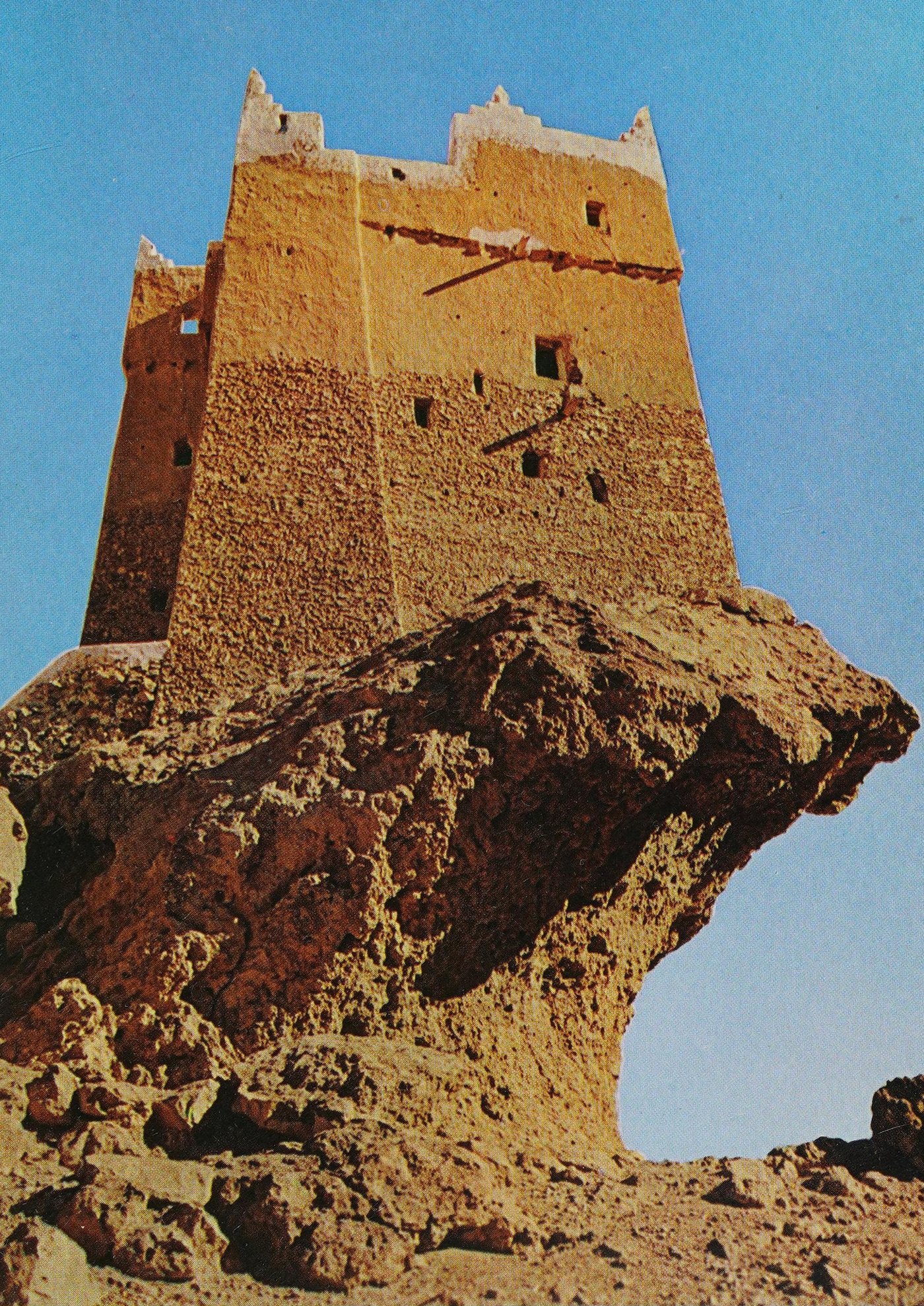
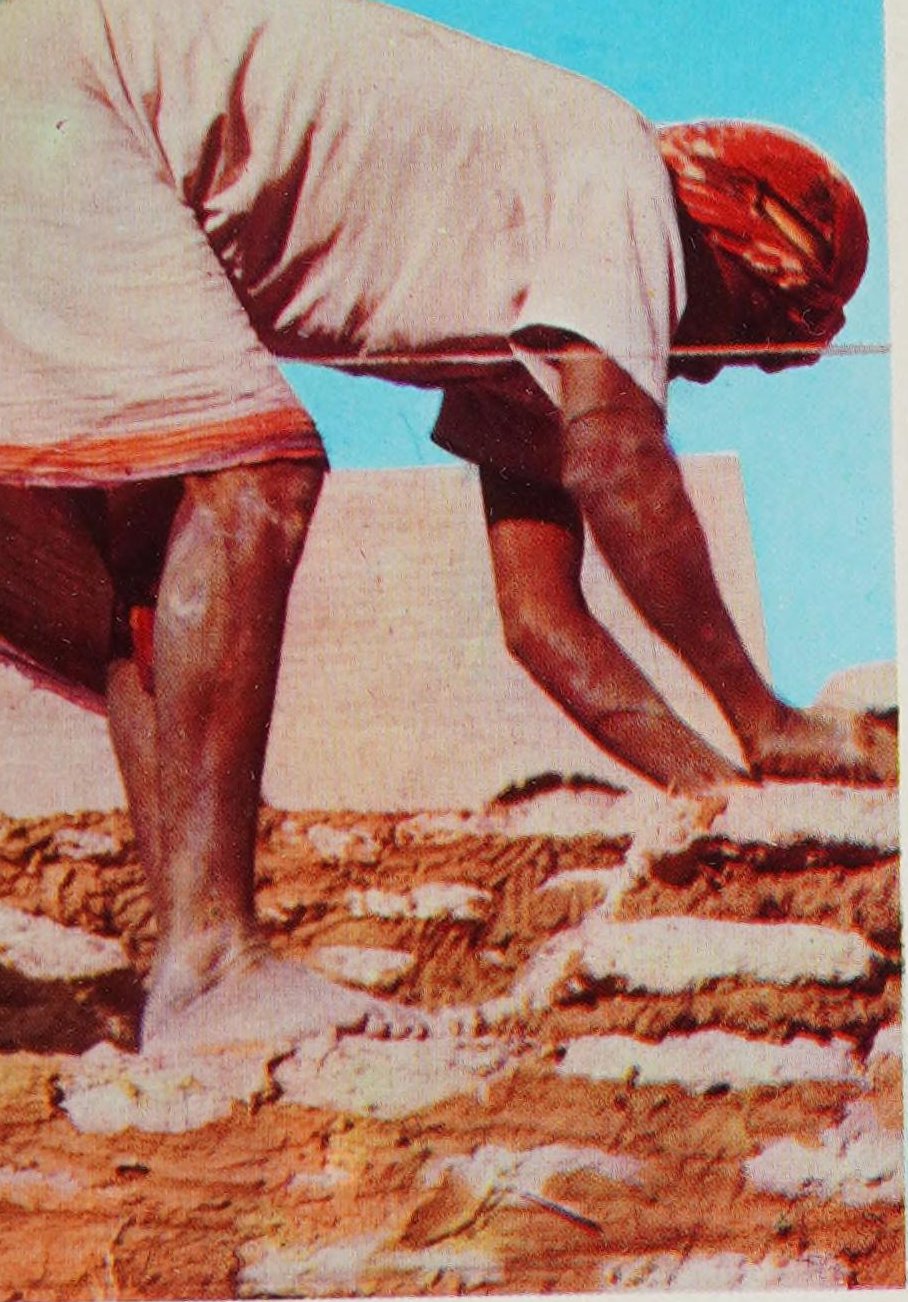
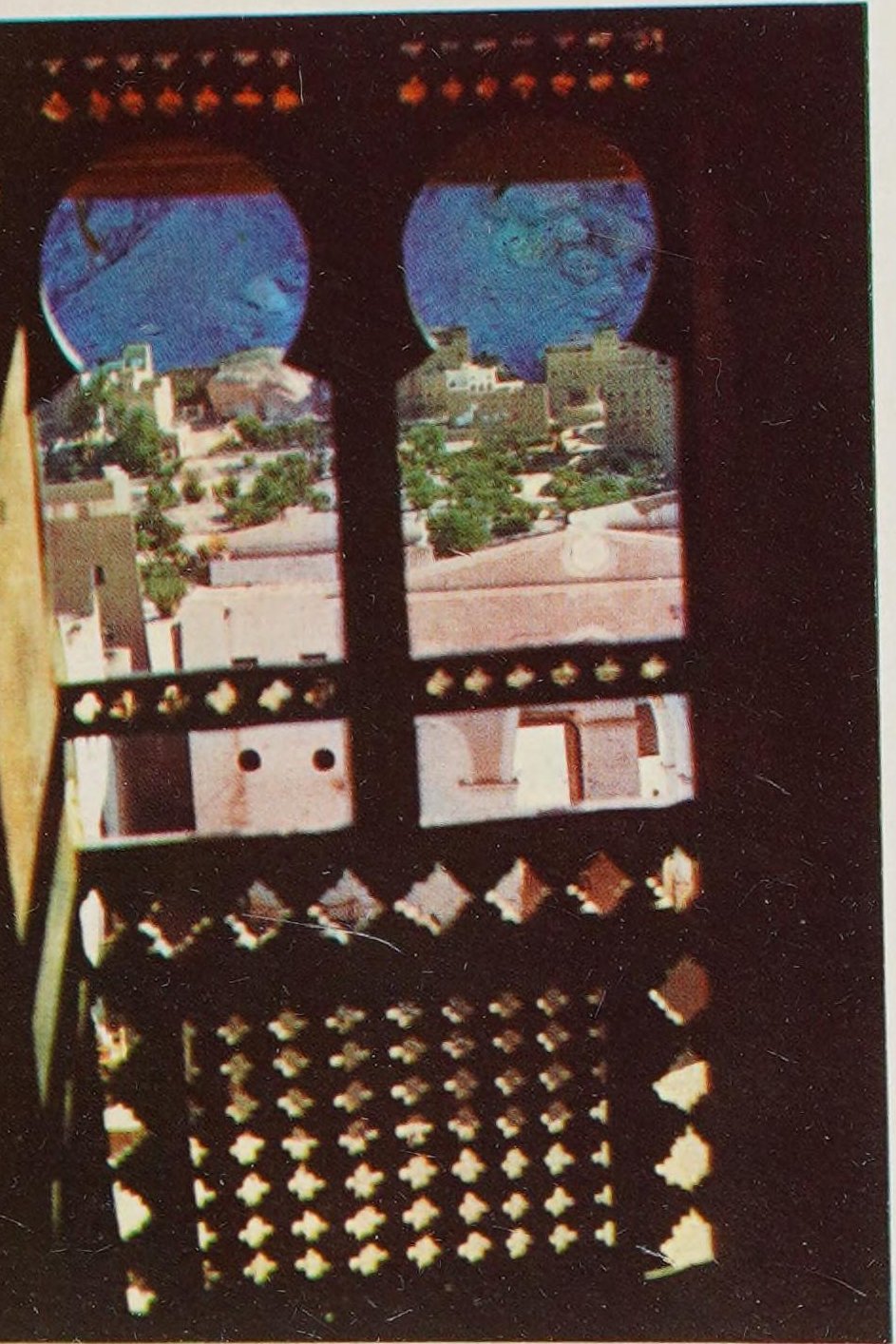
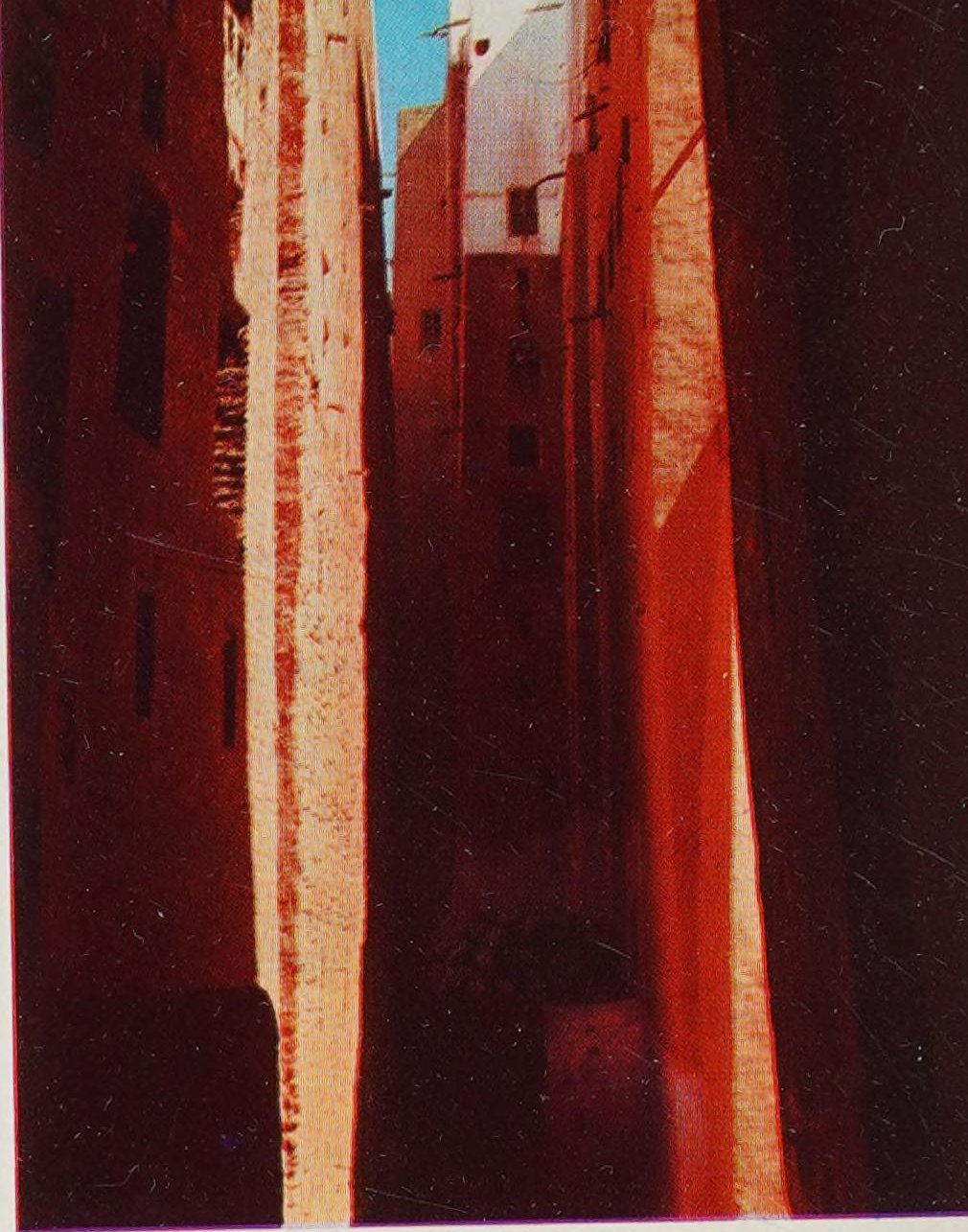
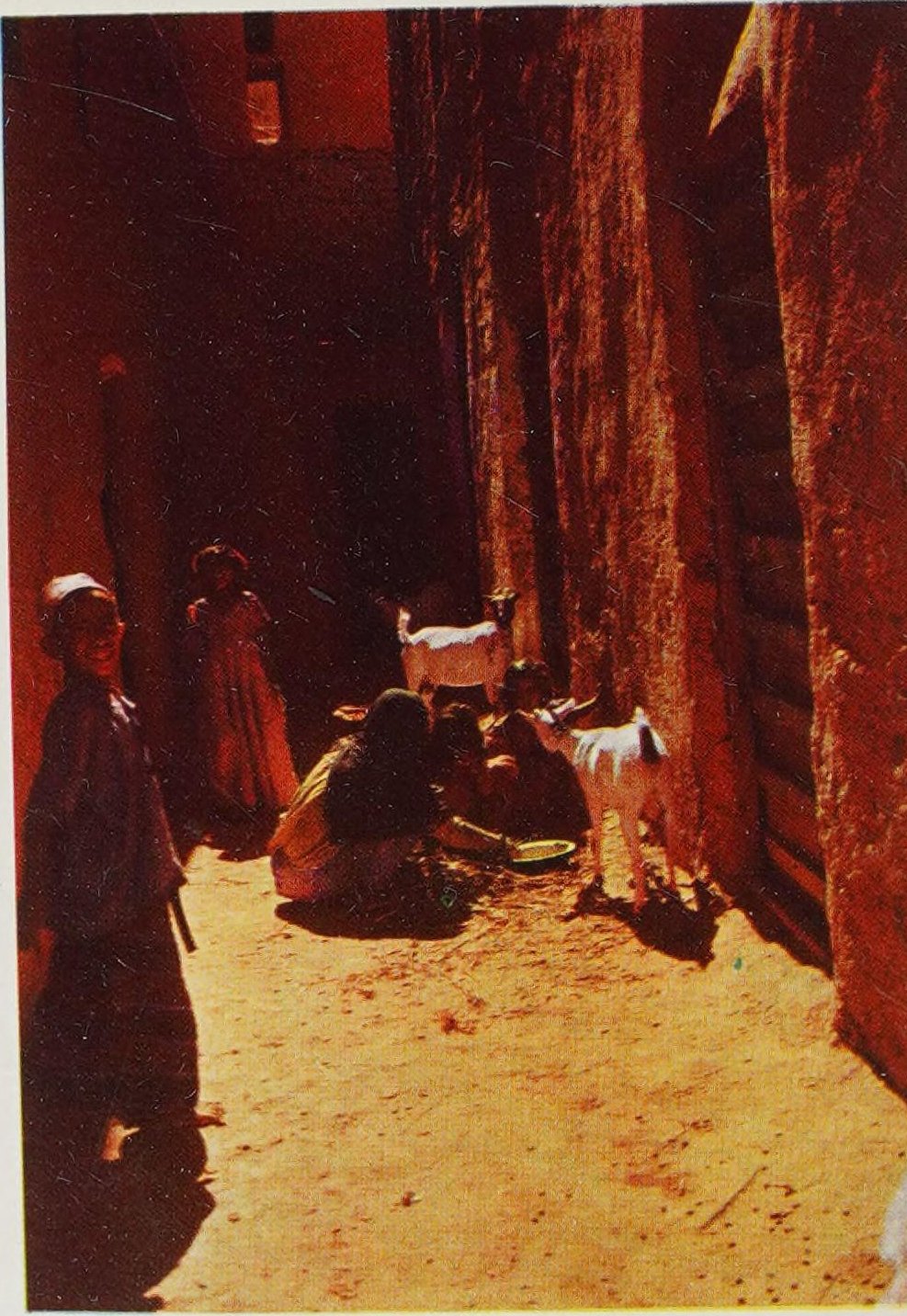
Before me in the wadi I saw a sahib;
he rode past me in the wadi.
It was my master.
My master is a rich man.
He is rich, he is mighty;
but rich men grow poor,
and rich men also die.
Rich men’s possessions die as well.
The big man cheats a little on the scales;
when he weighs, he cheats a little.
But if he gives away some of his property,
gives some of it to the poor,
only then will he look into Allah’s heaven.
‘I have so many songs, sahib,’ he said to me one afternoon. “They only come to me when I am working.’
The man was a dawiff, the same as ‘slave’. He had never been outside the oasis. He had no idea how old he was. He did not know the Koran; knew only that there was One called Allah who would some time reward him. He received no wages as such, but could claim a small share of the crops he and his family helped to produce. During the six months which it took for a new crop to grow, he could go to his master and obtain food, clothes, and a little pocket money with which to make purchases from the merchants who occasionally visited the oasis. When the crop was harvested, the payment he received would be deducted from his share of the yield. He was always in arrears! He and his family would never be able to go away.
The family consisted of his wife, two sons, and a daughter. I ran my eyes over them and stopped at the girl, whose gaze met mine. Even in the dusk her eyes glowed. They fascinated me, as they had done on my arrival when I had seen her for the first time. I scarcely noticed that her dress was poor, and that her body was wrapped in so many ragged garments that I could only guess at her figure. Nor did my attention stop at her odd, cone-shaped straw hat, which resembled those worn by the lamas of Tibet. It was none of these things that I first noticed; it was her eyes. Of course, like most of the women of the country, she had khol round her eyes. But besides the deep and remarkable lustre which khol gives to the eyes of Arab women, there was a remoteness in her look; something pensive and enigmatic which I shall always _ remember. _ She worked like the rest, walking to and from the well and drawing _ water in small bags. I think that it was because of this girl that I had spent 58 BEHIND THE VEIL OF ARABIA so many hours by the well that afternoon. For a long time we sat in the dark, neither of us saying a word.
To the inhabitants of that small oasis this silence was no doubt normal when they rested after the day’s monotonous work. What, indeed, were they to say to one another? The sameness of one day passed over into that of the next. There was seldom a break. On that day, it is true, the rare thing had occurred: visitors had arrived at the oasis. But they could not talk to me, for I did not understand their dialect; and politeness forbade them to talk about a visitor in his presence—even though he could not understand what they said.
I had no wish to disturb their silence. Now and then I snatched a look at the girl with the inscrutable eyes, and all the time I sat wondering what it could be that gave those eyes their singular magic, that dreaming, inexplicable character. What did that girl dream of? Of strange oases? Of flight? Scarcely. She had never known any other place, and barely heard anyone tell of any; for those who came to the oasis from outside do not converse with women. In that oasis she had been born and there she would die, unless some passing sheikh or merchant happened to buy her—or kidnap her.
Did she dream of escaping from the slavery at the well—of freedom? That was not very likely, for she would hardly know the meaning of the word ‘freedom’. Did she dream perhaps of love? In a country where a woman must share her husband with many others? In a country where she is looked upon as no more than a sexual need or a necessary part in the process of reproduction? In a country where, for example, this young woman played so subordinate a part that any camel was worth more than she was in ready money?
Did those eyes tell of pain or tragedy? Of unconscious longings? Of a never-dying hope in an Arab woman’s heart of feeling what it is to be human? The questions kept on worrying me; long after I had gone to bed I saw the Arab girl’s eyes in my mind’s eye.
After my unsuccessful attempt to find the white slave at Shibam I had arrived by the Gool wadi at Saiun, a name meaning “The far distant place’—an oasis town that differed in many ways from the one I had left a few days before.
From the roof of a large Arab palace placed at my disposal by the authorities I had a magnificent view of the big oasis surrounding the town, and beyond to the mountains of Geddarr and Gobbel. The houses were less impressive than at Shibam, but better maintained. Few were more than three storeys high, but some of them were plentifully embellished with elaborate decorations, mostly abstract. Of course neither at Saiun nor anywhere else is there a single human or animal figure or representation. That is forbidden by the Koran.
There is only one family to a house. If the accommodation should become cramped, the solution is to build higher. All houses have flat roofs, so that constructionally no great problems are involved. The houses are built of clay. When this has been brought to the building site it is laid on the ground in a layer 6-8 inches thick. It is then cut up into rectangles of about one foot by two just as one cuts peat. Straw has been mixed into the clay according to roughly the same principle asin the making of reinforced. concrete. Thus fortified, the material can resist almost anything—except heavy and persistent rain. But in these parts it hardly ever rains, and should rain fall, at intervals of years, there are precautions: the top storeys of most houses are covered with gypsum. Gypsum is fairly waterproof and helps to keep the houses cool, since of course white reflects the rays of the sun. Incidentally, the gypsum indicates how far the building has gone. It is only when the house is capped with white that it is finished.
Scaffolding is not used during building, the walls being so wide that the builders can stand on them when laying their ‘bricks’, between which a layer of freshly mixed clay is spread as a kind of mortar. The storeys are rather high, and the floors are laid at the same pace as the walls are erected, in order that the ‘bricklayers’ may walk on them as the work proceeds.
Well-to-do people give their houses a coating of gypsum all over, for aesthetic reasons aswell. The palace that was built more than a century and a half ago for Sultan Hussein Ben Ali Monsour Alketri at Saiun is a marvel of splendour and dazzling whiteness; its effect is so overwhelming that one is reminded of the palace built by the genie for Aladdin. In front of the great entrance, which could be a broad road through a city gateway, waves the sultan’s flag with the white star on a red ground surrounded by green and yellow squares. Spire and domes soar in worldly self-importance towards Allah’s heaven. And amore beautiful contrast to the unbelievably deep-blue sky than this chalk-white palace would be difficult to imagine. Belonging to the palace are extensive grounds with palm trees which require a troop of slaves to tend and water them. Round the gardens a decorative wall has been built, with white buttresses in modern style. Colossal as the palace looks from the outside, the interior seems just as enormous. But then the building has a floor area some 500 feet square. Like every other house in Saiun it tapers off towards the top.
I succeeded in obtaining an audience of the sultan, on which occasion I asked him how many rooms the palace contained. The sultan had no idea.
‘I can well understand, Your Highness,’ I replied as I expressed my admiration. “But I suppose there are as many rooms as Your Highness has slaves?’ I went on inquisitively.
‘I have not so many rooms as I have servants, if that is what you mean. But if we include the small rooms there must be many...’
‘If only Your Highness has as many rooms as Your Highness has wives, that, too, would be a number to remember,’ I said.
The sultan gave me a deprecatory look.
‘I have not so many wives as people say.”
Thus it proved impossible to get an exact figure either of slaves or Wives or rooms, just as it was impossible to extract from the sultan what he understood by ‘slaves’.
In the town I found out afterwards that the sultan’s slaves were generally thought of as ‘domestic slaves’, servants who are rather better situated than common ‘slaves’;but none of the many people I asked knew exactly how many women there were in the sultan’s harem. The statements varied widely, but the figure seemed to lie somewhere between 300 and 400. I was also told that the palace had about a thousand rooms.
Far more than at Shibam, the oasis outside the town dominates the view of Saiun; it even extends in between the outside houses, thereby breaking the town wall. A large part of this wall continues up the side of one of the adjacent table mountains; so high that the mountain forms an effective continuation of Saiun’s defences. Viewed from above, from a flat palace roof, the wall resembles a section—a very small section, it is true—of the great wall of China.
The table mountains round Saiun are an astonishing sight. Some of them are a thousand feet high and several miles long. The sides slope evenly like the sides of a pyramid, but suddenly, about six hundred feet up, a mass of granite forms with completely vertical walls. Only a few select mountaineers have got right to the top. With helicopters, however, future explorers and scientists should have a good chance of seeing from up there the grand view of the wadis which together with the mountains make the whole district seem like a gigantic piece of cracked pottery.
The domestic animals at Saiun are goats, sheep, and camels—in that order of numbers and importance. It may seem surprising that the camels should come last, but so it is in these parts; should any be seen they will usually belong to a strange caravan. The few ‘local’ camels at Saiun generally have a short rope between their forelegs, so that they can walk about, while their owners need never fear that they will escape. An even more effective—and barbarous—means of preventing the animals from straying is to hog-tie them when lying down. A rope is thrown round one of the camel’s folded forelegs and drawn up over its neck and round the other folded foreleg; the creature is then completely unable to rise.
A donkey is just as useful at Saiun as a camel. Walking about the oasis one will, time and again, see a small donkey carrying an imposing load, considering the animal’s size. When the burden is removed from its back one will see some branches sticking out oddly from the animal’s sides. They are placed there as supports for the load, like racks on a car. At Saiun a donkey costs the equivalent of about twenty pounds sterling. In the same town you could get a wife for about twelve pounds ten, though she would be one of the cheaper sort. You must be prepared to give between thirty and fifty pounds to be sure of obtaining one you would get any enjoyment out of.
The ground at Saiun is covered by a thick layer of incredibly fine dust. If you pick up a handful and drop it it will hit the ground with the same splashing sound as water. And yet this dust is so dry that it will fly up if you spit in it. The remarkable thing about this sand dust is that you do not get dirty from it—whether you go barefooted or get it in your shoes or sandals.
As I have said before, there is a great difference between the day and night temperatures; even in the course of a few hours the temperature can change from icy cold to broiling hot. I could sit in the morning in my polar cowl and yet feel cold. But a few hours later, having put on my shorts, I would be sweltering. In Saiun one can see small children wearing thick gloves and a head-dress resembling a cap with ear muffs, or a Greenland hood. The hood goes right down round the neck and has only a very small opening for eyes, nose, and mouth. Everyone who possesses such a hood uses it in the shade as soon as the temperature has dropped to about 85 degrees, for then they think it is cold in these parts. In the sun, of course, it is hot—even by Arab standards—but there the hood functions as a sun helmet. The clothing, too—and this is true of both children and adults—is designed to protect its wearer against both cold and heat.
The fact that Bin Be irr wore two undervests, however, had nothing to do with the climate. When I met him he was sitting outside his house with a little grandchild on his lap. It was the middle of the day and his head was shaded from the sun by a hat that was indescribably dirty and ragged. Iam sure that it would have dropped to bits if it had been washed. It was the dirt that held it together. The vest he wore was just as filthy. It looked so unsavoury that I thought I would do him a good turn by making him a present of one of my own vests, which, though by no means new, was clean. BenBeirr was delighted. Heat once put it on—on top of the old and dirty one! Whenever I met him during the next few days he was still wearing my vest, but a flap of the old one was sticking out at the neck. Clearly, he did not have the heart to part with it—or else he had no feeling for new things!
The costumes of the Saiun women are for the most part red—in contrast with those at Shibam, which are blue. But on one of the excursions I occasionally made up the sides of the table mountains I suddenly found myself face to face with a group of women enveloped in black. Our encounter took place on a rather narrow path, which was overhung by the rock. They stood completely motionless and their presence greatly surprised me; I had never thought of meeting anyone there. The women, however, must have seen me coming up the cliff path. In the black draperies which covered them from top to toe, and in which the eyes were visible through narrow slits in the veil, they resembled creatures from another planet, or members of some sinister sect.
They belonged to a small, isolated desert tribe, I heard later. Where their men were at that time I cannot say. Perhaps they were hiding somewhere, awaiting the outcome of our meeting. This passed in absolute silence. Neither party ventured to address the other, and I quickly passed on.
It was not my only encounter with this desert tribe. A few days later I was out in the desert and met them again; this time both the men and the women. It was some way from the nearest oasis, and that, no doubt, was why I surprised them at a dance—a sight seen by very few. The Koran does not allow dancing. But here both men and women were weaving to and fro in long chains, swinging staffs.
As before, the women were dressed in black, but on approaching them—after they had caught sight of me and stopped dancing—I noticed that their dresses were like pure silk. And they were lavishly hung with ornaments. Their hair had been rubbed in camel grease and plaited into dozens of ‘rats’ tails’. I was interested to observe this hair style because I had seen exactly the same in various African Bedouin and Negro tribes. The Negroes had been the Mosgu tribe from former French Equatorial Africa, and the desert tribes the Nubians of the Siwa oasis in the Libyan desert. Incidentally, this ‘rats’-tail’ hair style can be seen in Ancient Egyptian reliefs.
One of the younger women of the tribe was exceptionally well decorated, both with ‘rats’ tails’ and ornaments. Not content with one bead in her nose, as is customary in the district, she had one in each nostril and a gold ring through her nose. Her lips were painted violet-blue, and most of the rest of her face was smeared with the same virulent colour. Round her neck she wore heavy silver chains, and her breast was as heavily laden with silver ornaments as a display tray in a jeweller’s shop. I learnt, however, that on that day the tribe had celebrated the chief festival of the year, for which all had decked themselves out as best they could, with more regard for ostentation than beauty.
Understandably, I met with much suspicion, but I succeeded, after a while, in gaining their confidence. I allowed them to look into the viewfinder of my camera, and as they eagerly took turns I got picture after picture of them without their being aware of it.
When going through Saiun or the desert outside in order to film or photograph I was invariably followed bya long string of children. It is important to keep friendly with Arab children; if you do, all goes well. But if you fall out with them, you are done for, for then they are like ravening lions.
My first encounter with children did not go off as smoothly as I could have wished, but I must admit that it was largely my own fault. I passed a school just as a horde of children were let loose; some of them ran in front of my camera and stood in the way of a house I wanted to take.
‘Emsisch! Emsisch! Get out of the way!’I said irritated; but they showed no sign of doing so. On the contrary, they found it immensely funny to stand in front of my lens.
*Yellah, yellah!’ I roared.
But that I should never have done, for the next moment I had the whole crowd against me. (Yellah means something like “Clear out,’ but is more offensive.) The children shouted and screamed, and it is probably as well that I did not understand the abusive names which they slung at me. That they were abusive I had no doubt.
Niangara, who was with me—having evidently the ‘luck’ to be always with me when there was trouble—grew frightened as usual, and said:
‘Whatever you do, don’t throw stones at them. If you do, they’ll stone us in turn. They may do anyway, and don’t think we can run for it.’
Next to the house I had wanted to film stood another house, a fine, large one, where the door was ajar.
‘Come in here,’ I shouted to Niangara. Whereupon we threw off all sense of shame, rushed through the door, and banged it to behind us. Outside we heard the excited and disappointed boys yelling.
But the real surprise came from another quarter: a little boy came running down the stairs inside the house, and seeing us there stood for a moment as though paralysed. Then he turned round and ran screaming upstairs again.
All the time we heard the shouts outside: “Nazrani, Nazrani!’ (Christians, Christians). We could now expect attack from both sides, I thought.
But when the owner of the house appeared he turned out to be extremely friendly and understanding, on hearing what all the noise was about. First he went out on the steps in front of the house and told the children that I was the sultan’s friend and that instead of jeering at me they should cheer me and thank heaven that I had not got so angry that I was going to tell the sultan how naughty they had been. Then he invited me to tea; and when I went back into the street later the crowd had dispersed, Life continued its usual course and on the following days there were no more problems when I was out filming in Saiun.
All had gone well with my photographing for so long that I suppose Thad grown careless. In Shibam and other oasis towns I often went photographing with my disguised Minox; or I used the large Canon cameras, which I concealed in a basket of vegetables—photographing through a hole in the basket. But in Saiun there appeared to be no reason for such cautiousness. I went about photographing in my European clothes, brushing aside with as much authority asI could muster anyone who tried to object. This cavalier behaviour produced good results.
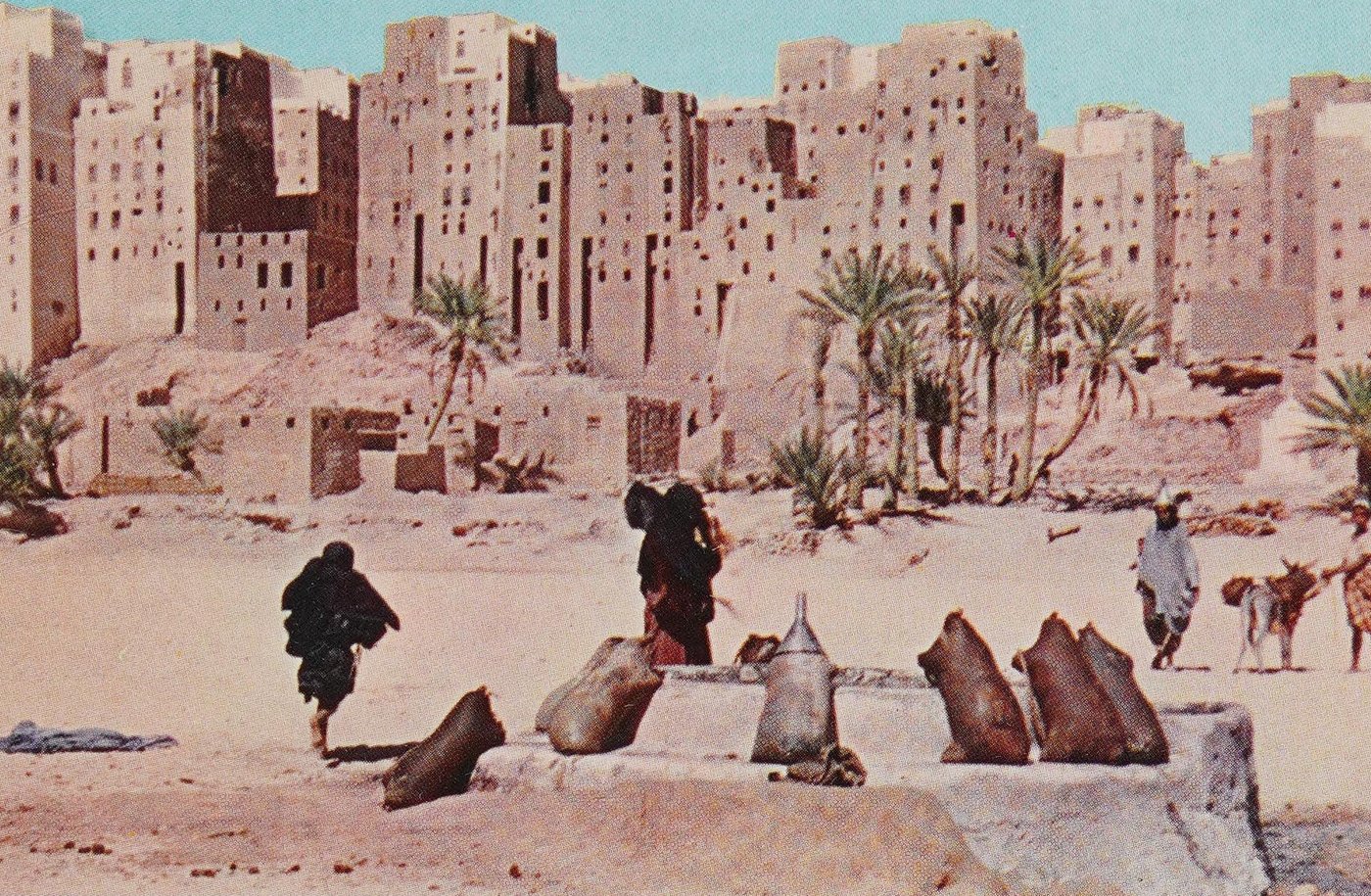
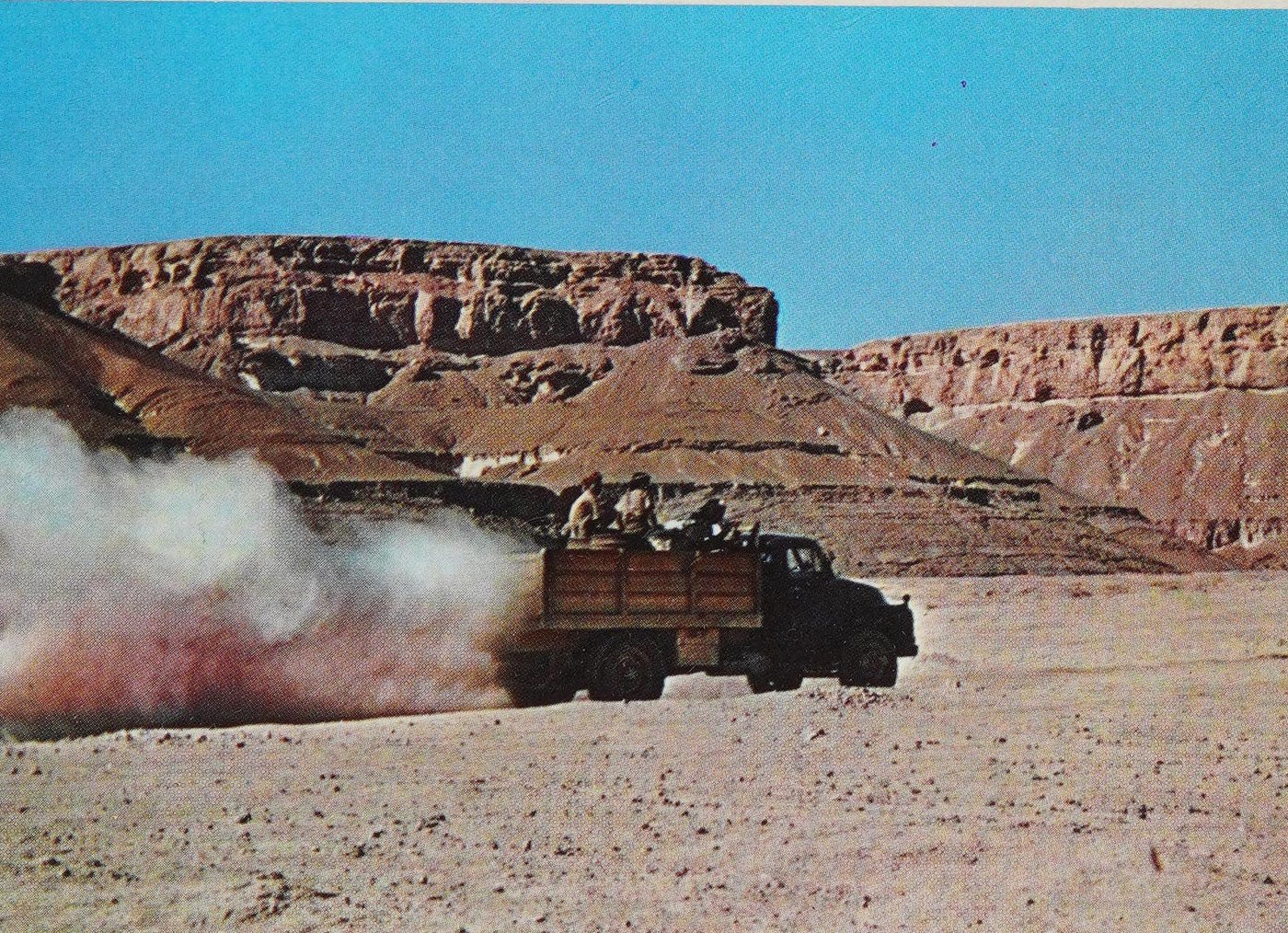
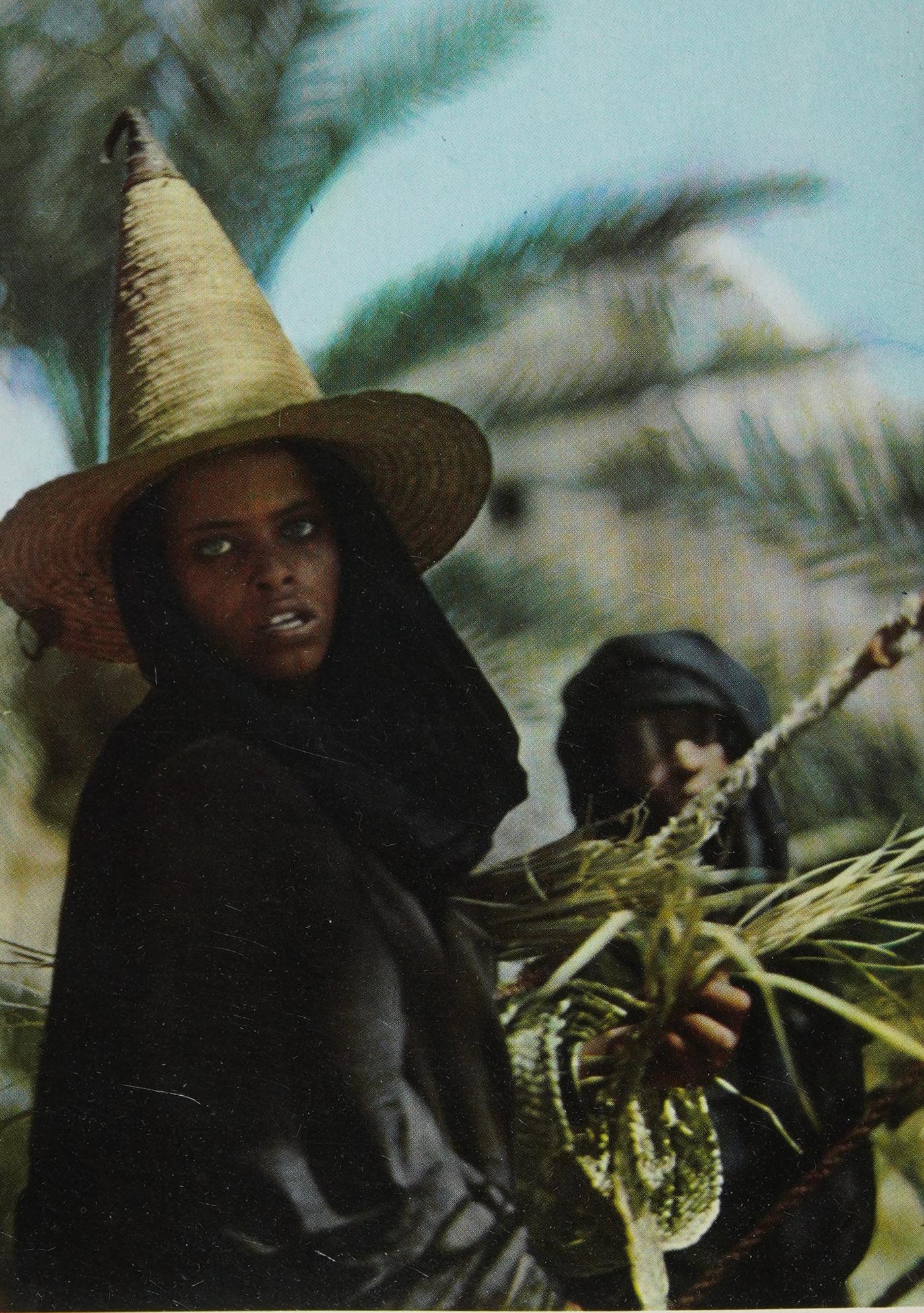
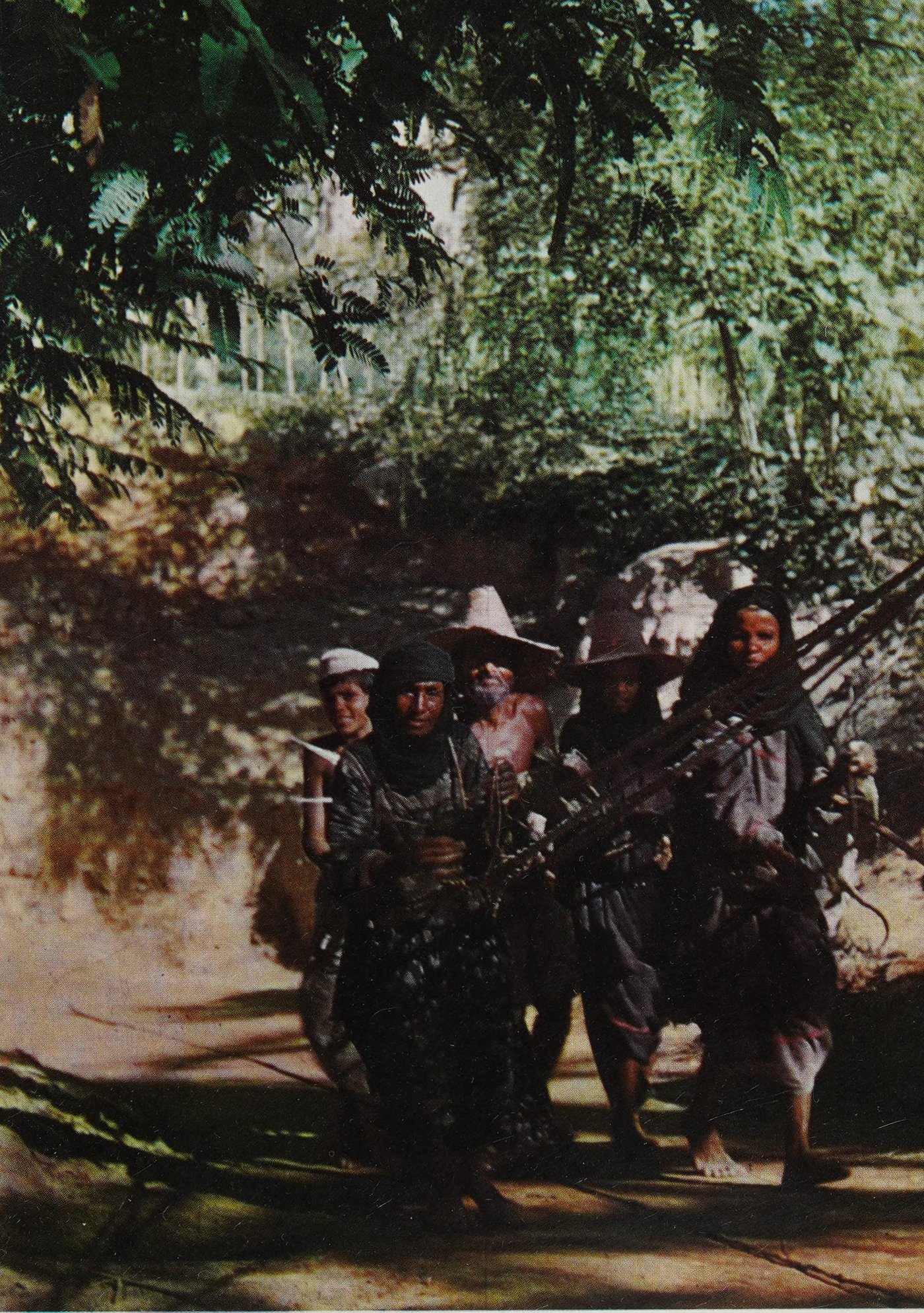
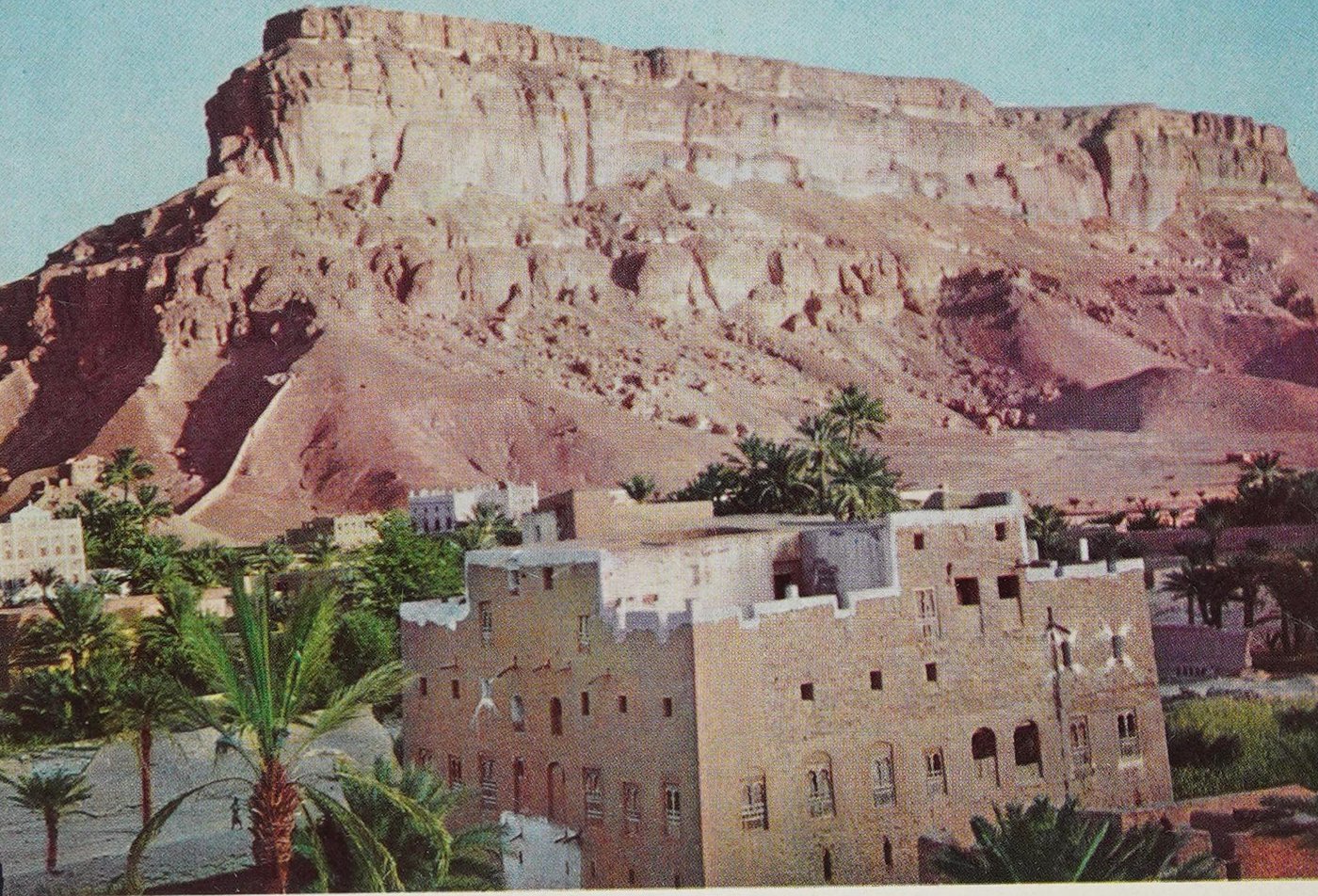
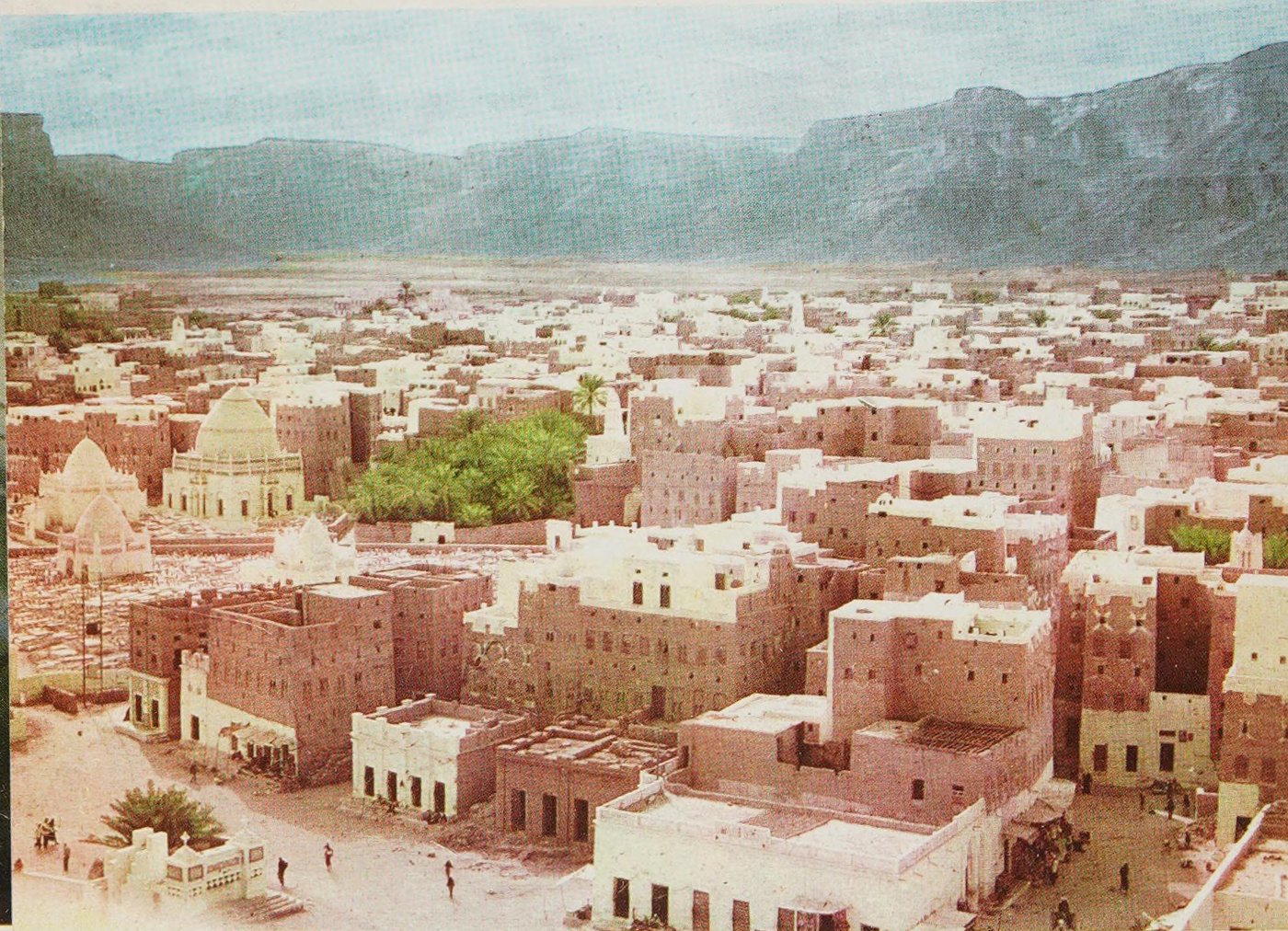
But one day it failed! As I had learnt from experience, the schoolboys there had no respect for authority, and on a certain occasion they began to whistle through their fingers at me as I worked my film camera. Some of the biggest roughs of the street came up and started a fight round me; they pushed one another into me, and in the end one of them gave me a direct shove, tore my clothes, and tried to trip me up. A couple of the inevitable stones and clods whistled past. I looked round for rescue.
By this time a large crowd had gathered, and I dared not run, or in any other way show how afraid I was. Suddenly the film camera was snatched from my hand. I saw a hefty youth streak off with it and sling it against a wall.
This was a signal for action by the adults. The fanatical Arabs divided themselves into two groups: one tried to trample on the remains of the film camera, while the other began to molest me physically.
But once again a door opened at the right moment; I sprang inside, and a bolt was shot. I cannot say if it was involuntarily that the Arab I had stepped in to became my rescuer. Perhaps he only wanted to see what was going on outside. He was not so bold as my other Arab rescuer, however. He was clearly nervous about having me on his premises, and led me by a roundabout way back to my house—where I at once resumed my Arab disguise.
For obvious reasons, no more films were taken on that journey, but my small Minox and my Canonflex with the long telephoto lens were put to diligent use.
The days passed far too quickly: both Niangara and I were kept busy: he in inquiring about the ‘white slave’, in whose existence he fully believed; I in studying local life and in photographing. Niangara had greater opportunities of obtaining information than I,aNazrani. He was indeed full of zeal and thought that the man might be in the sultan’s palace. Doubtless his imagination had run away with him; but if that was so, then I should have no chance at all of pursuing the matter.
By the tenth day we had got no further. There were plenty of slaves in Saiun: black, chocolate-coloured, and even white—but the white ones were all female and were confined to the sultan’s harem. But on the eleventh day Niangara came to tell me that he had got the name of a man E who was himself a big slave-dealer and could surely help us. Would I visit him?
‘Where does he live?’ I asked.
‘AtJedda, the big port on the Red Sea.’
It was a very vague clue, and would take me to quite different parts; but Jedda was one of the places where there were good chances of dipping into the slave problem and life behind the veil of Arabia in general, so I resolved to go there. This meant that I had to return to Mukalla and go on from there to Aden, where I hoped I would be able to fly to Jedda. Niangara would have to stay this time at Mukalla. He was a little crestfallen at having failed to trace my white slave for me. I, for my part, was well satisfied. The journey had been as thrilling as any expedition through unknown jungles.
I was leaving Saiun in the morning, and I decided that that evening I would enjoy the sight of the moonlight shining on the beautiful desert town for the last time.
It was a calm evening. The new moon lay on the horizon like a boat. The creaking of the wheels of a distant well was the only sound which reached me where I sat in my favourite place on the flat roof-top. With the setting of the sun that sound, too, ceased. For a brief space I could still hear the last faint signs of life from a town that was retiring to rest: a distant door which slammed, a crying baby.
Then the stillness became infinite.
Even before embarking on a Saudi Arabian Airways plane to fly from Aden to Jedda I felt certain that I should have an interesting introduction on the way to the part of Saudi Arabia that was to be my destination. I had examined the passenger list and had managed to get a seat next to one of the pioneers of modern Arabia. His name was Kamal Nouri, and I knew him to be a very close friend of Crown Prince Feisal, the brother of King Ibn Saud and the man who, more than any other, had done something to civilize Saudi Arabia.
It had been rather a problem to get on that Saudi-Arabian plane. On inquiring at Aden airport when there would be a service to Jedda I had been told that no definite time could be given. The point is that Saudi Arabia has its own time. It is the only country in the world which uses solar time! For example, you may be told that the Saudi Arabian plane will leave at eight the next morning; but the night may turn out to be a few minutes shorter than expected, so that if you stick to your watch you run the risk of being late. You therefore learn to be in good time. It is worst if you have inquired about the time of departure a week or so in advance, for then it is rather complicated to work out when it will be eight o’clock Saudi Arabian time. And that is not all. The Saudi Arabians reckon twelve o’clock as sunrise, and so there is a difference of several hours between twelve o’clock in Saudi Arabia and twelve o’clock in Aden. Still, by making the right number of additions and subtractions I managed to arrive at the airport in time, only to find that the plane was two hours late.
My hopes of being near to Kamal Nouri were fully realized, and in more ways than one. Kamal Nouri is not a Saudi by birth, but an Egyptian. Nevertheless his love of Saudi Arabia is so ardent that he has devoted his life in this country to educational pioneering work involving a fundamental break with former principles. Even with Crown Prince Feisal as his patron he is having a hard struggle to realize his ideas. Exposed to perpetual chicanery from the country’s reactionaries, he steers doggedly towards his goal.
Kamal Nouri is a staunch defender of Saudi Arabia. Admitting that in many respects the country is medieval, he insists that for this very reason one should not expect miracles of it. What progress has taken place in recent years is indeed miraculous and something of a revolution. But what the country needs is patience and tolerance, he says, and both are rather difficult to achieve.
Saudi Arabia is not tolerant of photographers. It is prohibited to take in cameras and film apparatus without prior permission from the Government. Moreover, even if you obtain such permission itisunwise to carry your camera openly, or you risk immediate arrest: either that or assault by Moslem fanatics who think that the Koran’s prohibition of pictorial representation of persons was made by the Prophet with special reference to the invention of cameras centuries later.
It is safest to apply to the Ministry of Information, who will provide an escort. This escort will bring a brief-case and ask the would-be photographer to conceal his camera inside it, the man being no doubt anxious not to risk his health or good name by being seen in the street with an undisguised photographer and offender against the Koran. One will then be conducted to the town’s most modern buildings, where one may take all the pictures one can. Afterwards one is requested, in one’s own interest, to lock up one’s camera in the hotel room for the rest of the stay—or, still better, deposit it with the authorities at the airport.
‘If you try to smuggle a camera in, it may cost you your head.’
Kamal Nouri said this as if it was a quite natural thing to lose one’s head for so small an offence. It almost made me sweat. I had not obtained a permit to photograph, and in my trunk were no fewer than five cameras. They are my inseparable companions, and not for all the world would I have dreamt of going to Saudi Arabia without them. But in my experience I have often found that such problems have a surprising way of solving themselves. I hoped for the best.
Kamal Nouri also told me, what of course I already knew, that it was rather expensive in Saudi Arabia. This was particularly true of hotel accommodation—‘but,’ he added, ‘if you run short of money, come to me.
I thanked him for his kind offer to assist me in getting my foreign currency exchanged.
RISKING MY NECK 69
“You misunderstand me,’ he said with a deprecating gesture. “There’s no need to change. Just come to me for all the money you need.’
‘To a European it is a firm principle to pay one’s own way, just as hospitality isa principle among Arabs.’
I was obliged to say this, as he seemed rather hurt by my non-acceptance of his offer.
In Kamal Nouri’s company the hours spent on that 750-mile flight seemed almost like minutes. I felt that we had only just started when we were already flying in over Jedda, Arabia’s principal port on the Red Sea, and I had my first impression ofthe town. Large white buildings stood out like gleaming pieces in a mosaic of clay.
Kamal Nouri had courteously asked to be allowed to help me on arrival, and of course it was a‘request’ I was only too willing to grant—especially since I might be in great need of his help in getting through the Customs. On alighting from the plane I was received by the chief of police, the director of the airport, and two sheikhs—or more precisely, Kamal Nouri, in whose company I was, was received by these celebrities. They kissed his hand, and I, thinking that this was the local custom, also held out my hand for a kiss. They only shook it, however.
Escorted by these gentlemen we easily got through the large crowd that was gathered at the airport and in front of the airport building. The people were simply thrust aside, as was the queue in front of the passport control. There was no waiting at all. We had only to leave our passports and a messenger would bring them out to the taxi when we had been through the Customs.
The Customs! I sweated double. At the Customs there was another long queue. But this, too, had to yield to our small select party. My hand baggage was placed on the barrier.
‘Anything dutiable?’ asked a uniformed man.
‘No,’ I braced myself to say (truly, indeed, because cameras are not ‘dutiable’, they are merely confiscated).
‘Cameras?’ he asked inquisitively.
My sun-tan hid my blushes. My heart behaved contrary to rule, but I managed to open my lips in order to say “No’. It was my only way, for in the plane Kamal Nouri had helped me to write, on the Customs declaration in Arabic, that I had nothing dutiable. Not a sound escaped my lips when the Customs officer seized the zip fastener and tugged it open. In a moment, when he started to rummage in my bag, he could not miss the cameras, and what then 2
On top were some newspapers, which I had stuffed in at the last moment. 70 BEHIND THE VEIL OF ARABIA The Customs officer made as if to remove them. A ripping sound indicated that one of the papers had caught on to something and was torn.
‘Never mind,’ I thought; ‘in two seconds you’ll be exposed, and from being a guest of honour, received with bows and cordial handshakes, you will be transformed into a criminal, thrown into gaol, charged with smuggling cameras and intending to take illegal photographs, to the possible detriment of the country. It’s espionage, and death by beheading is really a very just punishment for that offence.’
All this rushed through my brain, but then I became aware of a hand laid across the Customs officer’s. A few words were spoken in Arabic, and the zip was closed. Kamal Nouri had intervened. I still felt far from sure that I had got out of my jam. Was I, perhaps, to be taken before a higher official? Or sent straight to prison?
We came out into a small forecourt. The guards presented arms—or were they preventing me from making a desperate attempt to escape? A sheikh sprang forward. He made me jump. But he only wanted to open the door of a dark-red Cadillac for me. When I got in he seized my hand—and this time it was kissed most cordially. Kamal Nouri followed me into the car and the driver started up.
A quarter of an hour later I took leave of Kamal Nouri outside the Red Sea Palace Hotel, after he had invited me to visit his home and the school he directed.
‘And remember,’ he said finally, with a wry little smile, ‘to be more careful with your cameras.’
He was like the good genie of Aladdin’s wonderful ring, and had carried me on his wings through the troubles of the hot airport to the comfort of the air-conditioned hotel.
Kamal Nouri was right: also about the cost of hotel accommodation. The cheapest room (where the handle came off if you held it too hard and you could not lock the door without a previous course of instruction) cost over five pounds a day. And that was not the only expensive thing. I changed an Egyptian pound in order to make one or two small purchases—a cake of soap and a belt. I abandoned the idea of a belt: it would have cost twenty-three shillings. But nowhere have I seen such well-stocked shops as at Jedda. Everything there is of the best. There are luxury armchairs with gold mountings costing a hundred pounds apiece; gold plates; Rolex watches; silk imported direct from China; the finest imported eiderdowns (though not fine enough, having been provided with additional gold thread by the local dealers); and electric bicycle horns. The toy shops had a wealth of mechanical cars, electric trains, and dolls able to shut their eyes and say ‘Mamma’ and ‘Dadda’ in Arabic—all without equal even in the biggest of American toy stores.
There was a constant stream of cars in the streets, each one smarter than the one before. Only the taxis looked rather dilapidated, though no model was more than a year or two old. It can take five to ten minutes to cross the busy thoroughfares. Overtaking appears to be prohibited, and this, together with the one-way traffic of most streets, makes the stream of cars extremely slow and packed.
The Arabs delight in luxury and splendour. This is clear from the cars, most of which are air-conditioned. And it is also clear from the bicycles. Even elderly persons race along on garish bicycles with gilt handle-bars, three bells, and two gilt electric horns. The saddle will be fringed like a Hollywood bronco’s, the saddle-bag consisting of five different colours of leather. On the front mudguard there will be two rear-view mirrors, and in addition the bicycles will have various pennants and a dozen of the round beer mats supplied as advertisements by breweries stuck in the spokes of the front wheels. How on earth it is possible to obtain so many beer mats in a country where all alcohol consumption is prohibited Allah alone knows.
The Arab delight in splendour is also displayed in the style of their houses. The older houses, which thanks to many years of foreign rule are mostly in the old Turkish style, are fast giving way to large concrete structures in which luxury and solidity endeavour to make up for general lack of character. It is true that they attempt to give the new monumental buildings arches and window frames in the old Turkish style, but they are a poor imitation, resulting in a hotch-potch that is an offence against both the traditional architecture and modern ‘functionalism’. But in the old town the houses are as picturesque as stage settings, dominated as they are by numbers of closed balconies. That, one feels, is what it should look like in Arabia.
The real administrative capital isRiyad, which is about 500 miles to the east of Jedda, well out in the desert region, but Jedda—because of its situation on the Red Sea and its superior communications with the rest of the world—now has the most official buildings. Here, for example, is the large building of the Foreign Ministry; for Jedda is the town where the foreign diplomats and the very few foreign businessmen have their headquarters.
King Ibn Saud has a residence in Jedda—a whole system of palaces surrounded by along wall. Besides his own residence, there are special palaces for some of his many wives. Crown Prince Feisal also has a house in the town—a very large villa, but rather austere compared with the other rich palaces. The Crown Prince is said to be a moderate man; but one begins to doubt his moderation when one sees the huge palace he has had built for himself on the coast outside Jedda.
One of the first things I did on arriving in Jedda was to get my permit to photograph. I cunningly implied that I would buy a camera in the town. I also achieved a certain amount of goodwill by presenting the official who interviewed me with my previous books, so that he would understand from the pictures that I was visiting the country in order to acquaint the world with the new Arabia. That I also meant to write about the old one I thought it best to keep to myself.
At the Ministry of Information, however, they took no chances, for they accredited to me, as I had expected, a ministerial official, and he was only interested in seeing that I took pictures of the new and most flattering part of the town. The modern Arab is ashamed of the ‘old boxes’ and cannot understand the foreigner’s delight at all the closed balconies, which often look as though they had been stuck on to the houses. Inside them sit the women—tweeting and twittering like budgerigars in cages—and watching what goes on below through the small windows. It is rarely that they are allowed out to mingle with the crowd. Of course these houses are not nearly as substantial as the cement houses that are built nowadays. They are constructed of sun-baked clay, like the houses in other towns. Here, also, rain is something of a sensation, and the poorest-built houses will occasionally turn soggy and collapse when for once it is heavy.
I happened to be in Jedda during one of these rare showers. Although everyone knows that rain may fall at a certain time of the year, they are nevertheless staggered when the first drops crackle on the streets. Soon after they rush away, for the rain can become-so heavy that they had better be at home to look after the house.
Jedda has no sewage system; and as the streets mostly consist of clay and loose sand—though in deference to the new times there are a few pot-holed asphalt roads—the rain is soon inches deep, deep enough to get into the shops of the sukh, the shopping street. The dry dust is mixed up with water and clayey soil, and soon everything becomes a dreadful morass. It may take three or four days before the water has more or less seeped away. For long after, the streets will be thick with mire—the sun only slowly getting the better of the puddles—as the road congeals into a hard, uneven crust.
Everywhere in Jedda there isa motley life, but it is especially motley in the throng of the sukh. To gaze in through the open doors is like looking into the black jaws of some monster; the impression is all the more sinister since one is oneself in the blinding light of the sun, which is thrown off from the white walls of houses.
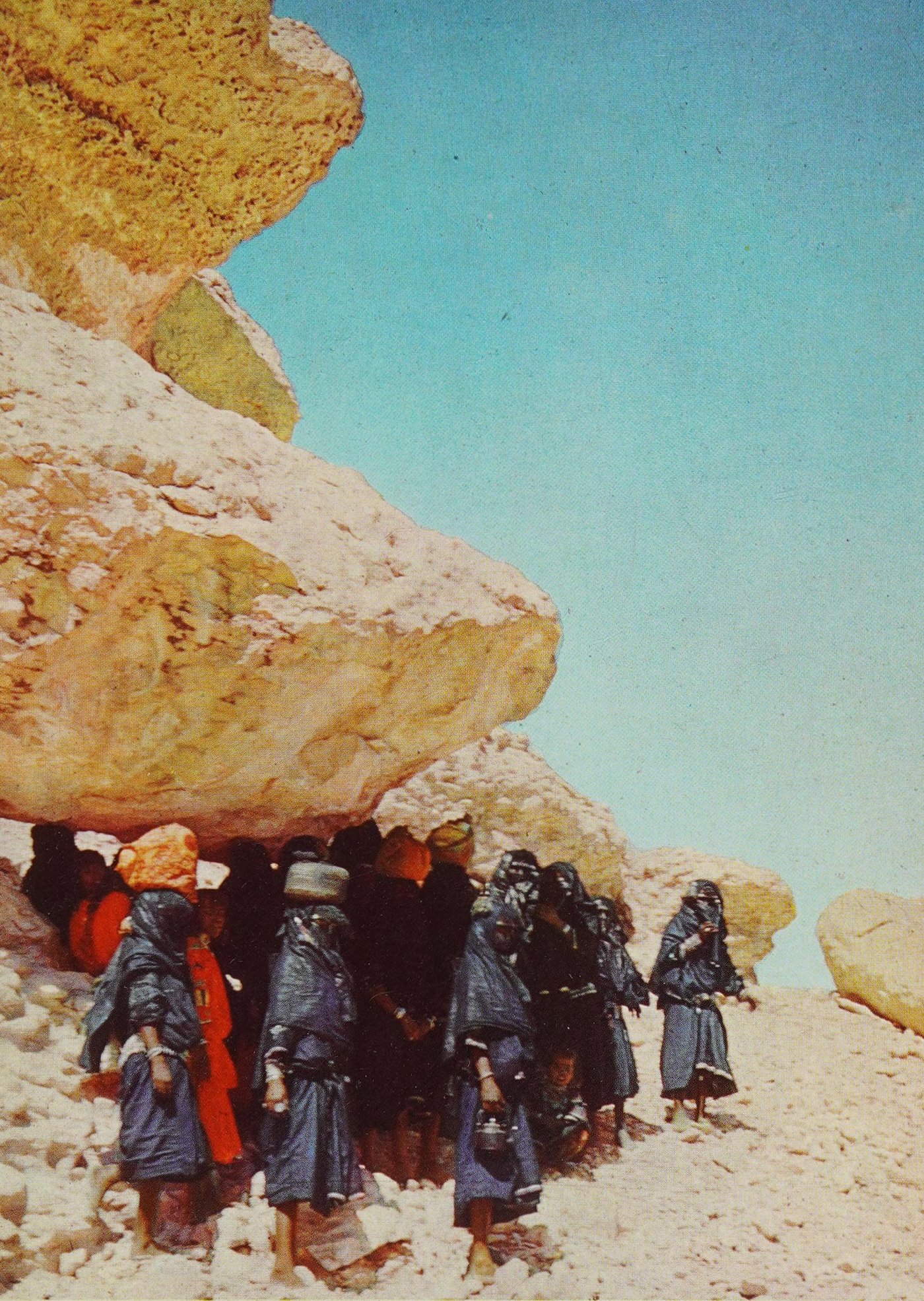
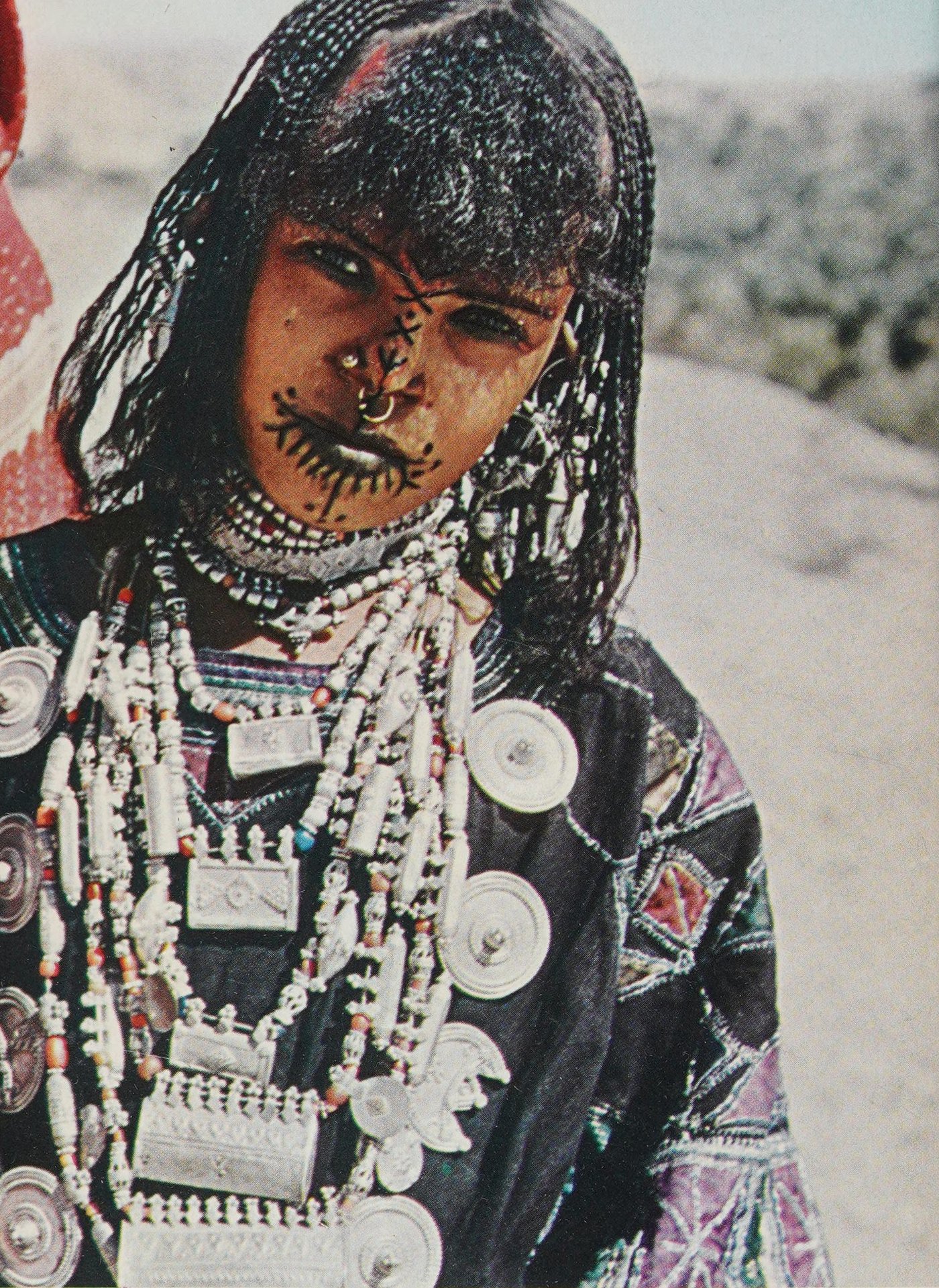
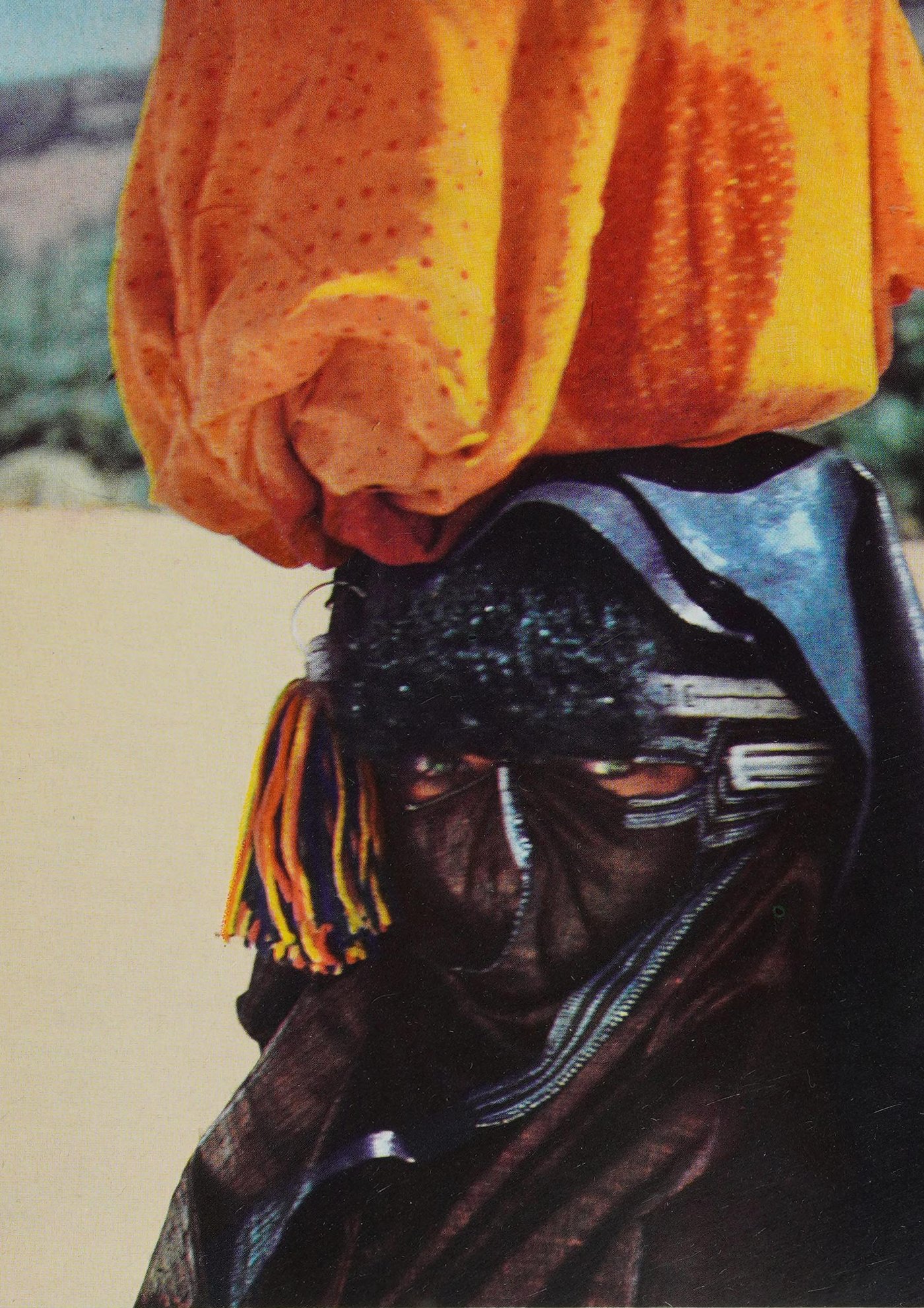
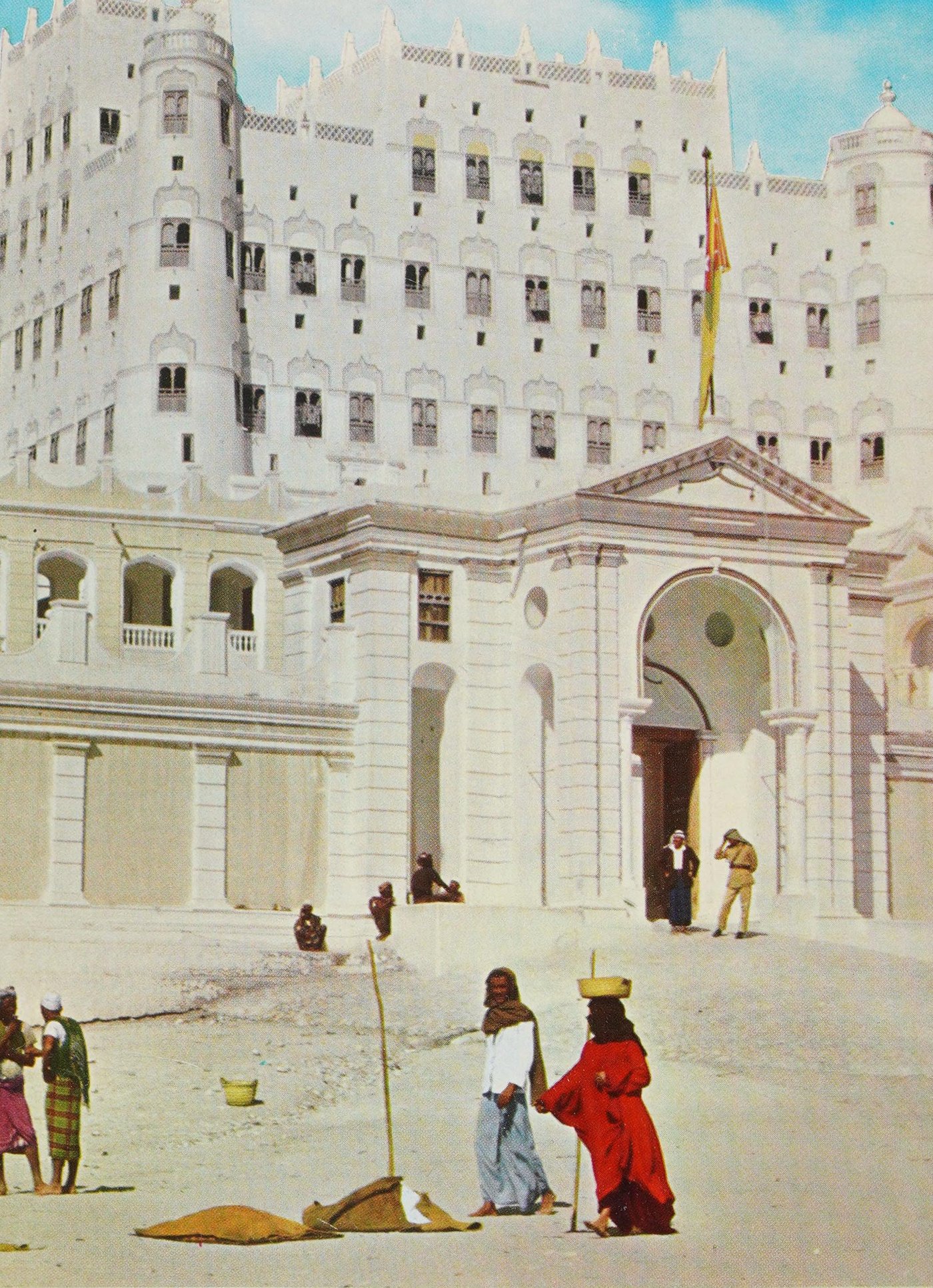
At one place I perceived only a pair of eyes in the light of a small fire, and it looked exactly as though they were hovering independently over a cooking pot that was bubbling away. From another pair of black jaws [heard loud laughter, though there was no one to be seen; it was as though the house itself was laughing. But at a third place it was still worse; here a set of white teeth grinned solitarily in the dark. They belonged to the charcoal seller, whose skin was almost as black as his wares.
Everywhere the colour scheme of the crowds was shot through with the green head-dresses of the priestly police. The particular task of this police force is to see that Moslems say their prayers five times a day when the muezzin calls from the minaret of the mosque. In Jedda—the town of progress—he will occasionally broadcast his call by means of a tape-recorder. There is sometimes a technical hitch, and the loudspeaker will bawl out its message at the wrong times, or the repairer’s oaths and curses will go out with it. The fanatical police will dash round the streets shouting their ‘S’lam, s’lam’ (To prayers, to prayers), and the traders and customers of the sukh will have to hurry into the mosque. If they are too slow to respond they risk getting a few raps over the shoulder from the police batons.
The priestly police will often be seen to have a blue mark on their foreheads. On close inspection one finds that this is not, as one might suppose, a tattoo, but hard, discoloured skin, caused by the constant obeisances. Other religious fanatics also acquire these blue marks of piety by hitting their foreheads harder on the ground than their more lukewarm fellows each time they prostrate themselves before Allah.
Before going to pray a Moslem should wash himself according to a definite ritual. He always carries a small can or—if he is well-to-do—a teapot of water. First he wets himself behind, then on his face and his feet, and finally he rinses his mouth.
At the midday prayers in the mosque there is always a ‘full house’. They pray in chorus, but if there is a short pause in the prayer one can hear fragments of a discussion which has little to do with religion.
‘Ten and a half?’ ‘No, eleven and a quarter.’ “Then ten and three-quarters.’ ‘No, eleven and a quarter.’ “All right, then, eleven and not a bit more.’
The fact is, the mosque is also a market, where busy merchants deal and hear the latest prices.
Jedda harbour has only one quay, and when the ships of every country in the world arrive there—excepting those which for political reasons are occasionally blacklisted—most of them have to anchor in the roads, loading and unloading with the aid of small lighters which take the goods in and out from the quay. For most of the year one sees no great bustle in Jedda harbour, but the picture changes when the time of pilgrimage comes round, Then numbers of the most diverse vessels arrive at Jedda, all laden with pilgrims.
Outside the harbour lie the wrecks of several steamships and smaller vessels. Some have been pilgrim boats which have been destroyed by fire. Panic must have broken out on the overfilled vessels and many will have perished, some in the flames, some in the waves; or else been devoured by the always hungry sharks. The wrecks in Jedda harbour have been left alone. No one dreams of removing them: not even the motor dhow which lay on the reef where, two years before, it had been driven by the police when the crew had tried to smuggle in a cargo of spirits.
There is little bathing as such along the coast; the sharks are enough to deter most people, though they rarely come close inshore. Morality also restricts bathing, Moslems being reluctant to bathe in public. It is exceptionally difficult for a woman to go bathing, as she has to wear her black cloak, which reaches to her ankles, as well as her veil. Furthermore, a bather in the Red Sea will find on coming ashore that he is covered with a glaze of salt, and so has to carry some fresh water for a final rinse.
There is not much picnicking round Jedda, either, though a few cars may be seen parked, towards evening, by as and-hill in the desert, while the passengers enjoy a melon—or simply the view of the setting sun.
My first few days at Jedda were spent in inspecting the town and in making contacts in ministerial offices that I hoped would facilitate my stay and my work. Everywhere I called I was well received, if perhaps rather more correctly than cordially at a few places. The buildings were magnificent both inside and out. Though the ante-rooms might be rather like outsize stables, in the room of the head official the floor would be laid with superb Persian carpets, and both the office furniture and the armchairs would be so deep that one could almost get lost in them.
As a result of my official calls I was shown many of the new buildings in the town and a couple of radio stations in the desert. At these I conscientiously noted their technical data and asked the appropriate questions. But it is no joke to be dragged from radio station to radio station conventionally wearing a suit and tie, despite the heat, and to be driven twenty miles there and back in the desert, with the sweltering heat of the sun penetrating the car along with the fine sand which mingles with the sweat that oozes from every pore. One radio station was very like the next, but I was a well-bred guest, firing off my technical questions—and finding only a modicum of amusement in the news that one of the technicians was unfortunately away, looking for a runaway camel, and that another had gone off to visit his future ‘in-laws’. Those were the few oases of human interest in a desert of facts.
I had been invited to dine with Kamal Nouri, the head of the modern school called ‘Sympathy House’—or “Dar elHanan’, to give it its Arabic name. I was picked up bya large red Cadillac. The car had been a gift from Crown Prince Feisal, a supplement to Kamal Nouri’s salary as principal of the school. Each year he received anew car—the latest and biggest and most chromium-plated model.
Traffic police were stationed at every street corner on our way. Although there were traffic lights at nearly every crossing, none of them functioned—most of them had been knocked down and nobody had made the effort to re-erect and repair them. The many accidents are not caused by excessive speed. It can cost a driver his head—or at least 1,800 rials—to run over one of the many bewildered Saudis who flap across the roads in their white draperies, and this naturally dampens a driver’s ardour when trying out the high horsepower of his car.
We passed an immense building—the barracks. It is about twenty years old, which means that it is quite dilapidated, since nothing in this country is maintained. Next to it stands the Foreign Ministry, still clean and white; but in ten years’ time it is likely to be just as peeled and dirty as its neighbour.
The many quite picturesque buildings with handsome galleries and balconies are of Turkish origin. In this large Arab port there seems to be very little architecture that can be called genuinely Arab. Nor is there any original music, or national art—that is to say, there is one Saudi painter in the country! He spends much time begging foreign postcards, and copies the subjects on to gigantic canvases. He has never seen a European city with his own eyes, and the results of his efforts are often rather strange: houses without doors, chimneys in the middle of garden tables, and so on.
We met a stream of Cadillacs—the Volkswagen of the Arabs—and among them tripped small donkeys harnessed to two petrol drums that were welded together and set on a pair of wobbly wheels; these contained Jedda’s water supply. Occasionally we met a flock of goats on the way to one of the large goat markets. In the passing cars I saw sheikhs and other high-ranking Saudis in long white burnouses and with black wreaths round their head-dress. Behind sat their harem women, closely veiled, but with the material covering their faces so thin that they could catch a glimpse of the street life. A few exceptionally slick cars had polarized plate-glass windows transparent from the inside but not from the outside. What space remained in the cars was filled with children of all ages and shades of colour, ranging from black through mocca to café-au-lait and thé-au-lait. The last is the pure Arabian colour. The colours of the children suggest that the black veils of their mothers conceal harem women of great variety.
We drove through the town diligently sounding our horn. An extra horn like the hooters of some sports cars seemed to be a standard appliance in all Jedda cars. Furthermore, the Saudi Arabians seemed to fill up the vacant space under the bonnets of American cars with extra extra horns and hooters. But they do not ‘play’ on them like coach drivers in the Alps—the Arabs have never been moved by a sense of music. They merely hoot on all tor horns at the same time, and so, with their horns alone, are able to blow every jay-walker off the road.
They sound their horns when they start; when they turn right; and when they turn left. They also sound them when they drive straight on or back. If a driver increases his speed he sounds his horn; and he does so when he reduces it. If he overtakes another car it is to the terrific sounding of horns, which also hoot if another driver dares to overtake him. If a camel is met with on the way it is greeted with a vigorous honk. If there is no camel in sight, one honks none the less readily for that—you can never tell whether one will emerge from behind the next corner. The only exception to the rule occurs when the battery has run out. To avoid this—the most degrading situation an Arab driver can imagine—many cars are provided with a reserve battery for their horns.
In less than a year every Cadillac, and every other de luxe car we passed that day, will have lost both mudguards, lamps, and other outside accessories, because in this country a car cannot expect to get let off lightly—but I will offer a handsome reward to anybody who finds an Arab car that has lost its horns.
The red Cadillac that had picked me up had got outside the town and now, like a battleship, ploughed its way through the sea of sand. The driver had been instructed to take me on a short excursion first, so that I could see for myself the arid desert which lay in a dry haze, and in which frequent mirages were encountered. Aridity and mirages—the perfect | contrast to all that was fruitful and real at the house of Kamal Nouri and his wife which I was later to see.
The asphalt had come to an end; the desert road was not much better than the road through the Sahara. The driver explained that we were on the main road to the holy city of Madena, or Medina. The heat was oppressive, but inside the car we did not feel it. The air-conditioning was so perfect that it felt almost cold in the middle of the sunny desert. After nearly an hour of driving we began to approach Jedda again, and the Cadillac glided to a halt in front of Kamal Nouri’s school.
Originally, ‘Sympathy House’ was established asa private college for two of the daughters of Crown Prince Feisal. When they had left school some ten years before, it had been turned into a school for fifty boarders and a hundred day girls from the town. The remarkable thing about this school is that the boarders, all of them poor orphans, are taught alongside rich people’s children. There are no fewer than eight princesses among the pupils; but then in Arabia there are hosts of princes and princesses.
Kamal Nouri received me warmly and at once had tea served on the splendid green lawn—the only one in Jedda. The school’s grounds are surrounded by a high wall, so that we were able to sit well screened from curious eyes. We were not alone. A honeymoon couple from Egypt were among the guests and there was also a small pyknic Turk, the father of one of the teachers.
The conversation was gay and easy. Kamal Nouri and his wife were splendid hosts. My first impression of Kamal Nouri was confirmed. He is a man of wonderful vision and optimism, but both are indeed necessary weapons in view of all the prejudices and difficulties which arise in the day-to-day work. Undoubtedly, Crown Prince Feisal is a good man to have in support, but inevitably there are others who aspire to his patronage and who find an outlet for their jealousy in all manner of chicanery.
From an Arab point of view, the opposition aroused by the school is understandable. Fifteen years ago, at the end of the Second World War, there were no such things as girls’ schools in Arabia. Women were inferior creatures made for men’s comfort and enjoyment: no more. And now all at once there were people who would teach them a lot of things the female sex knew nothing of before and give them an education which older generations considered unnecessary, even bad. There is no need to dilate on what this could mean in the future, nor to explain that many male Arabs see in this development a danger to their privileges.
Of course all the girls who now get an all-round modern education will have their troubles when they come to leave school. Whereas the great majority of their sisters have never known anything but the slavery of the harem, they, in a way, will have tasted the sweets of liberty. Inside the school walls they go unveiled and can play like girls in other countries. They wear school uniforms, so that the rich and the orphans taken in from the streets shall be indistinguishable. This democratic measure is sensational in itself. As soon as the older girls leave the school grounds they must conceal their faces again—and they hate it. It is the men who insist on the veil; but the fact that the women themselves have begun to loath it is at any rate the beginning of an emancipation.
‘Dar el Hanan’ is an experiment whose basic idea conflicts with orthodox Mohammedanism and is regarded by many fanatics asa sin against the Koran. But thanks to the fact that Crown Prince Feisal is above the law, and that Kamal Nouri and his wife Mofida are foreigners—he an Egyptian and she a Jordanian—malice, persecution, and suspicion will find it hard to destroy the school’s work.
Kamal Nouri and his wife are of course highly esteemed in progressive circles. One of their friends has described the school in a florid poem which all the children can recite as faultlessly as the prayers of the Koran.
The poem says that ‘the school is like an oasis in the desert, where all may come and rejoice in the shade. The tired will find rest. The sick will be healed. She (Crown Prince Feisal’s wife, who along with her husband has done great work in establishing the school) stretched out her life-giving hands across the desert sand and everything grew up round her two daughters. None excels them in knowledge and beauty but Ibrahim’s (Abraham’s) Sarah. They surpass the sun in beauty; for the sun sets, while their beauty never darkens. They are more beautiful than flowers; for flowers wither and their fragrance is lost. All this wonderful oasis will thrive and flourish under the hands of Mofida and Kamal Nouri. None can give shelter to the flowers better than they’.
The Arab language is rich in poetic embellishments, and this translation, while it does not do justice to the eulogies of the Arabic original, will give some idea of the poet’s enthusiasm. Fulsome though this tribute is,it is by no means empty praise; for at Kamal Nouri’s school much has been achieved that is worthy of respect and promises well for the future.
We went round the school and looked into the classrooms where the pupils sat in their blue uniform smocks bearing the school badge, keenly interested in their studies though aware that we were watching them. Even in classes where they were left to themselves and the teacher only occasionally looked in to put them right you could have heard a pin drop. In one class there was free instruction. It was surprising to see even this modern form of teaching employed at the school—and evidently with success. The children were completely engrossed. It was as though they wanted to satisfy as quickly as possible the thirst for knowledge which had accumulated over the generations.
In one class they were learning the elements of arithmetic; it was an object lesson with the help of figures that were put into bags. In another class a couple of girls were sewing away on modern sewing machines, while others were working at an equally modern machine loom. In a third they were learning English. Some could already converse a little in the foreign language and were very proud of the fact, amusing themselves by practising their knowledge on me. They also gave us samples of their reading—and as an extra item they sang a couple of short Arab songs for me. Meanwhile, a dozen girls were doing gymnastics in the school grounds, screened by the wall. Indeed, it could all have been a demonstration of the curriculum ina European school, if the surroundings had not been so exotic—and the children so well-behaved!
One thing, all the pupils seemed at first sight, to have in common: dark and vivacious eyes. But I eventually discovered that there were also girls whose eyes were blue, confirmation of the theory that in the course of time some Nordic blood had entered the Arab harems.
That the children were also well catered for materially was apparent from the dinner that was served. First there was spaghetti, then grilled shiskabab, followed by fried veal cutlets, chicken, fillets with parsley, and, for dessert, preserved cherries, preserved pears, huge fresh apples, oranges and bananas—and finally, Turkish coffee. After this substantial meal the pupils eagerly began to play ball, while I elected to relax in the shade of a tree.
Again and again I asked myself what would be the fate of all these girls when in time they grew up to become educated women, and I passed the question on to Kamal Nouri.
‘Saudi Arabia will realize the importance of women in a modern society, he said. ‘It may take many years before a real revolution takes place. But none of these girls whom we are trying to teach to think for themselves will submit to confinement in a harem; they will undoubtedly prefer monogamy. As a matter of fact, Saudi Arabia has begun to look outward. Many an Arab living abroad among people who do not accept the Arab form of marriage may want to marry one of our girls, precisely because she has achieved a status which makes her fitted to represent our country abroad.
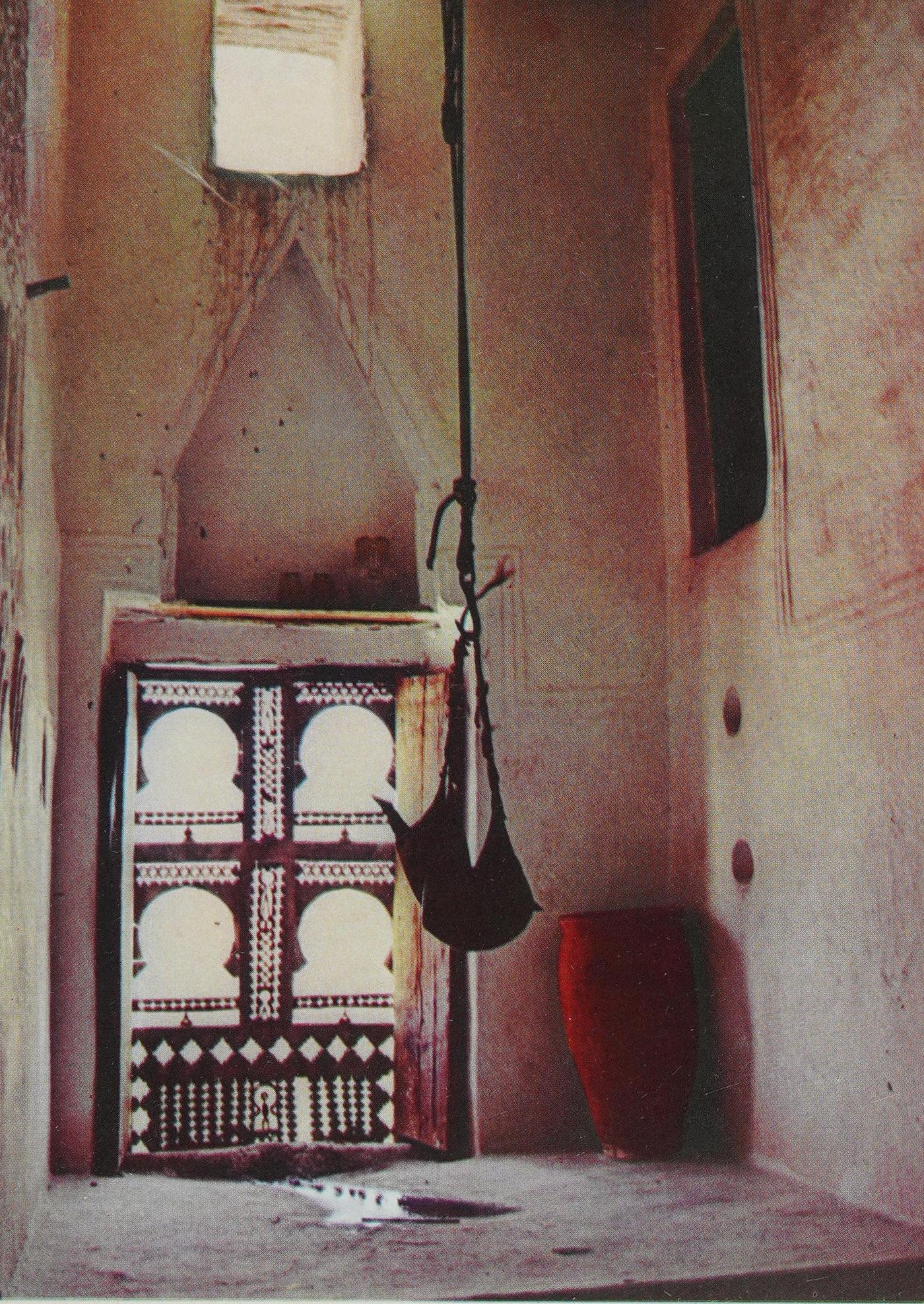
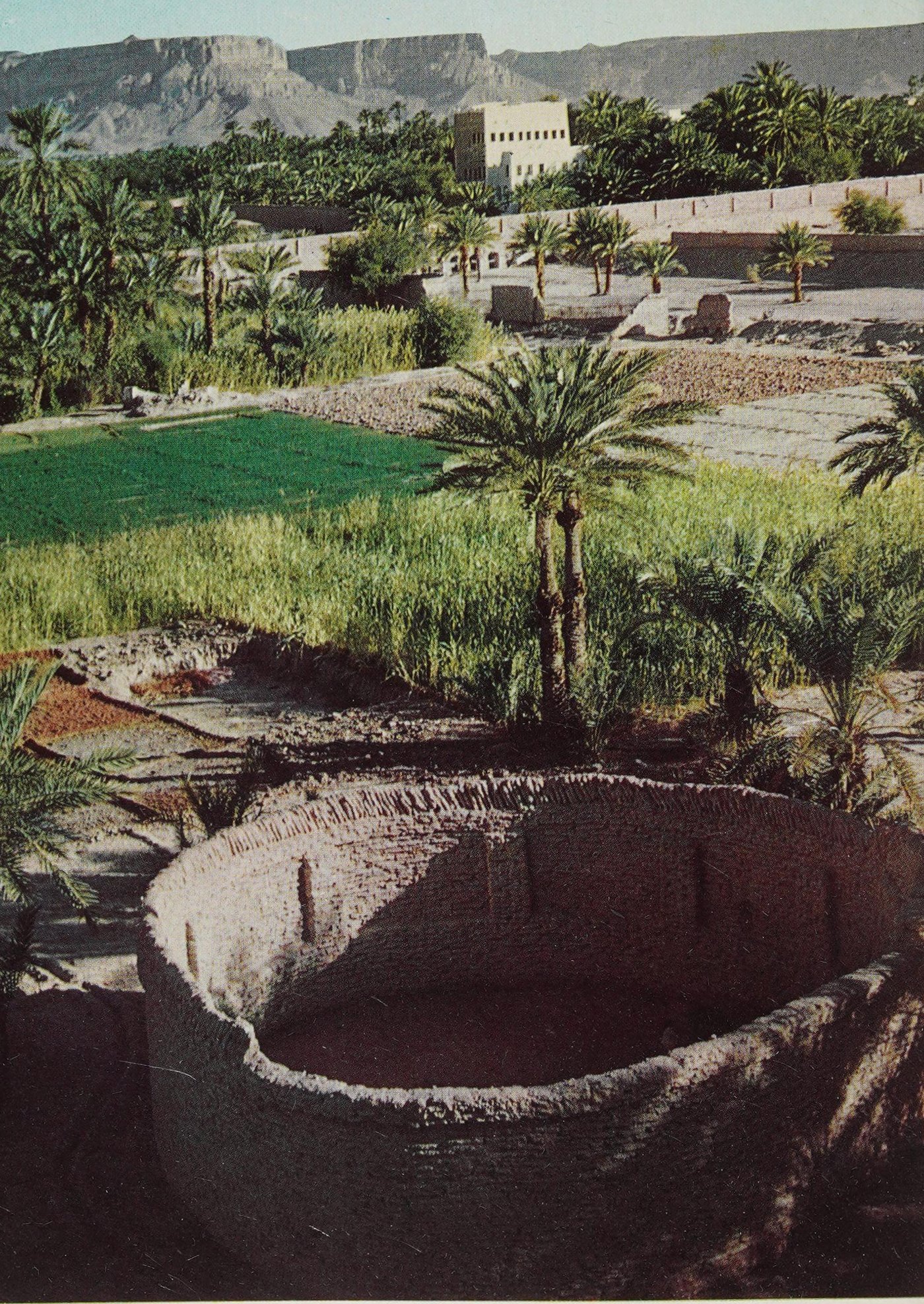
‘Don’t think that it is easy. Many of our educational materials have actually had to be smuggled in, and our whole enterprise can only succeed because our patron, Crown Prince Feisal, is the personality he is.
‘I hope,’ Kamal Nouri concluded, ‘that you will tell the world that Arabia is working to keep up with modern civilization. It will take a long time, but one day the aim will be achieved.’
Among the day girls I noticed a beautiful girl of eighteen to twenty. She was not wearing the school uniform but a costly Arab dress. There was something timid about her; when I held my hand out she shook it but did not look at me. I had deliberately avoided speaking to her when she had inquisitively followed us during the presentation of the school, so as not to embarrass her. But I had questioned Kamal Nouri about her and he had said that she was one of the school’s eight princesses.
Later she took tea with us, and then for the first time I spoke to her and asked if I might take a photograph. She vigorously shook her head and almost fell off her chair in astonishment that I could make such an improper suggestion. Certainly not. Of course I was not helped by the fact that Kamal Nouri seemed to side with her.
A little later when I was taking leave of her I learnt that her sister would shortly arrive, and that she wanted me to meet her. “With pleasure!’ I said; and it was not long before a Cadillac turned in at the gate. From it stepped a figure that was enveloped from top to toe in black, with the usual thin veil before the eyes. It was the girl’s sister.
‘The “mummy” is not so pretty as her sister,’ I said to Kamal Nouri, with an admiring look at the modern girl at my side.
“You just wait,’ he said, as the new arrival disappeared into the house.
In less than ten minutes the door opened again and out stepped a beautiful and chic young woman, dressed in European style.
‘There’s your “mummy”, Kamal Nouri said with a broad smile.
I was amazed. The young woman might have stepped out of a Parisian fashion journal. Her hair was done up in a modern style. It was dark, and as well-arranged as if she had come straight from a skilled ladies’-hairdresser. Her skin was café-au-lait, and she turned on me a pair of black eyes, full of the mystery of the Orient. She was wearing low-cut shoes with stiletto heels. But though in outward appearance so European, she was by nature exactly like her sister, timid and reserved.
If before I had wanted to photograph the sister, my desire to get a F picture of this young woman was even stronger. I hinted at the possibility again. Again there was a shy but categorical ‘No’.
‘Yes,just with the little camera.’
‘No, not even with the little one.’
‘Not even if I take a picture of you both together? Then you can sort of share the blame.’
For a moment the two princesses wavered. They stole a look at each other, but decided on a vigorous shake of the head. No. Not even together. In decency I could not goon pressing the girls. Ipretended that the matter no longer interested me and resumed my conversation with Kamal Nouri and his wife. I noticed the girls put their heads together; but as they spoke very softly, and in Arabic at that, I failed to catch what they said.
When the conversation with Kamal Nouri and Mofida eventually began to flag I once more prepared to leave. When I held out my hand to the elder sister she looked at me rather nervously; then she dropped her eyes and in a faint, well-modulated voice, in an odd mixture of Arabic and English, said:
“Will you give us the pleasure of visiting us in our home? Together with Kamal Nouri. We are alone at home just now.’
If I had not been astonished before, I certainly was now. To be invited to visit two young Arab girls in their home! When they were alone! It was so unheard of that I doubted whether I had understood her aright. The fact that such an invitation had been given could only be due to the modern unorthodox influence of Kamal Nouri’s school. It flashed across me that such a visit could have awkward consequences if it was discovered. But it was too exciting. I would run any risk for that experience. I accepted!
~
I doubt if Kamal Nouri was very keen about acting as my chaperon during the visit to the two princesses but he did not object, at any rate not directly. We were picked up by a white Cadillac—the same car in which one of the girls had come to the school. The curtains were drawn, and we were shrewd enough to leave them drawn during the whole drive. Presumably it was on the girls’ order. No outsider should know that a strange man had driven to the palace in their private car. The servants in rich Arab houses can in most cases be relied upon, so on their side the young ladies need have little to fear.
As we approached the gates of the large villa where they lived they were thrown wide open; the driver did not even have to reduce speed when he drove into the extensive courtyard. Here there were several smart and expensive cars and I thought that perhaps the girls had been afraid to receive Kamal Nouri and me alone after all, and had mobilized a small army of friends and relations. This, however, was not the case; I was told afterwards that all the cars belonged to the house. The princesses’ father had three, their mother two (which of course she did not drive herself), and the girls one each. Furthermore, there was a car which took the small sisters to and from school, a station-wagon for going to market, and a large car which could hold the whole family sitting close together.
There were also some ‘old’ worn-out vehicles. These had been gifts from royalty, and so could not decently be either sold or discarded the first year. Incidentally, it was important to keep account of which coloured car had been received from which prince, so that it could be cleaned and used when the noble donor visited the family. It is obviously bad form to come empty-handed on a visit, and it is a well-known fact that not many flowers grow in the sands of Arabia; so what are the poor princes to fall back on? A Cadillac, of course—it may be a bit ordinary, but there is no mistaking what it is meant to be. 84 BEHIND THE VEIL OF ARABIA
We had stopped before a large flight of steps which we mounted, after which we entered a hall where the floor was laid with precious carpets. The large reception room we were then shown into had a fitted Persian carpet of warm colours and elaborate patterns. The furniture was confined. to a couple of armchairs, some low stools, two enormous air-conditioning plants, and a radio cabinet of country-cottage model. The windows were hung with fine old tapestries and the walls were painted a schoolgirl pink.
After a moment’s pause the two princesses glided in. This time they were completely veiled, like the women in the streets, but I took that for coquettishness, having already seen them unveiled at ‘Sympathy House’. Then all at once—as though at an agreed signal—they dropped their veils. So much loveliness took my breath away. They wore European party dresses: long and rather décolletée even by European standards. The dresses were gold-embroidered and superbly matched the black hair and the golden complexion. Their gold sandals had stiletto heels and the toenails on their chubby girlish feet were a glowing deep-red.
The khol had made their eyes even darker and more brilliant than on the first occasion I had seen them—almost hypnotic, in fact. The full, sensual lips were provocatively emphasized. But with the shyness which they played on, with such virtuosity that one almost believed it to be genuine, the girls repeatedly covered their faces in their black shawls, leaving only the eyes visible. Their hands with their red-varnished nails, however, soon grew tired or careless; the shawls were dropped more and more and the guest found it difficult not to gape at those faces, those figures, at such refinement. (I wondered how many of the black mummies one saw in the streets looked like this when some of the wrapping came off!) ‘
The two coquettish—and shy—girls asked us to sit down. Without words—only with a graceful gesture. There was a wonderful aura about them. Slightly less ethereal was their scent of spicy exotic perfume. When, thanks to the psychological shock of their entry, I had difficulty in finding a subject for conversation, I hastened to compliment the girls on this perfume. A brief order came from one of them, and a moment later a slave woman entered and placed a porcelain bowl of rauud incense on the floor. The younger beauty, the one who was the more sparing in words, rose, and straddling the bowl, allowed her long skirts to fall right down on to the floor so that the incense could lap round her body.
Another slave girl came in with a coffee pot, and the young lady who had taken the incense bath settled her aromatic body in an armchair while the coffee was served in thin, thimble-sized cups. Kamal Nouri explained to me that in that town they normally served‘ Turkish coffee, in cups
PRINCESSES WITHOUT VEILS 85 rather smaller than European Mocca cups and a little larger than ege-cups. A cup of Turkish coffee is half water and half grounds, and so no one ever drinks up. One should remember this, Kamal Nouri said; and he told me of a European guest who did not care for coffee and so, wanting to get it over as quickly as possible, swallowed a cupful at one draught. It was a long time before he recovered his powers of speech. I was reminded of my visits to the sheikhs at Mukalla.
But the Arabian coffee we were served with here was a really outstanding drink. It was fairly light-coloured, in appearance rather like tea, the beans being lightly roasted. Various penetrating spices had been added, and the effect was extremely stimulating. Out of politeness to the host one should always drink more than one cup; and here one could safely drink up, for there was a wad of coconut fibre in the spout of the pot which limited the intake of grounds. If one hands the cup back to the slave girl it is refilled. But if one tips it between one’s fingers it means that one does not want any more. After we had sat talking for a while I asked ifI might take a picture of the amusing coffee pot; the ladies gave their permission, and I thus had a welcome opportunity to get my camera. I tried to take the picture with the princesses forming the background, but they discovered the trick and hurriedly fled into an adjoining room. I was afraid I had ventured too far and was annoyed with myself; perhaps now I had spoilt all my chances.
Instead of the girls I took some pictures of their little brother, who was tremendously interested in my gear and not at all averse to being photographed. The girls realized that they were out of danger at the moment. They came in again and eagerly watched me at work.
While photographing I had an accident—but one of those which sometimes bring good luck. I nearly dropped the flashlight; and asI snatched at it it went off in the face of the younger princess. She gave a little squeal, and I was about to reassure her that a flashlight could not take a picture of her by itself when, seeing that she was not greatly upset about it, I changed my tactics. Ipretended to feel thoroughly guilty at my accident. I greatly regretted what had happened and promised to send her the picture I had accidentally taken.
When she had consoled herself with this, I explained to her that she would not come out very nicely in the picture. Unfortunately, I had been holding the camera slanting, so that she would look rather crooked in her face. Would it not be better if I took some good pictures of her on the rest of the film? I could send her these along with the one that had failed?
Yes, that might be a good idea, she said; and in a short time I had taken 86 BEHIND THE VEIL OF ARABIA a score of photographs of her. At first she was very shy and held her veil in front of her face, but gradually the shyness disappeared and in the end she was sitting full figure and unveiled before me. She was rather strongly built, her arms and legs being perhaps a trifle too short and her body somewhat ample for European tastes. But one forgot all that for her eyes. Having eventually overcome their fears the girls went almost to the opposite extreme, and I fired away with my camera as if it had been a machine gun.
When at length I had run short of film the two gazelle-eyed princesses asked Kamal Nouri to explain to me that I now had their honour and their lives in my hands: if a portrait was published there was a risk that the girl’s family might happen to see it on a journey. If that happened the father would have to kill his daughter to defend the honour of his sons, and it would not matter if the father also had to spend millions in taking revenge on the photographer—a bloody revenge. Consequences almost as awful could happen if it became known in the town that the princesses had received me in their home, and moreover unveiled.
I felt at my collar: Kamal Nouri’s tone was serious, and the girls’ eyes were fixed on me as if they were trying to read in my face whether I was a man they could trust. The lull in the conversation, the silence which followed, emphasized the gravity. They were scarcely empty words that I had heard.
At a motion from the princesses five slave girls advanced in a row. In their outstretched hands they carried bundles, as though they were precious gifts. The first of the slaves unfolded along pale-blue prince’s shirt. The next had a rather heavier coat of the same colour. The third brought one of the distinguished silks which princes wear over their heads. The fourth held a silver head wreath; and the last a black cloak with wide gold edging, heavy gold fringes, and tassels—a cloak like the one which King Ibn Saud wears on official occasions.
‘How exciting to be allowed to see all this,’ I said. ‘I only wish I had more film, so I could take some pictures of the costume.’
“You can take as many pictures as you like when you get home, as it’s a present for you,’ Kamal Nouri said.
“What?” I said, staring incredulously at him.
He merely nodded.
I looked at the two girls. I could not believe I had heard aright. Did they want to make fun of me?
‘I couldn’t possibly accept it,’ I stammered.
"You couldn’t possibly do anything else,’ Kamal Nouri replied.
The slave girls began to help me on with the regal costume. The head
PRINCESSES WITHOUT VEILS 87 wreath was difficult as it was a little too tight for me. The younger gazelle tripped up in front of me and pressed the wreath well down on my forehead, enabling me to look her straight in the eyes, though only for a fraction of a second. Her gaze was impossible to catch, but her eyes now looked quite different from the way they had looked when I had photographed her. Now they were darker than chestnuts; the khol edges emphasized the surrounding whiteness. There was an inexplicable power in those shining, brown-black pearls of eyes. I think I stood and gaped for a whole minute after the girl had gone round behind me to adjust the dress at my neck.
Afterwards we talked. Kamal Nouri had told me that the princesses were exceptionally modern by Saudi Arabian standards. They had even been to Paris, where, however, they had spent most of their time looking at shops; though one evening, with some male relations, they had visited a night club where a strip-tease dancer had performed. She had greatly shocked them. One of the girls had covered up her blushing face when she had realized what the turn was about.
‘It was dreadful,’ they said.
‘Did your male companions think so too?’ I asked.
The girls smiled:
‘No, not at all. They are more used to that sort of thing.’
“What was the best thing you experienced in Europe?’
‘The Paris shops.’ (They had bought over five thousand pounds’ worth of dresses, shoes, and jewels.)
I also asked them about their views on marriage, and what they thought of a man who took several wives. They replied that they certainly would not marry a man who had other wives. Their own father, for that matter, had only one.
The elder sister was twenty and a very determined lady. She managed everything in the house, even when her mother was at home. This right was hers because she was the first woman in the family who had received a real education. She reminded me several times that I was to be sure not to mention their real names if I spoke or wrote about the visit. It would scandalize not only them but the whole family.
‘Is your little sister in love?’ I asked openly.
‘It is a very personal question to ask,’ I was told.
‘Yes, I know,’ I continued undaunted; ‘and I am only asking it because I understand that you are both so modern that I can take that liberty. Indeed, I only ask in order to prove that I consider you as modern as young women in Europe.’
‘Yes, my sister is in love—just a little.’ 88 BEHIND THE VEIL OF ARABIA
Further details I could not expect to get, nor did I question them further. In Saudi Arabia the families decide whom their daughters shall marry. Young lovers will occasionally exchange letters, if they can read and write; but it is all done in the utmost secrecy, and should they succeed in getting their way and marrying each other it is something of a sensation. Love-matches are almost unknown in Arabia and are actually regarded as frivolous.
‘The veil?’ I asked.
‘We hate it, and we are angry with the men for holding us down so long and ordering us to wear it. But we can’t go out without a veil—not yet. We should be scandalized. The mere fact of taking off our veils in here in the presence of male guests is terribly daring of us. But no stranger comes inside our walls without our knowledge. If the gates were not locked we should not dare to take off our veils. Of course we belong to one of the leading families and are friendly with the king’s nearest relations, so that normally people look up to us so much that whatever we do they think is right—up to a point. We have in fact a rather wider margin than others, because of our wealth—but we also have more to lose if we fall into disgrace.’
‘Do you ever go bathing?’ I asked, continuing my interview.
“Yes,thirty miles outside the town—at a place where you can see a long way in all directions, so that nobody can surprise us. There is a palace there by the shore, and we bathe from there when there’s no one watching.’
‘Can you swim?’
‘No.’
‘Now you have given me a princely costume. Should you come to Europe, I will give you a bikini—and teach you to swim.’
The girls were convulsed with laughter when the word was explained to them, and blushingly hid their faces.
“We should like to see Europe, and we should like to learn to swim; but we should have to wear our long black dresses as we do when we bathe here.’
“Yes,”I said, ‘I understand’—while I thought to myself that such a long nae dress would create as big a furore there as a bikini on the beach at edda.
The next day I was on my way to visit Kamal Nouri and his ‘Sympathy House again when my car was overtaken by a red Cadillac. Two mummies were sitting in it, but just as they passed me a slender female hand with red-varnished nails appeared at the open window and waved
PRINCESSES WITHOUT VEILS 89 at me suspiciously. When I saw the ‘mummies’ again they had been transformed once more into the two charming young girls tripping about the school grounds on their stiletto heels.
I looked forward to continuing this exciting acquaintanceship, but I found that the princesses had inherited generations of shyness, for I had to begin all over again—it was as if they had failed to recognize me. It irritated me a little that I had to waste time on new formalities, but gradually the ice was beginning to break. Then all at once the gate opened and a distinguished sheikh entered. When I looked for the girls again they had vanished.
A moment later Kamal Nouri asked me to excuse him and withdrew to his office with the visitor; whereupon I saw the hopelessness of further conversation with the princesses that day and returned disappointed to my hotel.
A day or two later a letter awaited me at my hotel. I opened it and saw that it was written in Arabic. My first impulse was to go down and ask the hotel porter to translate it, but then the unmistakable scent of rauud tickled my nostrils and I knew that the sweet-smelling paper was a message from my two princesses. Clearly I could not let anyone translate it. So I asked Kamal Nouri to do so the next time we met. He read it through quickly to himself; and then he looked gravely up at me and read it aloud:
‘Our lives are in your hands—and so is your own. Take care of those pictures you took.’
The hall porter at the Red Sea Palace Hotel was a young Yugoslav who had gone over to Islam. He was a man who knew how to use his eyes and his ears aswell as his mouth! Having scarcely ever seen a Dane before, he directed his whole attention and flow of words at me. Much of what he told me went in at one ear and out at the other, but now and again he blurted out information about Arab matters which interested me, and so I remained patient. Even when after a day’s wandering round Jedda in the heat of the sun, after lengthy but necessary interviews with government officials and trivial courtesy visits to public institutions, I had finally settled down on my bed, the man would come up to my room, and I dared not plead tiredness because that evening he might have something important to tell. Incidentally, he was a linguistic genius. Besides his own language he spoke French, Spanish, and Italian, not only fluently but rapidly; in English he was a little more hesitant, which was lucky because it enabled me to get an occasional word in edgeways when we stuck to this language.
One evening we sat talking together, he, as always, holding forth. I myself clung to the topics which had my special interest, while bearing in mind how cautious one must be about asking questions in Saudi Arabia, at any rate where religion, politics—and slavery—are concerned. But suddenly he broke into a long account of some of the shocking experiences that foreigners have had in this land of surprises.
For instance, a thin little Belgian electrician experienced the most passionate love adventure of his life, the porter went on. He had come to the country to install various effects, among them some of his country’s cut-glass chandeliers, in one of King Ibn Saud’s palaces. He was staying at the hotel, and on coming in one evening was quite distracted. He staggered to the reception desk, asked in a barely audible voice for his key, and locked himself up in his room. The porter felt it a proper duty—also to himself—to investigate what was wrong with the man, and the electrician eventually told him that while he had been peacefully at work hanging up a chandelier in one of the smaller rooms of the palace a dozen harem women had suddenly come dashing in and had pulled him off the ladder and seduced him. Just as he had been about to shout out for help the women had threatened to scream themselves and declare that he had been the aggressor; and the electrician was shrewd enough to realize that if they did he would never get a chance to hang up a chandelier again! For which reason he swallowed his injured innocence and left the country soon after.
The porter also had a tale to tell of an American who had surprised three women out walking in the desert some distance from their oasis. The place was deserted and so they were unveiled. The American drove after them in his jeep, and they started to run for all they were worth. But who can run away from a jeep? When the American caught up with them they got so flustered that they hurriedly threw their skirts up over their heads. And they had nothing underneath...
The porter also informed me that I was on no account to get involved in a car collision—and if I did, then, like the other person, I was to get away ina hurry and avoid an argument. Any interference from the police, and both parties would be gaoled until they agreed to a division of the responsibility. A procedure which might be successfully applied in other countries, I thought.
To be gaoled in Arabia, the Yugoslav assured me, was the worst thing that could befall anyone. One had practically no chance of making contact with the outside world. He told me about an Italian who had landed in gaol. He was diabetic and said that he had to have insulin. He begged the gaolers to procure it. They turned a deaf ear to his pleading; the Italian had no money to bribe them with. Nor was he allowed to send a message to his friends. After a short time he died.
In Arabia, as previously mentioned, the consumption of alcohol is prohibited. An offender who is found out is locked up at once. But on that evening the Yugoslav and I had locked ourselves in with a bottle of Scotch, which he had received from a Saudi-Arabian prince (princes can take liberties, so long as they do so on the sly). The porter had seen that the curtains were well drawn.
‘There was a European,’ he said, ‘who was recently condemned to six months’ imprisonment for attempting to smuggle in a bottle of whisky.’
‘Talking of Europeans,’ I hastened to say, ‘have you ever heard of a white man who lives here in this country as a slave?’
For a moment the porter was silent. I was beginning to fear I had gone too far. He repeated the question:
‘A European a slave? Yes, there is one, I think. From Sweden.. “
‘... from Sweden?”
My astonishment was so great that the porter looked at me quizzically.
‘Yes, he was here in Jedda. Then he went into the interior, where he still is, I think. He can’t get out of Arabia again. He’s sure to be a slave, suress.. 2:
‘In the interior? Where?’
‘Don’t ask me. A man who’s disappeared has disappeared. Nothing good would come of looking for him. Allah has his fate in His hand. Allah has surely decided that he shall remain a slave.’
‘Allah might free him again?’
‘He might, but it isn’t certain He wants to. Maybe the man is better off as a slave. Swedes might even like being slaves.’
I tried several more questions, but the porter was not to be drawn. ‘Ah, yes,’ he said, ‘then there was the Swiss business man who bathed from the open beach...’
And the Yugoslav went on to relate incidents which invariably sounded quite improbable, though I had heard just as shocking things from people whose reliability I had no reason to doubt. I had also personally experienced the most incredible things in this country...
The Yugoslav was embarking upon a new story when he broke off and asked:
‘Could you get me a job where I can earn a bit more?”
Before I could ask if he was not content with the rather interesting job he had at the hotel he had rummaged in an inside pocket and produced a badly thumbed and yellowed photograph. He passed it over to me. It showed a black-haired girl in a bathing suit. It could not be an Arab girl, photographed in such a scanty costume, I remarked.
‘No, she’s from Egypt. I met her four years ago, and we fell in love. She still writes to me and says she’ll wait for me. But how long can she keep it up? I won’t have her come here on any account. So I shall have to make enough money to get me to Egypt. But every month I send most of my wages to my mother and my little sisters in Yugoslavia. I have to. They have nothing to live on. And the cost of food goes up from one day to the next.’
‘I shall have to earn more,’ he said, absorbed in contemplation of the girl. I felt very sorry for him when I saw the hopelessness that suddenly appeared in his eyes. Perhaps he was talkative because it helped to keep his mind off his lady love in Egypt. I only wished I could help him.
During the next few days I was kept busy—I had to find out more about the Swede who was reported to be in the heart of Saudi Arabia. And luck was with me. One day the porter introduced me to Haji Noureldin Elmagary. He had been born in Hungary and was now about fifty. He had travelled round the world, and when we had made contact he enjoyed talking of the Matto Grosso in Amazonia, of Rio de Janeiro, of the pygmies of the Congo, of race relations in South Aftica, of the Libyan desert, and of the mirages of the Sahara.
He equalled my Yugoslav for talkativeness. Sometimes I had difficulty in keeping my attention from wandering. He considered himself a man of the world and a globetrotter and flatteringly thought me the first real colleague he had met in twenty years of travelling. This gave an extra stimulus to his eloquence, and on the evening of our very first meeting we got through ten years of his travels. But I let him talk on, for he had immediately declared himself willing to accompany me through the native quarters and distract attention from me while I was photographing with my miniature camera.
Elmagary had been long in the country, and like my hotel porter had gone over to the Moslem faith. One simply has to, he said, to get on in the long run. Whereas all his neighbours kept slaves, he contented himself with a ‘boy’ who functioned as a sort of butler. His nearest neighbour was a well-to-do merchant, who had four wives and five slave women. One of the wives kept a private slave, a Sudanese, with whom she had two children. _
It was largely because I was a Dane that I got on good terms with Elmagary. He had relatives who had escaped to Denmark during the Hungarian revolt in 1956. They had described the friendliness shown to them there in letters, and Elmagary’s gratitude knew no bounds. He was ready to help with anything at any time. He even offered to take me to the grave of the biblical Eve, which was stated to be in the Arafat mountains outside Jedda.
He also offered to take me into the desert where there were ‘flying snakes’. But for the fact that I had read about the flying snakes in Herodotus I should have concluded that these fearsome creatures were products of a lively imagination; but Herodotus described just such a desert country where the serpents had wings and were so dangerous that foreigners had no hope against them, though the local inhabitants were said to be immune from their bite. On hearing from Elmagary that he had been in the district and had seen these flying snakes, I thought it would be interesting to find out how much there was in the story. My new friend suggested that we should adapt a jeep for the purpose; fit it with a mosquito net, and for the rest protect ourselves with leather gloves, a specially designed leather dress, long riding boots, and a bee-keeper’s mask.
Alternatively, what did I say to visiting the great pyramids ten or twelve days’ drive from Jedda, beyond Riyad? There, according to Elmagary, was an Arab Atlantis, with buildings that resembled pyramids. In the surrounding desert were huge chasms from which poisonous vapours erupted. It was said that a large prehistoric civilization had perished at this place. Perhaps some natural disaster had wiped out the inhabitants.
I shook my head incredulously, but in his eagerness the Hungarian seized a pencil and drew a map of the area, while describing the route we should take. It all sounded a little too sensational.
‘Will you help me to get into the interior and find a white slave?’ I suddenly asked.
Elmagary gaped.
‘There are many white slaves in this country,’ he said finally. “There are white slaves in most harems.’
‘I mean a male white slave.’
I then told him what I had first heard as an idle rumour but had afterwards obtained concrete information about. I also confided in him that I had gone on this expedition to look behind ‘the veil of Arabia’, and that this quest for the Swede had become an ideé fixe with me and made me change my plans. Every new clue was of value.
“Well, [don’t mind telling the world what happens in Arabia—including slavery,’ he said thoughtfully with a nod. “My people in Hungary have had a taste of slavery—in a rather different way, of course. And though in this country there are many slaves who are better off than they would be as free men, I’m ready to help you all I can.’
Elmagary had first-hand experience of the slave question. After becoming a Moslem he had visited Mecca, where he had called on one of the town’s leading officials. He was sitting alone in one of the rooms when he had heard two women talking; it was obvious that one of them was very unhappy. Elmagary realized that she was speaking French, and contrived to see into the room from where her complaints came. A white girl of about fifteen was clinging desperately to an older, heavily veiled woman, When the latter briefly left the room Elmagary managed to exchange a few words with the girl, and learnt that she was from Brazzaville in the French Congo and was being held in that house against her will.
After prolonged negotiations with his host and another man, who was part owner of the girl, he persuaded them to sell her for 300 rials, the equivalent of about two pounds sterling. He took her with him to a small oasis village in the mountains where he was living at the time, and on arriving in Jedda three months later handed her into the care of the French consul. The consul saw that she was returned to her family. It turned out that the girl had been kidnapped one day in Brazzaville as she left school. She had been sailed up the Congo river and afterwards sold into slavery in Saudi Arabia.
I told Elmagary that I did not want him to run any risks for my sake, merely because he felt a debt of gratitude to my country. I therefore asked him to think the matter over; I should be returning the next day, when we could discuss further plans.
I was eager to get his reply when I visited his home again the next day. I was reluctant to raise the matter myself, and it was some time before we discussed it. True to his habit, Elmagary expatiated on dozens of other matters first. However, he sent his boy out for tea. This he did by pushing a dirty, rolled-up note into the spout of a teapot and giving it to the boy. The note was in payment for the tea, which would be pumped into the pot from a nearby teahouse. One learns to take a large view of hygiene in Arabia.
Tm still willing to help you to find the white slave you talk of,’ Elmagary said at last. “Far too many people in the world know nothing at all about what goes on in Saudi Arabia. They won’t believe what experienced. people have to tell; it all seems too fantastic. So they must have proof. If the man you say exists at all, it’s a fine enterprise to try and find him.’
‘But won’t it be dangerous for you?’
-‘T’ve considered’that, but somebody has to take the risk. Look, suppose WE ons
Bringing out a large map of Arabia, Elmagary began to explain what possibilities there were of getting to the places in the desert where we might obtain more information.
‘But we know far too little,’ he said. “We must begin here, in the town. It’s no use asking the authorities. They’d simply deny there’s any such thing as slavery in this country. We’d better go to Salem bin Omar. He’s one of the biggest thugs we’ve got, but he has his spies everywhere and there isn’t a thing he couldn’t find out if he wanted. But will he want to? They say he deals in slaves himself. By the way, why don’t you ask the Greenlander that lives here, first?’
The words very nearly made me drop my teacup. Two days ago a Swede in Saudi Arabia, and now a Greenlander!
‘A Greenlander?’ I said sceptically. “You mean an Eskimo?’
‘No, no,’ Elmagary said. ‘He’sa Dane like yourself. He only comes from Greenland’ (a half-truth, it was to transpire later), “and he has his wife and son with him.’
‘How long has he been living here?’
‘A long time.’
“Where’s he live? And what’s his name?’
‘Fritsch or Friis, or something like that. He’s a business man. Last house but two on the left in the direction of the desert, north of the harbour. Just past a big dovecote...’
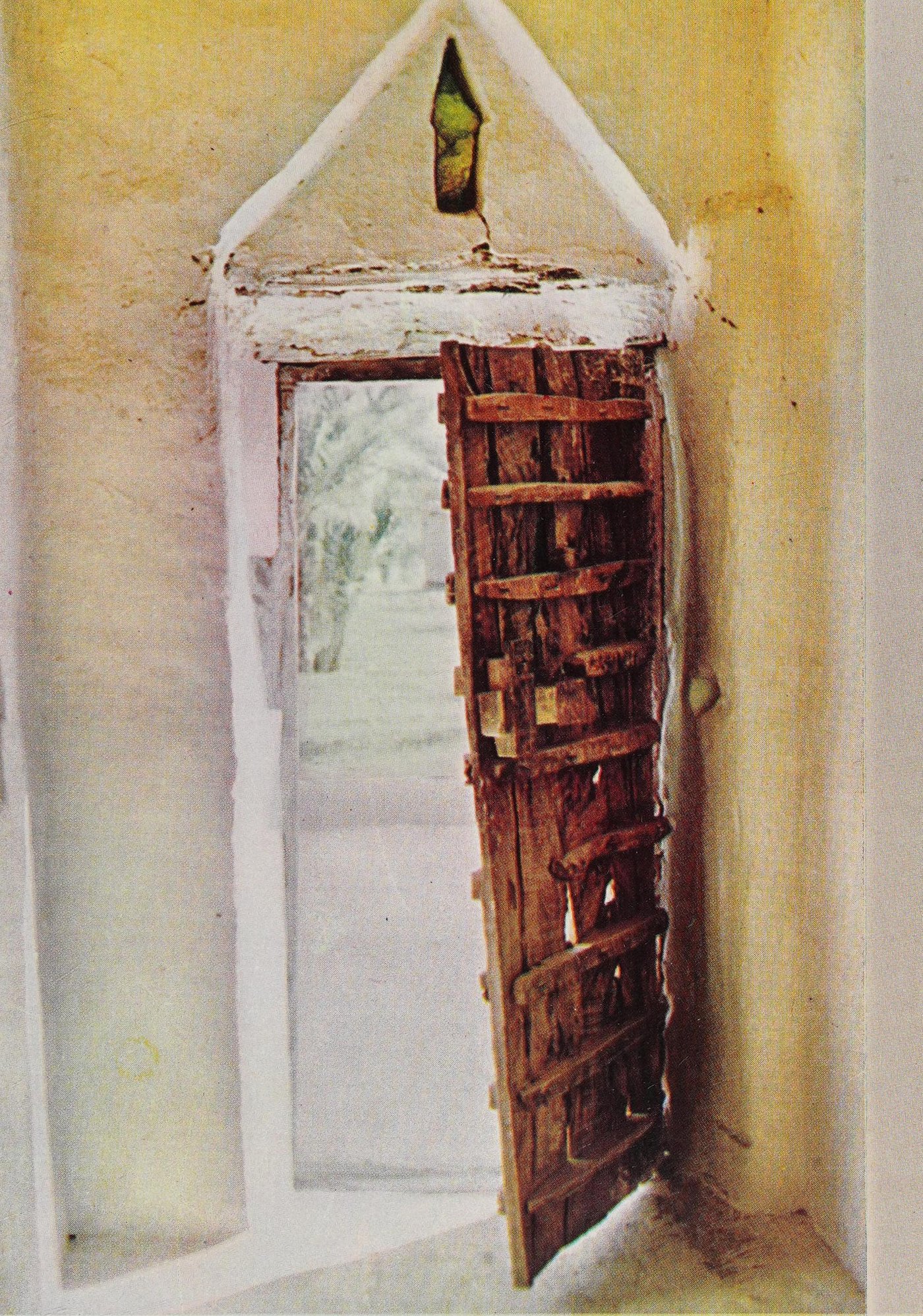
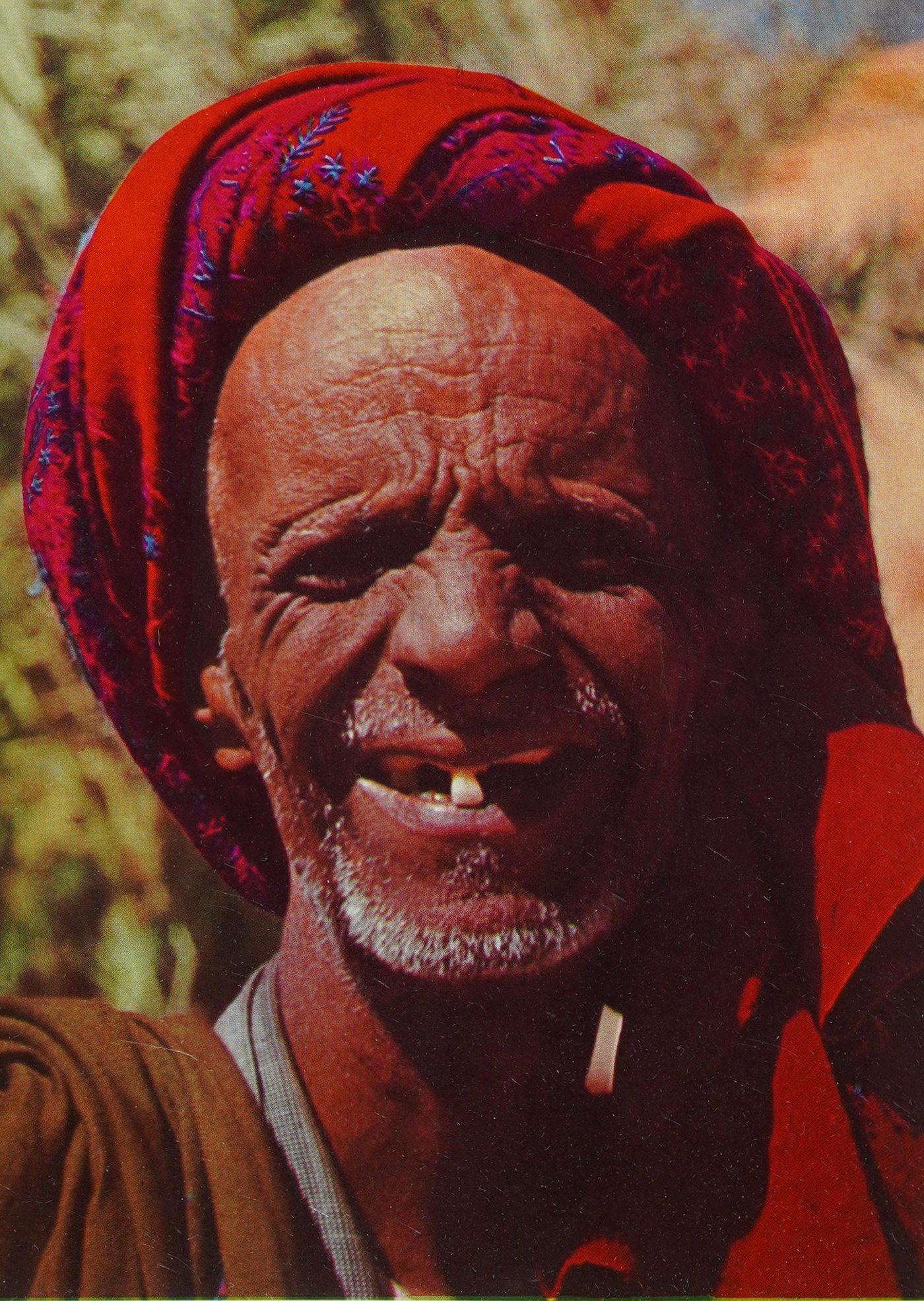
The dovecote was the biggest I have ever seen. It was painted in glaring green colours and I had expected to find pigeons swarming round it. There was not one. There had never been any, for it was not intended for pigeons; the doors were merely indicated with black paint. The owner had once seen a dovecote in Europe and it had occurred to him that one like it would look decorative next to his house. But he was aware that pigeons made a mess and were a lot of trouble and so he had preferred a sham.
Next to the dovecote stood ‘the last house but two on the left in the direction of the desert, north of the harbour’. I had not been given the name of the street—for the simple reason that it had none. There was a bell at the gate in the wall which surrounded the house; I pressed it a couple of times but there was no response. I tried a last time; and then I stepped back a few paces in order to examine the villa where the family from Greenland was supposed to live. As I did so I heard at long last a voice which said, in not very good English:
‘Oh, you are American or European. I could not see you. You were too close to the wall. I will come in a minute.’
A few minutes passed before the gate was opened, and facing me stood a slender little woman of about forty. On introducing myself as a Dane, a relaxed smile spread across her grave face and she said, in broad Jutland dialect:
‘Well, I never! Then you’re one of us. Heaven itself must have sent ou.: I corrected her mistake, but at once realized that Mrs Friis—for it was she—was rather upset; and when we had seated ourselves in the house I got the explanation. Her husband had learnt that a rival in the Arab business world had filed an indictment against him, and the charge could G involve his immediate deportation. Many Arab businessmen are little more than gangsters and the gentleman in question was a particularly vicious specimen, Mrs Friis said. Friis worked for a firm which installed cold storage plants and the Arab was jealous of his favoured position in the business.
If this man had succeeded in bribing the authorities—and that is certainly not difficult in Arabia—Mrs Friis had every reason to think that her husband was at that moment on his way out of the country as ‘an undesirable person’. He had left early that morning and now it was late afternoon. She had heard nothing from him. What would happen to her and her son if the worst had come to the worst? Hearing me ring the bell, she had feared it was the Arabs who had come to fetch her; and being unable to see me properly from the windows, she had been afraid to open the gate.
I doubt if I was much consolation to her, for her agitation infected me. I knew so much of Arab affairs by this time that it was hard for me to reassure her. She bore her uncertainty indeed with great composure.
We went for a short walk in the garden—if one can call it that, for the soil was nothing but dried clay and sand, and only four hardy trees had managed to grow there. The remaining vegetation comprised five or six flowering cactuses, which had to be watered twice daily in order to keep them alive. But there were neat gravel paths. The cheering feature inthe picture was a desert gazelle, a frisky little fellow who sprang about, performing all sorts of tricks, as if this austere garden had been the world’s finest playground.
Each time Mrs Friis and I heard a car in the road we listened tensely. Was it Friis returning? Or a message to say he was not returning? Nearly four hours passed before a powerful, well-built man entered the door. He seemed to be about forty, but turned out to be nearer fifty. From the look of joy and relief which lit up Mrs Friis’s face I could see that he must be her husband.
Olaf Friis was a man of action—and from what he had to tell it appeared that he acted quickly. On the other hand, he talked in as low, drawling tone of voice which to a fellow-Dane betrayed his Jutland origin. He was the type that is not easily pushed around—not even by Arab gangsters!
‘I got away with it,’ was all that he said to his wife as he entered; then turning his attention to me, he wanted to know who I was and what I wanted. When I had told him, he returned the compliment by giving me an account of his own career. Friis had the spirit of adventure. His life had been so exciting that he could have written a book about it if he had found it worth the trouble. As a ship’s engineer he had sailed the seven seas, and his knowledge of cold storage had gained him admittance to many countries.
‘In 1933 and ’34I was employed by a firm that was to build a factory in Russia,’ he told me among other things. ‘I worked with Germans and Englishmen, but when the factory was nearly finished the building work was sabotaged. It was in the years when the purges began in earnest, and when none of the Soviet bosses trusted one another. Suspicion, hatred, and informing were deciding factors inthe power game. Nobody could feel safe from the secret police and head of the pu. There was sabotage everywhere, though they came down hard on the slightest irregularity. Sometimes they actually invented cases of sabotage to get at their opponents.
‘So when sabotage was detected in our factory it came as no surprise that those of us who had been connected with the management were instantly thrown into gaol. We were quite certain that we had only one thing to expect: a parody of a trial and a sentence of death or Siberia.
‘But in those years miracles could happen, because there was an underground movement against those in power, and it was not to be sneezed at. One day when I sat miserably in my foul cell I had the mouldy-looking and even more mouldy-tasting piece of bread pushed through to me as usual. But inside I found a note, which said: “Stand by the big latrine trench tomorrow when the guards go their round. Swallow this when you have read it.”
“When the guard came the next day I did as instructed, and as the last man passed me he gave me a push, sending me head over heels into the ditch where the privy tins were emptied.
‘A man in hiding nearby got me by a strange way through the outflow. I was taken to a house some distance from the prison where I was washed and scrubbed clean—and a big job it was. Then for days I drove in a troika with a German and two Englishmen, and finally I was smuggled across the frontier into Finland.
‘After that I spent some years at sea, Friis went on. ‘Including the war years.
‘At the end of the war I went to Greenland, where for a year or two, my wife and I worked at various jobs. But there was time for many other things. For example, every Wednesday we had a small evening school where we taught various handicrafts to the Eskimos. When the lessons were over my wife would make coffee and then we would play party games. They liked that. In time we became so friendly with them that we got them to speak Danish every other time. I regard that as something I0O BEHIND THE VEIL OF ARABIA of an achievement, as Greenlanders are not ones for talking much else but Greenlandic.
‘Tstill longed to get back to my great interest—cold storage—and there might have been a job for me in the Greenland canneries. But at the same time I wanted to see other parts of the world, and so I got into touch with Swedish manufacturers and obtained an appointment with the internationally known firm of as ga, which employs a “mere” 69,000 workers. In those years I helped to lay ice rinks and build atomic stations; and I installed machinery in slaughterhouses and cold stores, including the biggest in the world, the one at Halsingborg in Sweden.
‘My wife, who up to her eighteenth year had never been outside her part of Jutland, is wonderfully adaptable. She’s never afraid to knuckle in and can make herself at home anywhere. Even here!
‘Thad been with as za five years when they asked me if I fancied the idea of coming to Saudi Arabia as the firm’s representative. I accepted. That was in 1957; and for the next two years I saw very little of my family, as to begin with I had to leave my wife and two children at home in Denmark.
‘Here in Saudi Arabia I became friendly with one of King Ibn Saud’s many brothers, Prince Moshef, who was extremely interested in fish canning. He liked me and persuaded me to work for him alone. The prospects were very bright—to start with. Moshef was something of a pioneer and, in spite of a lot of opposition, stuck to his belief that fish canning had a future in Arabia. He needed all the optimism he could muster, because time and again his friends would go to him and say: “What’s all this you’ve got yourself mixed up in, Moshef? Is this work for a prince? You’ll never make a success of it.”
‘But I promised him that his work would one day be a success. “T’ll make a fish cannery that will make people come and praise you for your vision,” I said. “You’ll have reason to be proud of it.”
“Without bragging, I think I can say I kept my promise, and I know that Prince Moshef has often taken high-ranking friends and visitors to the factory and triumphantly shown them the results of his efforts. After such a visit he would put his arms on my shoulders, kiss me on both cheeks, and assure me I was his best friend and his brother, and that he would make me the richest man in Arabia “You shall be so happy, so happy,” he would say.
‘There’s a limit to how happy I’ve become. I haven’t received a fraction of what he promised me. My wife and son joined me here last year; my daughter had to continue her nurse’s training in Denmark. At the same time my income was cut by half!
‘Of course I ought to have been wiser and listened to what many people told me: that an Arab isn’t altogether to be trusted, and that his assurances of friendship and brotherhood are very often nothing but phrases. But unfortunately I’m not very suspicious by nature, and I imagined that when a prince, a man of royal blood, said he would treat me as a brother, he must have meant something by it. SoI let myself be bluffed.’
Friis shrugged regretfully.
‘Officially, Prince Moshef and I are still “brothers”. Now, with an Arab co-director, I manage a cold store which I have built, and which is directly responsible to the Government. Cold stores of this kind are of great importance to food imports and Denmark could play a big part if exporters only realized it.
‘Up to a few years ago Holland had a monopoly of food exports to Arabia. The Dutch Government had borne the costs of sample consignments and the first two years of overheads, just to get into the market. I have gradually introduced certain Danish foods, but at much trouble and expense.
‘I had to pay for the first trial consignment myself. I found it one day on the quayside at Jedda, where it looked like a mass of red jelly with long yellowish stripes. It was the frozen meat and frozen cream which had been on the quay for half the day in a temperature of a hundred and twenty. They had forgotten to send me the shipping papers. Once a consignment of frozen meat and butter arrived for Prince Talal, and when I found it the butter had run all over the quay.
“When a consignment is notified, the importer has to get busy. He has to run round with a thermometer to control the temperature of the goods and with enough money on him to bribe the Customs, or there will be a risk of his competitors bribing them to hold things up. As a foreigner, I can’t even import under my own name, and I have to pay for the samples that are distributed out of my own pocket, as well as replace consignments that are spoilt in the harbour.
‘Oh yes, you have to fight on many fronts; and if only you could rely on assistance from the Arabs that have been appointed to represent our country! The duties they take upon themselves do not interest them in the slightest.
‘Of course I could go somewhere else with better prospects—the Sudan, or Pakistan, or Jordan—but there are things that tie you to Saudi Arabia. Even setbacks have their charm, appealing to your ambition and making you want to show that you don’t easily give up.
‘Living in Jedda, I always say, is like living at the “Gates of Hell”; and it’s quite exciting to live in such a place and do your best to get the better of the half-million devils inside the gates. There are swarms of them; and yet quite a few are rather charming. They may be selfish, may be hardboiled; but you just can’t resist them when they come to you and say:
‘“If you care for me at all, dear friend, you will help me in my distress!””
‘Many a time I’ve been on the point of clearing out altogether when they’ve come and said the same thing:
‘“Tf you care for me at all, dear friend, you’ll help us with the fish cannery.”
‘Saudi Arabia imports twenty million dollars’ worth of fishery products every year. There’s no point in it, because they can catch all the fish they need in their own seas. They can be self-supporting, but it’ll take time.
‘I spoke of jealousy, and I know what I’m talking about there! My codirector of the Saudi-Arabian Fishing Company is an Arab, and time and again I’ve felt that he would rather see me hanged.
‘A few days ago I sent my son Niels Christian to the factory for a few trifles I’d forgotten. I was in bed with lumbago. I told the boy he was to explain the position to the watchman, who anyway knows the boy, but as it happened the watchman wasn’t there. Instead Niels Christian told a workman what he’d come for, and as the door wasn’t locked he went straight in. On the way out he showed the man what he had called for.
‘The next day, while I was still in bed, my co-director came to see me and said silkily that a bad thing had happened: the watchman had told him that my son had broken open a door of the factory and removed certain valuables. Unfortunately, he would have to notify the police, and it might be a serious matter for me and my son.
‘I was in no doubt as to the last. The punishment for a very ordinary theft, as I well knew, is to have a hand cut off.
‘“What are we going to do about it?” I asked.
“Well, he was sorry and all that, but of course would have to make a report so as not to get himself into hot water.
““Tt wouldn’t happen to be you, my friend, who are interested in getting Niels Christian into hot water?” I said. “You know that neither the watchman nor the workman can write. So that it’s you that will write the report. People know my son well enough, and I’m the firm’s technical director. I sent the boy. It looks a bit fishy, this. I’ll just draft a short note to Prince Moshef, and that will be the end of that, you’ll see. You needn’t bother your head any more about it.”
‘He flew up from his chair.
‘“You see if I don’t write that report! This has got to be notified. I won’t have anybody accuse me of condoning theft!”
‘And with that he was out of the door and down the stairs.
‘I was aware I should have to act quickly, and so I told my wife and the boy to help me to get dressed and I would show them.
‘I quite forgot I had lumbago and couldn’t really move.
“You drive, Niels Christian. We’ll go and see Bufali.”
‘Bufali is one of the most influential men in the business world of Jedda.
‘So I went to him and told him the story. He listened to me with growing excitement, and when I had finished he gave it as his opinion that the game had gone too far.
‘“T know your relations with your co-director,” he said, “and I know your relations with Prince Moshef. He’s spoken of you so many times, and I know he likes you. I’ll write a letter to your partner, and if you feel well enough you can go and give it to him yourself.”
‘I took the letter, and met my man as he was leaving the house. He had a large portfolio of papers under his arm, and tried to slip past me. But I stopped him and handed him the letter, saying that he should read it before he did anything rash.
‘He gave me an arrogant look—but decided after all to look at the letter. And he had not read far before he gave mea rather less arrogant look. Then he read on, and said in his softest tone of voice:
‘““Why, Friis, we’ve always been the best of friends, you and I. Of course I’ll do everything I can for you. I’ll go with you to Bufali and explain it all. We can settle this little matter in all friendliness.”
‘“All right, come along, then. Or you run the risk of Bufali sending to fetch you.”
‘The point is, Bufali has the low-down on him. He knows a bit about his past, and it’s not without blemishes. He had reminded him of these in the letter, and I was afterwards told that the letter had warned my man at least to fight fairly. Otherwise Prince Moshef would be informed, and then he would have to fight him.
‘Apparently it helped, but only apparently. The man won’t fight fairly. He’s just made another attempt to get rid of me. The very day he sat here buttering me up and saying he was sending a Christmas card to my daughter in Denmark he had bribed a senior police officer to make a deportation order against me, accusing me of having given a member of the factory staff a beating-up. The bribe cost him 7,000 rials.
‘Luckily, I was informed in time—and paid an even larger sum to bribe another official even more senior. This official sent for my co-director.
“When he arrived I was sitting in an armchair, enjoying a soft drink and smoking a big cigar. On either side of me sat two of Bufali’s sheikh friends as my personal bodyguard.
‘It was amusing to see the man’s face. I had never imagined it could grow so long and yellow.
‘It cost him a further 4,000-5,000 rials for “most humbly begging leave to withdraw the charge against Olaf Friis, which had been found to rest on false assumptions”.
‘T’ve just come from this little comedy,’ Friis concluded, ‘so you’ll realize I’m a bit faint. The excitement has rather taken it out of me. When I went, I couldn’t tell whether I should succeed this time. If I’d failed, maybe I should already have been on my way out of the country. I can’t bear to think what might have happened to my wife and son then.
‘Anyway, the danger’s over for this time. I’m sorry if the story has bored you, but I’ve told it rather fully so as to give you an impression of the rather “‘cosy”’atmosphere that prevails in Arab business circles. I’m now going to nurse my lumbago in bed. You can stay here for the night, if you like. We can talk on tomorrow.’
‘Just a minute,’ I said. ‘I just want to ask you if you know anything about a white, male slave who’s supposed to be in this country. They say he’s a Swede.’
‘Oh, Hedendal,’ Friis said, as calmly as if keeping Swedish slaves was a perfectly natural thing to do.
I stared at him astounded.
“You actually know who he is?”
“Why, of course, but let’s talk about that tomorrow. It’s along story.’
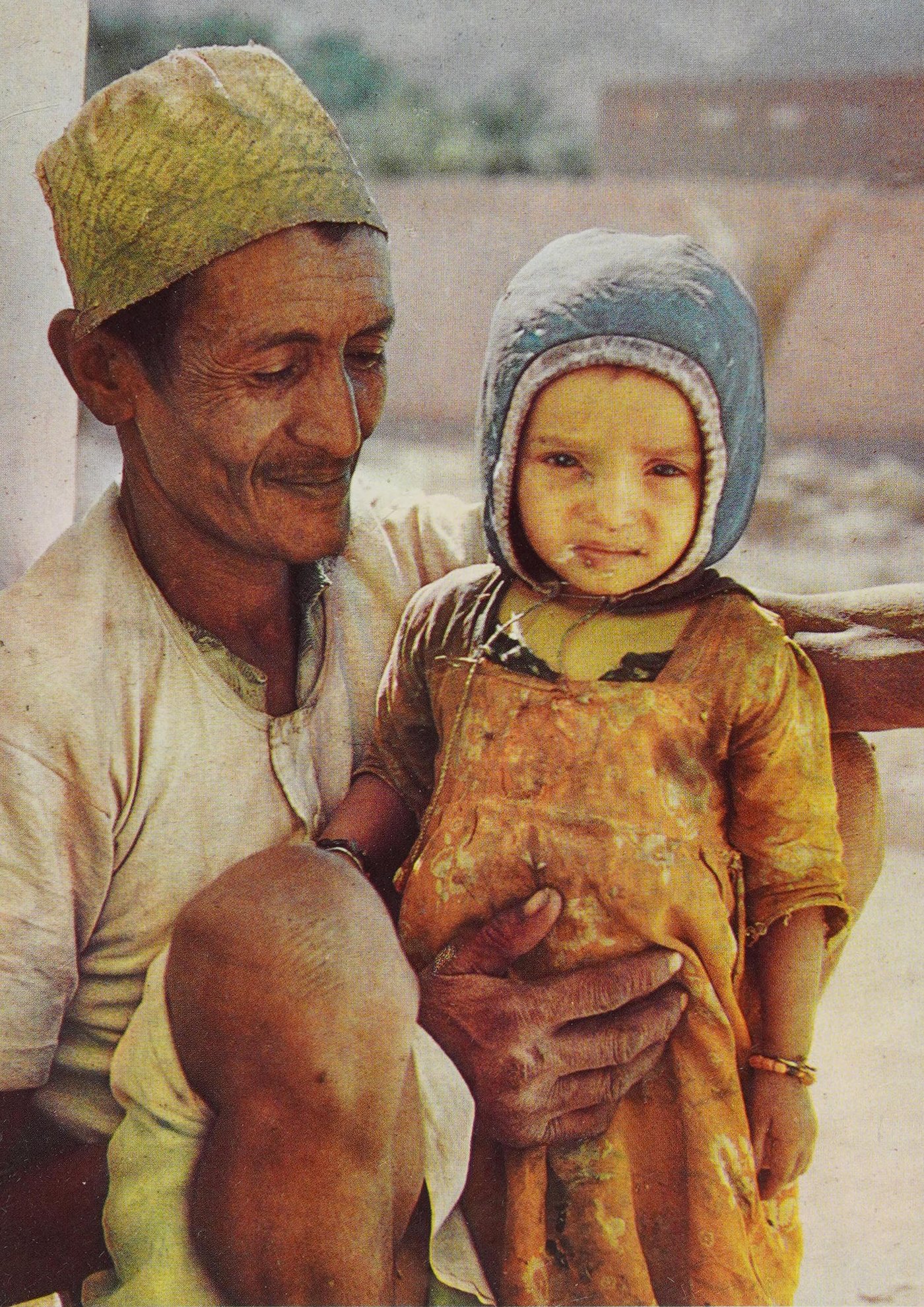
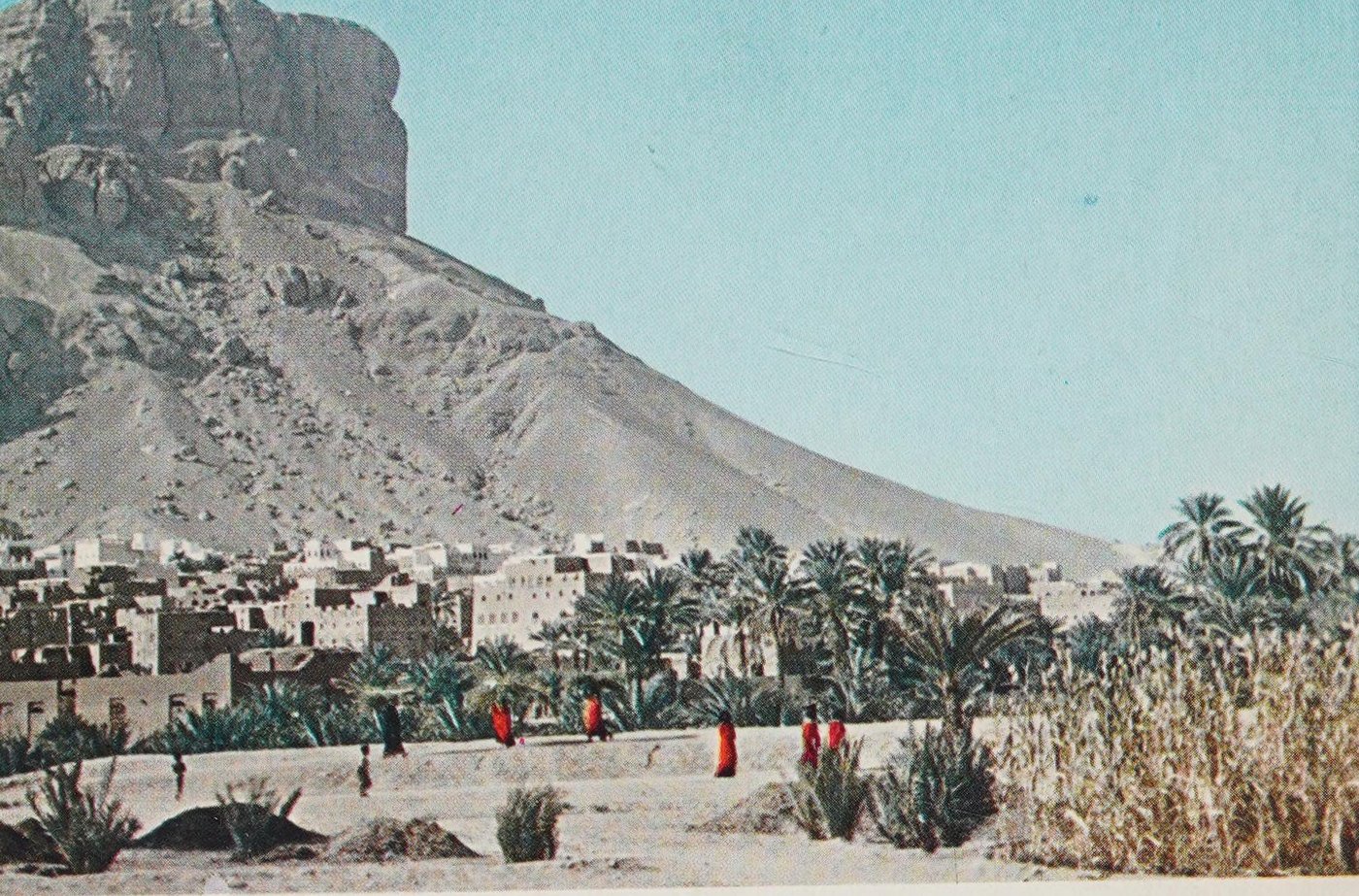
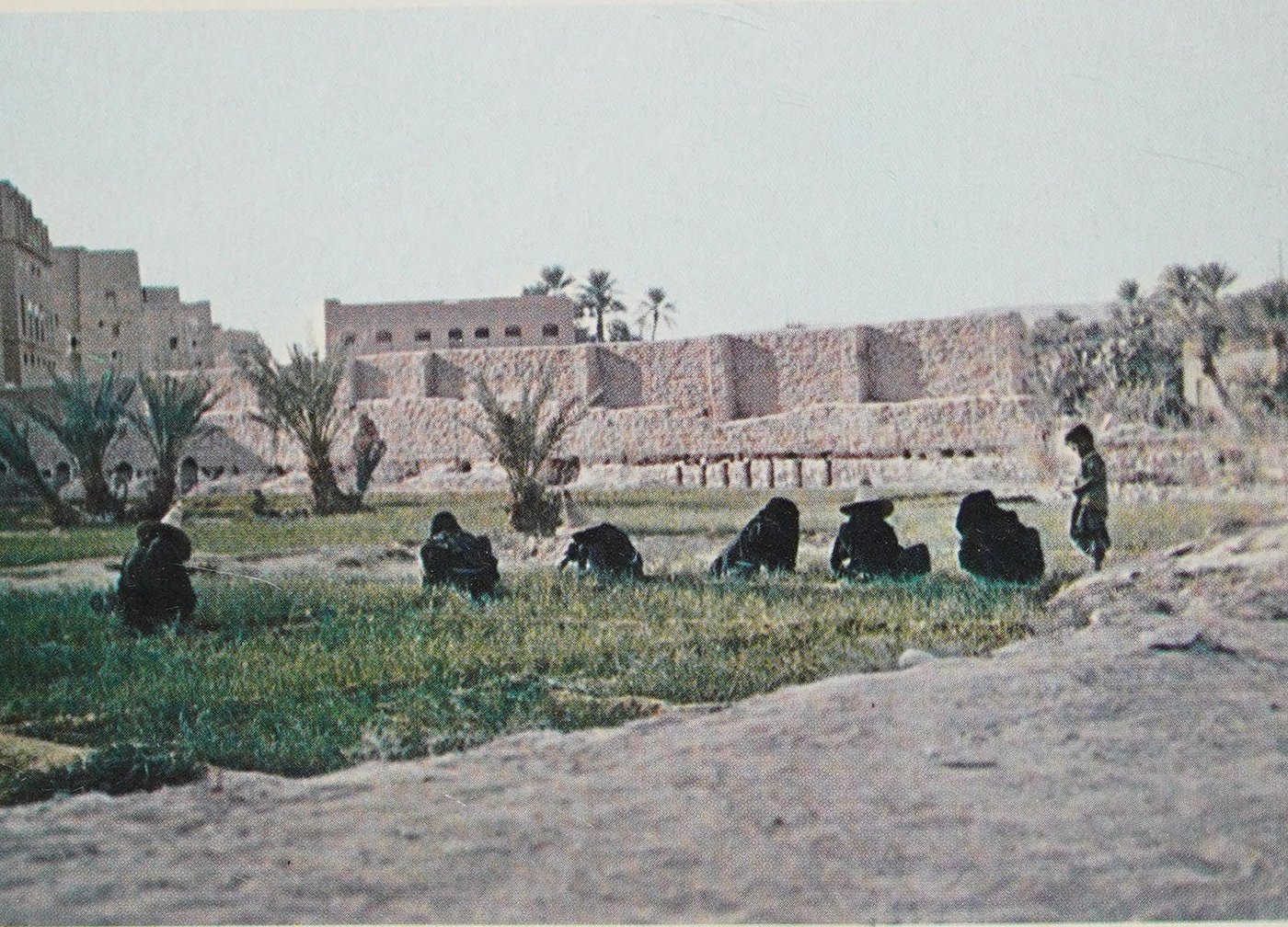
The day after, when Friis was telling me about the fate of Helge Hedendal, the Swedish well-digger, a desert storm had risen outside. Mrs Friis had immediately closed all the doors and windows and laid many pieces of cloth in the cracks, but it was impossible to keep the fine desert sand out. Soon it lay in thick layers on carpets, tables, and chairs, formed a sediment in our teacups, and crunched between our teeth when we ate the cakes that had been set out. When a sandstorm can have such effects indoors, what must it be like to be out in one? But while Friis was giving his account of Hedendal I took little notice of the sand which got into my ears and nose and beard and hair, I found the story so exciting. This is what Friis told me.
The forty-year-old Swedish well-digger Helge Hedendal arrived in Saudi Arabia in 1958 on a six-months’ contract to bore for water. But the six months had grown into two years, and in spite of a lot of effort he had still not succeeded in getting out of the country. For two years he had lived in the heart of Arabia, and each time he had tried to get away they had employed every trick to stop him. While working at the oases his permit had expired. He had been unable to raise money for the journey to Jedda in order to get it renewed, because everything he possessed had been retained by the authorities at Jedda. And no one sets out to walk through the desert all by himself unless he wants to commit suicide—in any case, there are hundreds of other ways both quicker and pleasanter.
For two years Hedendal had slaved for the Arabs in the region of Taif, where the shortage of water is almost catastrophic. To strike water at all it is necessary to bore through twenty-five feet of rock, often at the rate of two or three inches a day. Frequently the attempt fails, and after working through the rock one will have to begin all over again. In this trying district Hedendal had located a fair amount of water, but the Arabs were not content. They wanted yet more, and so refused to let him go.
In a way, his failure to find enough was a blessing in disguise, for otherwise he might no longer have been alive. Hedendal was an ‘infidel dog’ among fanatical desert Arabs, to whom his life would mean nothing the moment they considered his mission completed. These two years had been a misery to him. He had had to submit to all sorts of humiliations. He knew little Arabic, and if he raised any objections against his treatment they spat at him. He was not technically a slave, Friis said, but was certainly one in practice. What else was a man whom anyone could treat as he pleased, and who did not enjoy even the easier treatment of domestic slaves?
As Friis spoke, I wondered why Hedendal had not been rescued long ago. I know, however, that it is not easy for non-Moslems to gain admittance to the interior of Arabia, and that the Arab authorities present a hard wall of resistance if they feel their interests in any way threatened. The idea occurred to me that I might try to pass myself off as a Moslem, temporarily adopt the Moslem faith, and, thus prepared, go on into the desert and endeavour to help my distressed fellow-Scandinavian.
I mentioned the possibility to Friis, but he shook his head.
‘It takes from fourteen to eighteen months to become a Moslem,’ he said. ‘First you have to learn a lot of the Koran by heart, whether you understand it or not—and don’t forget you have to learn it in Arabic. You have to reel off a string of words at top speed. You also have to learn to say the prayers correctly and do the right knee-bendings at the right times, and that in itself isa long and troublesome process. Don’t run away with the idea that it’s easy. When you’ve announced your intention to adopt Islam, you’ll be spied on for at least eight months. There’ll be people to keep an eye on you day and night and report all they learn to the priestly police: what you do and how you practise your new religion. Unless you comply with the precepts to the full in that time you’ll never become a Moslem. Lars Eek didn’t.’
“Who’s Lars Eek?’
‘Don’t you know him? He’s another Swede. He’s lived here in Jedda for many years.’
‘Yet another Scandinavian in Jedda?”
“Yes. And you’d better have his story first, because it ties up with Hedendal’s. Lars Eek has been in Saudi Arabia getting on for ten years. He’s about sixty now. He’s the son of C. A. V. Eek, the Stockholm financier, and his mother was a daughter of a vague politician, Niels Victor Ekenman.
‘Soon after leaving college Eck inherited a large fortune from his grandfather, Frederik Eek. Lars then went to California, where after studying for thirteen years he became an assistant professor. He was a happy fellow who had great charm, but in the United States fate overtook him in the form of an American lady whom he married and had a son by. Later they were divorced and he married a Dutch woman, whom he also had a son by—and was divorced from.
‘Eek returned to Sweden, but left a large part of his fortune behind for his sons’ education, and they’ve both become prominent business men in the States. Back in Sweden Eek went into industry and lost a lot of money. He started his own factory for making producer-gas units for cars, but was too far ahead of his time; nobody would use them and he had to liquidate the business. Then came the war, and the people who had taken over his business made millions while he was on the verge of bankruptcy.
“But Eek isn’t the man to stand back,’ Friis went on. ‘After the war he started an import business, and when that didn’t succeed because of dollar restrictions he changed over to exports and got into a business which sold sanitary installations and prefabricated hospitals to Saudi Arabia. In Arabia there were such big problems that Eek had to come out himself, and again he had bad luck, when the Suez crisis broke out. But instead of giving up and going home again he started various other projects here: for a time he was a personnel manager, and he also worked in close association with a brother-in-law of Crown Prince Feisal. The Arab had found out that Eek was a linguist, and that he was imaginative, full of ideas, and able to get on with anybody.
“When in the end his luck turned, Eek started to raise money for various big undertakings; and in some cases he succeeded, for he’s no fool. But Lars Eek has one fault: he thinks the best of everybody, and that’s a weakness in any society and a disaster in Arabia. Eek walked in leading circles and associated privately with princes; and when these people came and asked for help he was too soft-hearted to say “No’’—now he must have millions to his credit.
‘In good fortune and in bad Eek is still the same elegant bon vivant. Even in bad times he dresses immaculately. His good manners and Swedish taste have not been spoilt by bad luck and bad times, and I suppose that’s one of the reasons why all of us, Europeans and Arabs alike, admire him. He strikes us as the personification of the “‘man of the world”; and on top of it all he’s extremely good-natured and exceptionally charming. It’s true he’s a bit over-optimistic; but that too has its charm, and you have to be an optimist to get on here at “Hell’s Gate”.
‘I mentioned before that he tried to become a Moslem,’ Friis went on, ‘and that he hadn’t succeeded yet. The fact is, he’s too intelligent! If you’re going to live here for many years you almost have to become a Moslem; and Eek had actually got himself a teacher, after making a thorough study of the Koran himself. But it so happened that whatever it was his teacher wanted him to believe the eloquent Swedish pupil would always argue about, and in the end he very nearly had the poor Moslem converted to the established Church of Sweden! At last the teacher got genuinely afraid for his salvation and dared not go to see Eek. So nothing has come of it all yet.
‘One of Eek’s many ideas was to form his own artesian company to supply water to the thirsting regions of Arabia. He and an Arab partner bought boring equipment in Sweden and had it sent to Saudi Arabia. At the same time they engaged a skilled Swedish well-digger. That was Helge Hedendal: a quiet, modest, rather trusting man who was content so long ashe could live without making himself a burden to other people. He had been married but was divorced, and his only financial commitment was the maintenance money he sent home every month. Hedendal wasn’t out to make big money—not at all: just enough to open a small service station or buy a good tobacconist’s when he returned to Sweden.
‘He was set to making borings in the region of the town of Taif, where Eek’s company had been commissioned to find water. Under the agreement, Hedendal was to have 1,800 rials a month during the six months of the contract. Now, Taif isn’t a place where you spend a lot of money, and so Hedendal had the arrangement that the bulk of his salary should be paid into an account in Jedda, the money to be transferred by a government office. The balance was to be sent to Sweden to his former wife. He was told that everything was in apple-pie order, and that the transfers were carried out regularly.
“When the term of the contract was about to expire, and he had become clear in his mind that he didn’t want to stay on in a godforsaken place like Taifa, he wrote to Jedda and asked the company—which Eek had now left—to send him enough money to enable him to hire people who would see him through the desert to Jedda.
‘He wrote one letter. He wrote two. No reply. He wrote a lot. But it was like shouting in the desert. The contract period had run out, but Hedendal had to go on boring—without a contract—so as to earn enough money to live.
‘As luck would have it, he had made the acquaintance of a Jordanian at Taif, and he got him to promise that he would look up Eek in Jedda. A year passed before the man arrived in Jedda. There Eek explained to him that Hedendal’s money had been invested ‘inthe boring company, which had since failed. However, Hedendal had a credit with the Ministry of Labour, and this Eek promised to try and get released.
‘So Hedendal had to go on boring. He was the only European in the town, and his work was persistently the object of embarrassing curiosity on the part of the desert Arabs. They looked upon him as a sort of popular entertainment, a strange animal at a zoo.But there was no sign which requested the public not to tease the animal. When they got too much of a nuisance and Hedendal tried to keep them at bay by shouts which, though they didn’t understand, they got the meaning of, they would spit at him; and Hedendal didn’t dare to spit back. It would have been all the worse for him. When they weren’t spitting at him they used to patronize him. At first he thought the biggest insult was when they would roll down their trousers in front of him and wash their behinds with water from his well—though there they were only following the commandment of the Moslem ritual.
‘And now a few more months have gone by,’ Friis concluded. “There have been no more messages from Hedendal. I suppose he’s lost heart and feels himself deserted—not without reason, either. He has only his borings to live for—and on! When a boring has succeeded, he can start on a new one somewhere else. Bore, bore... and stop thinking of life on the other side of the desert, of the world where once he was a free man.
‘Has he any chance of getting the money that’s owing to him?’ I asked.
‘It’s a small one,’ Friis said. “But you never can tell, in this country. Until he manages to get out of it, there’s no means of knowing whether he’ll be rolling in money, or the poorest man in the world.’
During the we cks spent at Jedda with the hospitable Friis family I heard many accounts of European women who had fallen for one of Arabia’s dark-skinned, black-eyed sheikhs, of how they had married him and gone with him to his distant homeland in the belief that for him, too, they were the great romance—and would continue to be. Here under the Oriental sky, ‘in the shade of waving palm-fronds and to the sound of murmuring fountains’, they would pass the rest of their lives in love and luxury!
All this is romancing. Scandinavians at Jedda can testify to it. This very day there is a young Swedish woman who lives in one of Arabia’s many harems. Her story is as tragic as can be, but contains a sad and healthy moral and should therefore be told.
Some years ago she met a handsome young Oriental, the son of a rich sheikh from the interior of Saudi Arabia. He had been sent to Europe for his education, and during his journey he also visited her country. In a well-known restaurant in the Swedish capital, one of those places where Stockholmers and their visitors go for a good time, he met one of the country’s pretty blondes. They danced and flirted; she fell genuinely in love with him, and when he asked her to be his wife she saw in him only the courteous, travelled, in every way desirable suitor and accepted. All the subsequent warnings were lost on her, she was so intoxicated with happiness. The great romance lay ahead...
The girl had many other admirers, among them a Swedish pilot who had been in the Near East and who urged her to give up the idea.
‘Keep off him,’ he said. ‘You’ll regret it for the rest of your life. It won t be long before he takes other wives—if he hasn’t got a few already—
A SWEDISH WOMAN IN AN ARABIAN HAREM IIl and whether he is personally fond of you or not, he’ll have to make you wear a veil whenever you’re allowed out of the harem. If only it had been a Saudi-Arabian business man from one of the towns you were marrying—but a sheikh is a man who lives in the desert and has to follow the customs of the desert. He’ll never be able to make do with one wife; and as regards that which is the only task of an Arab woman, you could never hold your own with the Arab girls, even if you were to spend years studying sex. Remember that the Arab woman is trained from childhood to please men. She has no other function.’
But in vain. All this was said by a young man who was, of course, in love with her; she saw him trying to advance his own interests and was firmly resolved. She was twenty-one when she accompanied her Arab husband to his homeland. That was in 1953. Now she is the mother of a six-year-old son—and hopelessly unhappy.
A few years later when travelling with her husband and two other wives he had taken in the meantime, she met at an hotel, strange to say, the same Swedish pilot who had warned her. She was veiled, but managed to make herself known and told him, in tears, that he had been right.
‘Tm at my wits’ end,’ she said. ‘I don’t know what to do. I’m treated like an animal, and it will probably get worse. This is my last visit to Beirut. We’re moving into the desert, and my husband says he’s going to take two more wives—he already has two besides me, and so he’ll have to get rid of me.’ (The Koran forbids a Moslem to have more than four wives.) ‘I shall become just a servant and slave to his other wives.’
“Why don’t you try to see the Swedish consul here? He might be able to get you back to Sweden. I’ll try to help you.’
T can’t. I can’t leave my little boy. That would be even worse.’
The young woman is lost. Her one consolation is that she has a son. That may make her future a little more tolerable. Though she has to go with her husband into the desert, though she is regarded as a sort of slave in the house, and though sexually she cannot compete with the sheikh’s new wives, she is, as a Scandinavian, of an altogether different, more self-dependent type. And already at the age of seven or eight the boy will begin to have power and influence in the house. He is the eldest of the sheikh’s sons, and the position of the first-born is exceedingly strong in an Arab family. None honours his son more highly than a Saudi Arabian father, and none honours his mother more highly than a Saudi Arabian youth. There is thus reason to believe that the son will look well after his Swedish mother when he grows old enough, and will do what he can to make her life tolerable. She can never hope to regain her liberty, but she may be much better off with her son than with her husband.
The fate of the Swedish woman is not unique. True, recent years have seen an improvement in the conditions of married women, in that modern, educated Arabs in the large coastal towns, and at any rate most of those who are in the public services, lead a married life on western lines. For example, there are two other Swedish women who are married to Saudi Arabians and appear to live happily, one at Jedda and one with an Arab diplomatic mission to Iraq.
It must be said that men in high office could have a more edifying example than their ruler, King Ibn Saud.
As I have said, the Koran allows the faithful only four wives, but they may keep as many concubines as they can afford. King Ibn Saud can afford the most amazing things: they say that he becomes a father every other week and has two secretaries who are fully employed keeping an account of his marriages and divorces and children. To get divorced costs only a few words. A man who wants to be rid of one of his wives has only to go outside his house, turn his gaze to the sky, and shout three times that he no longer desires to be married to this or that Morgiane or Zuleima. When that is done he can without more ado turn her out—or, if he is merciful, keep her as a concubine or domestic. It is alleged that King Ibn Saud marries anew girl almost daily—and the next morning gets divorced from her so that he can have a fresh one the following night. The castoffs are looked after, because a few weeks, or months, later the king might want to marry them again—for a night. A careful record is kept of those who have shared the king’s marriage bed, and fingers are counted to see whether he could be the father of children born to his former wives.
Once King Saud visited Jedda. The visit lasted.only three or four hours, yet in that time he succeeded in marrying and divorcing a sixteen-yearold girl. He has been in the town several times since, and has married and divorced the same girl each time. So he is not altogether faithless! If she becomes pregnant she may even have the honour of going to Riyad, the royal residence, and being installed in one of the king’s harems.
An Arab woman has practically no say in her own home. She has nothing to do with the cooking, and need not concern herself about cleaning. The house slaves see to that. Normally, she is not even permitted to pass the time on needlework. No respectable Arab wife can go shopping in the market. She may not walk by herself in the streets, even. though veiled.
The chief interest in the lives of Arab women is their mutual association, with its chatting and gossiping. As they do not’ read newspapers, reports by word of mouth, whether true or untrue, are of extreme importance to them. The sedentary life explains why they grow plump at a rather early age, but this is not, by Arab standards of beauty, an absolute misfortune.
Asa tule, the veil is left off only in the harem; though on rare occasions an Arab woman will be allowed to show her face when she visits her husband’s European friends. Traditional Arab social life affords the women little opportunity to break out of their isolation. On arrival at a party, the guests immediately divide according to sex, the men occupying the best room in the house, while their wives will repair—heavily veiled—to one that is reserved for them. There they seem to enjoy themselves quite well, Arab women generally being lively and talkative. On the rare occasions a Western woman is present, there will be no end to the excitement, and she will be the sensation of the season. It is typical that the women will try, in every way uncritically, to copy her manners: should she eat chipped potatoes with her fingers, then they will all lay down their forks and do likewise, and from then on that will be regarded as the proper thing to do. If the lady happens to lick her knife—or, shall we say, throw her cake out of the window—they will quietly follow her example.
It must be said that women in advanced circles have acquired rather more experience of the world in the course of the last ten years or so, and that the Government is doing something for their ‘under-development’. For example, in 1957 compulsory education was extended to women—though only up to the age of twelve. From then on it is a private affair and all education comes to an end unless the parents are both wise and rich enough to engage a private tutor, or send their daughters to a school like Kamal Nouri’s.
When an Arab man meets a Westerner he will invariably ask him what he paid for his wife; and when the Westerner replies that he paid nothing, he disgraces not only himself but even more his wife, because if he got her for nothing she cannot be very good. In Arabia a man of honour pays fairly and squarely for each wife he acquires. But there are differences in the prices that he pays. A black woman (a Sudanese, say) costs from thirty-five to five hundred pounds. A Saudi Arabian girl, on the other hand, may well cost a thousand. Saudi Arabians are patriots—in love as in other respects.
When an Arab marries he gives a great feast. An enormous, gaily coloured marquee is erected, for a vast number of guests are invited and there is entertainment all evening by singers and actors. The food is plentiful, the courses many. Late in the evening two men will appear,
H each carrying a sign. One sign states how much has been paid for the girl: though the bridegroom may sometimes (by arrangement with the bride’s parents) display double the sum he has actually paid, so as not to convey the impression that his wife is‘cheap’. The other sign indicates how much the two families—bride’s and bridegroom’s—have given the young people in marriage portions. There is a tendency, it is said, to exaggerate these figures too. The fact that the appearance of these signs is regarded by many as the highlight of the feast is typical of the generally earth-bound Arab view of holy wedlock.
It is the great dream of many a poor Arab labourer to save up for a wife, but often the dream is hopeless. It is exorbitantly expensive to hold a wedding in this country; and as all unauthorized intercourse with the opposite sex incurs heavy penalties, this may be one cause of the widespread homosexuality.
Close to where I lived, just by the entrance to the sukh, there was a Coca-Cola shop. It had recently changed hands, the former owner having landed in gaol as the result of a rather embarrassing affair. One day his eye had fallen on a good-looking youth of sixteen who stood idling near his shop. It must be a lot cheaper to live with somebody like him than with a wife, he had thought; it would save a marriage portion, and at the same time there would be some help in the shop. The two agreed, and went to the local scribe in order to get a written contract made out. They then lived happily until the end of the month, when the Coca-Cola man’s eye was caught by another young man, and he turned his attention to him.
His first friend was infuriated at this turn of events, and going straight to the police said: ‘My husband is unfaithful. Here’s our contract, and he’s shamefully broken it.’
In his indignation he had forgotten—or perhaps had never known—that though homosexuality is quite legal in Saudi Arabia, it is so only as long as it remains a private affair. Now a formal complaint had been lodged, and the police were forced to intervene. The informant and his rival got off;but the Coca~Cola man was put behind bars. Daily for several weeks he endured ten lashes of the whip—always just before the noon prayer, so that his soul might be cleansed and prepared for a silent period with Allah...
It is alleged that the two remaining young men went amicably to the scribe and had a new contract drawn up. But that may be untrue.
The king of Jedda’s gangsters is Salem bin Omar. He was the man to whom my Hungarian friend had first referred me—the man who would easily obtain for me all the information I needed about ‘the male white slave in the desert’, if it suited him.
In a country like Saudi Arabia where bribery and other shady methods are essential to success in business, a local Al Capone has rich possibilities. Just as Al Capone controlled the sale of spirits in important parts of the United States during Prohibition by bribery and murder, in the same way Salem bin Omar through his lawless activities gained control of a large proportion of Saudi Arabia’s—legal or illegal—imports.
Now one must beware of accusing this Arab Al Capone openly (the name I have given him in this chapter, incidentally, is fictitious). Were one to do so, one would have to reckon with the same fate that befell many of those who accused Al Capone of leading a crime trust. It is well known that Al Capone played his cards so skilfully that it was impossible for the authorities to pin him down to a single one of the gross crimes he was justly suspected of. The only way they were able to get at him was to establish some irregularities in his accounts, so that he could be convicted of tax evasion. Very conveniently for law and order in the United States, Capone was to die in gaol while serving his sentence of twelve years, only nine of which he survived. So far, Salem has been as shrewd a general as his American prototype: the authorities have never been able to prove that he has engaged in anything unlawful. On the contrary, he is outwardly a highly respected citizen, known for his great charity to the poor. Sentimentalists might liken him to Robin Hood, who took from the rich in order to give to the poor.
Salem bin Omar was born at Karachi and so is a Pakistani. During his life he has attended school for six months all told. He can neither read nor write, but for all that he has not done at all badly. Asa boy he ran about the port of Karachi and earned his living by carrying ship passengers’ baggage, running errands for sailors, and selling cigarettes, chewing-gum, and sweets. He cannot remember, he says, having ever eaten a sweet himself. At fourteen he signed on a dhow as cook; but cooking must have been one of the few things he was not good at, for he was put ashore without any pay when the ship touched at Jedda. At the same time, he had applied his business talent on board the ship to selling cigarettes, bought cheaply in various ports, at an exorbitant price, the crew being willing to pay when plagued by hunger for tobacco.
In Jedda he became an orange seller, earning quite good money, and later he worked his passage back to Karachi on another ship. The connections he established in the ports en rouze formed the basis of a small business which he set up in his home town.
At twenty he married an Egyptian girl who bore him seven children, all of whom died soon after birth. When nearly thirty he moved back to Jedda, because of the large business possibilities in that town. His wife he left behind in Pakistan, but every year he has gone across to her—or she to him—so that they have been able to cultivate the joys of family life for a few months. Eight years ago his dearly beloved Faryal was born, and at the same time fortune began to smile on Salem in earnest. Money poured in to him; each time it was little Faryal’s birthday he was able to make her the proud present of 1,000 pounds sterling, and also to give a party which cost him at least as much. But one day, they say, his wife interfered and said: “Why don’t you spend your money more sensibly?”
This gave Salem food for thought, and he resolved, in gratitude for having been allowed to keep his little Faryal, aswell as out of veneration for his country, to build a school in Pakistan. It was named after Faryal, and Salem pays all the costs of maintaining it. When Faryal grew big enough she herself attended the school. Besides the ordinary teachers, she has two private tutors and an English governess at her physical and spiritual service.
At the school Faryal is treated like other children; but her father has impressed upon her that she should honour him and the school which bears her name by always being top of her class. This her teachers religiously see to—but possibly they dare do nothing else. Meanwhile her illiterate father is hundreds of miles away, scraping more and more money together—and longing for his family in distant’ Pakistan.
My Hungarian friend had given me an introduction to Salem, and I called on him with the underhand intention of winning his favour and securing his help in this country where he was alleged to have so much underhand influence. Perhaps I should need both when getting my films through the Customs. It might also be very interesting to form a personal impression of a man who presented such an unusual blend of family feeling and villainy. But I decided not to ask his advice about Hedendal; the more so since the information Friis had given me about the unfortunate Swede might be enough for the time being.
I had been allowed to visit Salem in one of his large villas. Like other big establishments it was surrounded by a high wall, which in Salem’s case undoubtedly served defensive purposes. I rang the bell, but as usual it was a little while before there was any response. I had the feeling that I was being closely watched, but was not at all surprised. It is quite normal for there to be a number of peepholes in such walls, so that the visitor may be inspected before being admitted. After a couple of minutes the heavy door swung very slowly open. I could go in, the boy said. His master was expecting me.
Salem was sitting in his courtyard in the shade of a large oleander. He was wearing a pair of filthy trousers and a loud yellow shirt, unbuttoned, rumpled, and dirty. On his head was a fez of indeterminate colour. The chair he was sitting on was three-legged and high-backed, and suggested a throne. Here this monarch of the underworld received his information, and from here he gave out his orders to all the people who came and went while I was there. I was reminded of Odin and his ravens; Salem’s ravens are all the agents who keep him constantly informed of what goes on in the country.
He apologized for not having personally received me at the gate. The reason, he explained, was that he was not very well just then. I readily believed him because his eyes shone feverishly, though that might have been their natural appearance. With such eyes in an almost round, badly shaven face he did not exactly impress me with his beauty. He was rather small. On his feet he wore a pair of Oriental sandals, and I noticed that his toe-nails were remarkably yellow, as if carved out of cow-horn.
Round him romped two cocker spaniels which he had imported from Hamburg. They were little more than pups, and each of them had its own boy, so that it could be very carefully looked after. The eyes of one of the dogs looked as sickly as its master’s, and one of the boys was putting drops of boiled water in it and smearing it with ointment. For the rest, the boys were busy during my visit in brushing the dogs, but had not yet got the knack of it, for usually they brushed against the hairs, a treat-ment to which the pups submitted with angelic patience.
Salem politely asked how I was and expressed his pleasure that a foreign photographer and author had wished to meet him. It was a great honour to him, he said. While Coca-Cola and cigarettes were served, and afterwards tea with goat’s milk, he asked me to tell him my errand in Saudi Arabia, which I also did, though carefully omitting anything that had to do with the slave trade. I suspected that Salem had some shares in that lucrative business. While I talked, Salem found time to dictate four telegrams: two to New York—arranging a forthcoming visit—one to Paris, and one to Hamburg inquiring about the best cure for running eyes in cocker spaniels. In addition he received messages from three Arabs who arrived breathless at his throne and in whispering excited voices brought him particularly important news. Salem himself was cool and controlled: the great strategist who listened patiently to everybody and then disposed his people and made his decisions ashe thought fit.
He also had time—apparently—to listen to me, while occasionally interjecting a question or comment in reasonably good English. At a discreet sign a servant refilled my teacup and held out a dish of biscuits. Salem took a few himself, and when he had finished munching them held his hands behind his head. A servant stood ready to wipe his fingers with a moist cloth. He had only to hold out his right hand and his hookah was put into it. And when his wrist watch bothered him he took it off, held it over his shoulder, and dropped it—a servant was ready to catch it before it reached the ground.
Occasionally Salem excused himself. There was a small item of business to settle—and I remembered that people had told me that Salem’s ‘small items of business’ represented sums of at least five thousand pounds each, lower price levels being beneath his notice. When there was a pause in the business transactions and the stream of comers and goers he took over the conversation entirely. It became almost a monologue; and, stimulated by the compliments I politely interposed when he took a draw at his hookah, he began to tell me about his family.
‘To tell the truth, I long for my wife and daughter. They only come to stay with me three months in the year, during the holidays when the school at Karachi is closed. I’m sick to death with longing when they’ve left again.’
‘Can’t you have them living here?’
‘In this country? My wife and daughter shall never live in a Saudi house. I know too much of how things go on in this town. Think of the Arab woman’s status. Think of our harems...’
True, he had no doubt special qualifications for knowing those. Salem had stopped. Perhaps he was afraid he would give something away about his role as a procurer of women for the various harems. Then he went on:
‘I don’t want my daughter, when the time comes, to marry a Saudi Arabian. She shall grow up in Pakistan.’
Salem was unwilling to talk of what he actually traded in. When I asked him if it was true that he was a multi-millionaire, he confined himself to saying:
‘No, Pm not a rich man. If 1 was, the dust of this country would long since have been shaken off my feet.’
And he went on to talk of his little girl. On her last visit, he said, he had taken her to see King Ibn Saud at Riyad, and he related a little incident which gave him great amusement.
“Why do people kiss his hand, Father,’ the little girl had asked in Pakistani.
King Ibn Saud had turned to Salem and asked: “What did the little girl ask?’
Salem, somewhat confused, had replied: ‘My daughter said that she thought Your Majesty was a good king.’
‘No, Father,’ the little girl had then said in Arabic. ‘I don’t know anything about that, but I think it’s rather dirty to kiss his hand. We don’t do that in Pakistan.’
‘There you see,’ Salem said exultantly, “eight years old and already a sense of hygiene!’
Salem had no great respect for the Arabs, not as regards trade at any rate. ‘They squander money,’ he said: ‘throw it about as if it were pebbles. Is that culture? I sit something to be proud of? They’ve been lucky, yes; but when the oil’s finished, what then? Camel dung!’
Nor did he enthuse over the Americans, whom he disparagingly referred to as ‘those fat individuals’ (though he himself had nothing to boast about in that respect). On the other hand, he was rather enthusiastic about the British. “They’re proud people,’ he said; ‘and if you’re good and do good, you can afford to be proud.’
The French were also proud, he said—very proud. But there was this difference—they had nothing to be proud about.
Twenty years ago Salem went about selling oranges himself. Today he imports cheap fruit from the Sudan and sells it again at a profit of between three hundred and a thousand per cent. That is only one of the trades he engages in. He owns three large villas in the town, almost palatially furnished; but on everyday occasions you are most certain of finding him in a dirty little shop in one of the streets of the bazaar. It was to be considered a special mark of favour that I had been invited to visit him in this villa. In the shop in the bazaar his favourite place is a sofa he had bought eighteen years before. Every morning it is filled with coins and notes. These are not the previous day’s takings, but money brought in from his ‘treasury’. In the crowd visiting him at the shop are many beggars, among them young girls. The men receive perhaps half a rial, a girl perhaps ten or twenty rials; and if the girl happens to be suitably goodlooking, malicious tongues say a large bundle of notes will be thrust into her hand and it will be indicated to her by a nod that she can go upstairs, where shortly afterwards he will come and talk over with her what more he can do for her.
Jedda’s proletariat think that Salem is an exceedingly good man, and will never allow anyone to hurt a hair of his head.
In his shop there is also a desk where he transacts some of his business. Many Saudi Arabian officials and businessmen have an extra drawer in the side of their desks facing the visitor, intended for depositing the traditional bribes. Though Salem’s desk also has such a drawer, in his case it is more or less a matter of form. It is not of very much interest to him, as his transactions are on an altogether different scale. Big business!
It was reported that two years before Salem had bought a whole shipload of rice from Siam; under the contract it was to be paid for in cash on delivery. The ship arrived, the rice was discharged, and the moment had come for the buyer to inspect the consignment and pay up. Salem appeared, examined the quality—and declared the rice uneatable (though it was first-rate). Now the law says that goods once imported cannot be returned; and when Salem flatly refused to pay, the case got so involved that the Siamese consul had to intervene. But Salem had only to mobilize a couple of his spies in order to find out that a few years before there had been certain irregularities in the conduct of the Siamese consul. He managed to find people who were prepared, for a consideration, to witness against him. The same afternoon the Siamese consul landed in gaol. Meanwhile, the Siamese exporter concluded that it would be better to let Salem have the rice at half price than that it should rot on the quay at Jedda. The cheap price at which the rice was imported did not benefit the consumers, of course, for Salem was able to point out—and profit from the fact—that Siam thereafter tightened up her exports to Saudi Arabia—thus sending prices up again.
No wonder Salem still has plenty of money to share with the poor, and with which to recruit spies. When informed that someone has got into financial difficulties he will give a thoughtful nod, but will rarely strike at once. It is better to wait. Only when the’man concerned ventures on a speculation with implications which he cannot have foreseen, only then does the hammer fall, and doubly hard—unless Salem is given an ample fee to let the other off ‘lightly’.
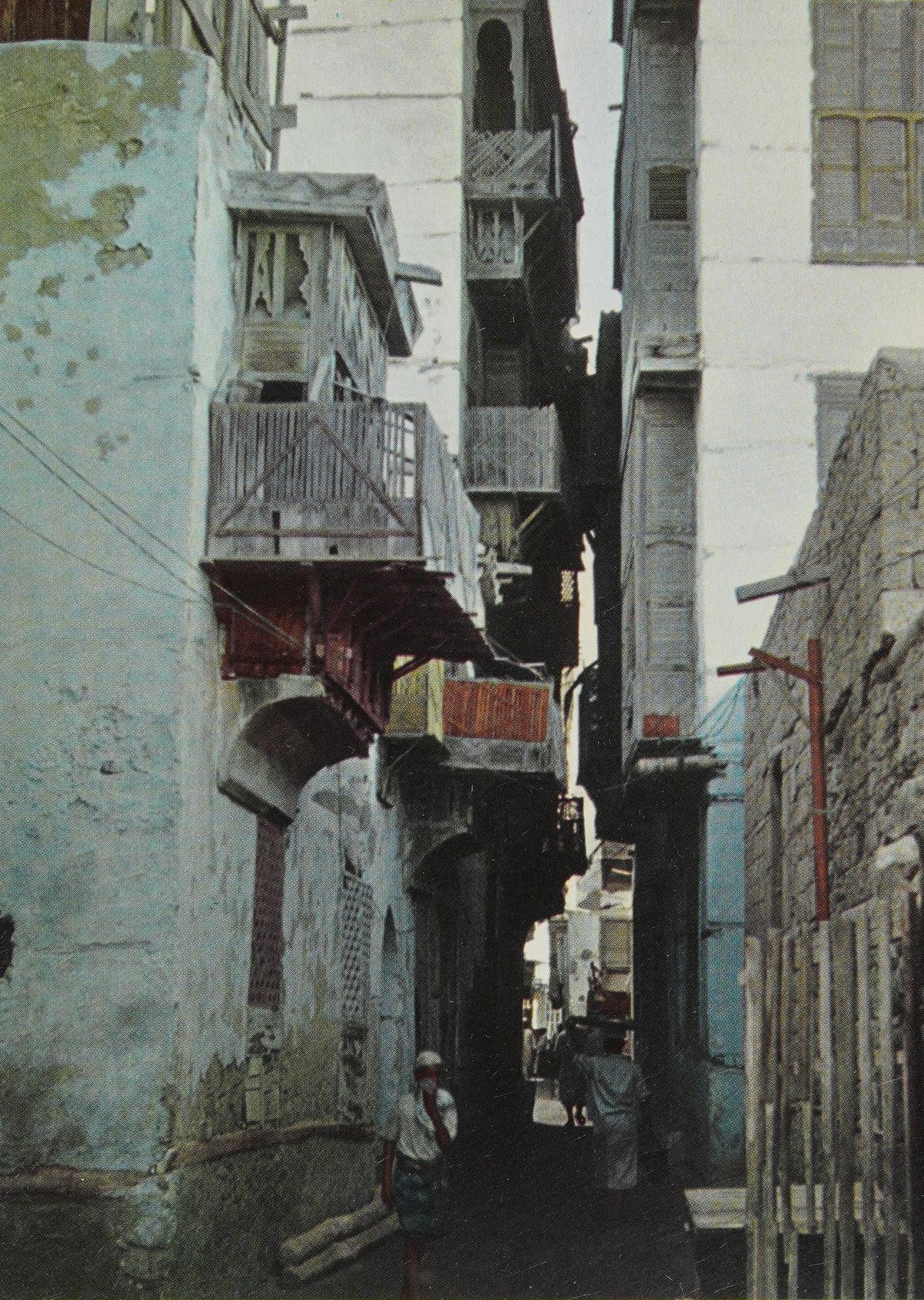
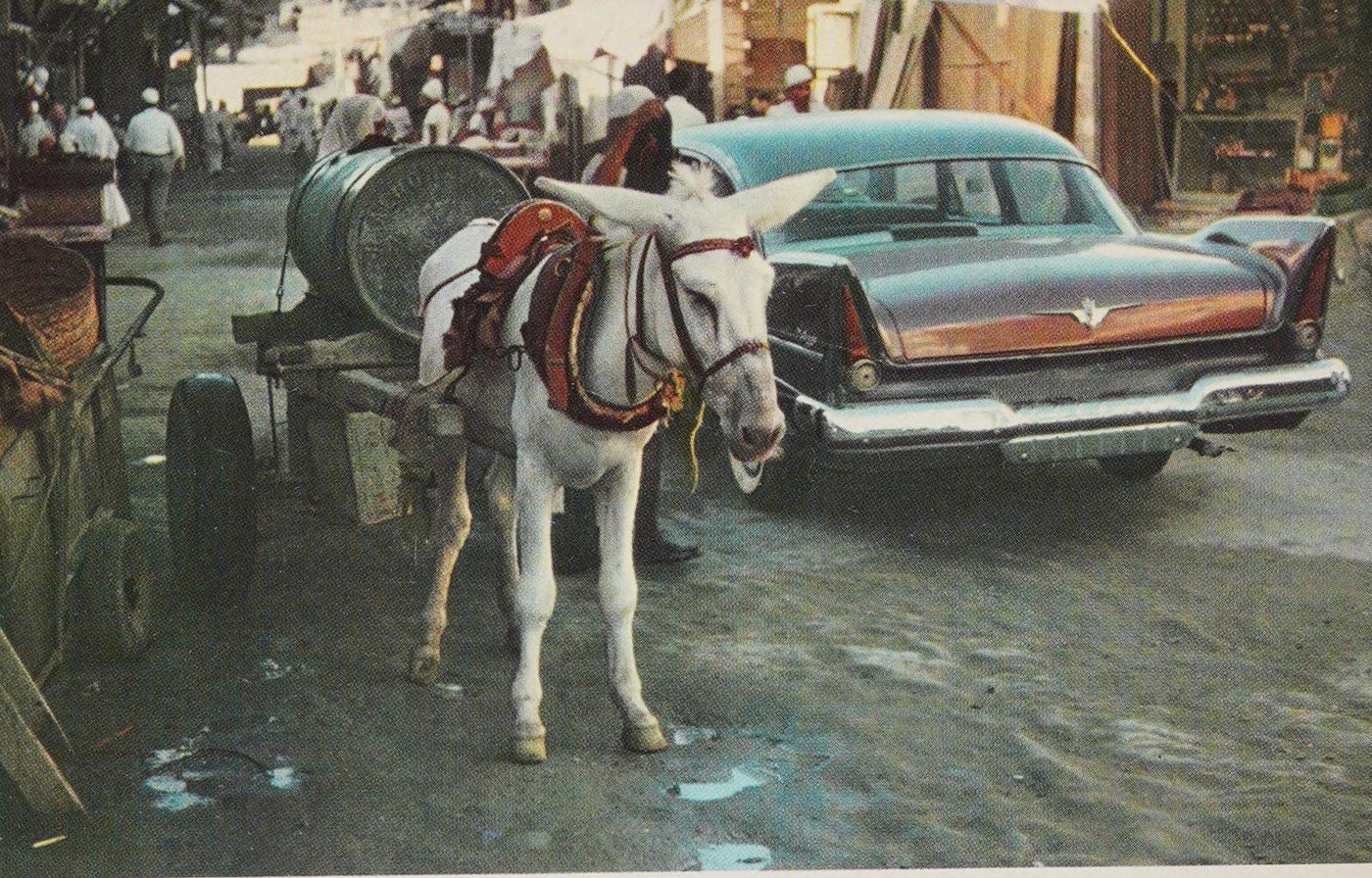
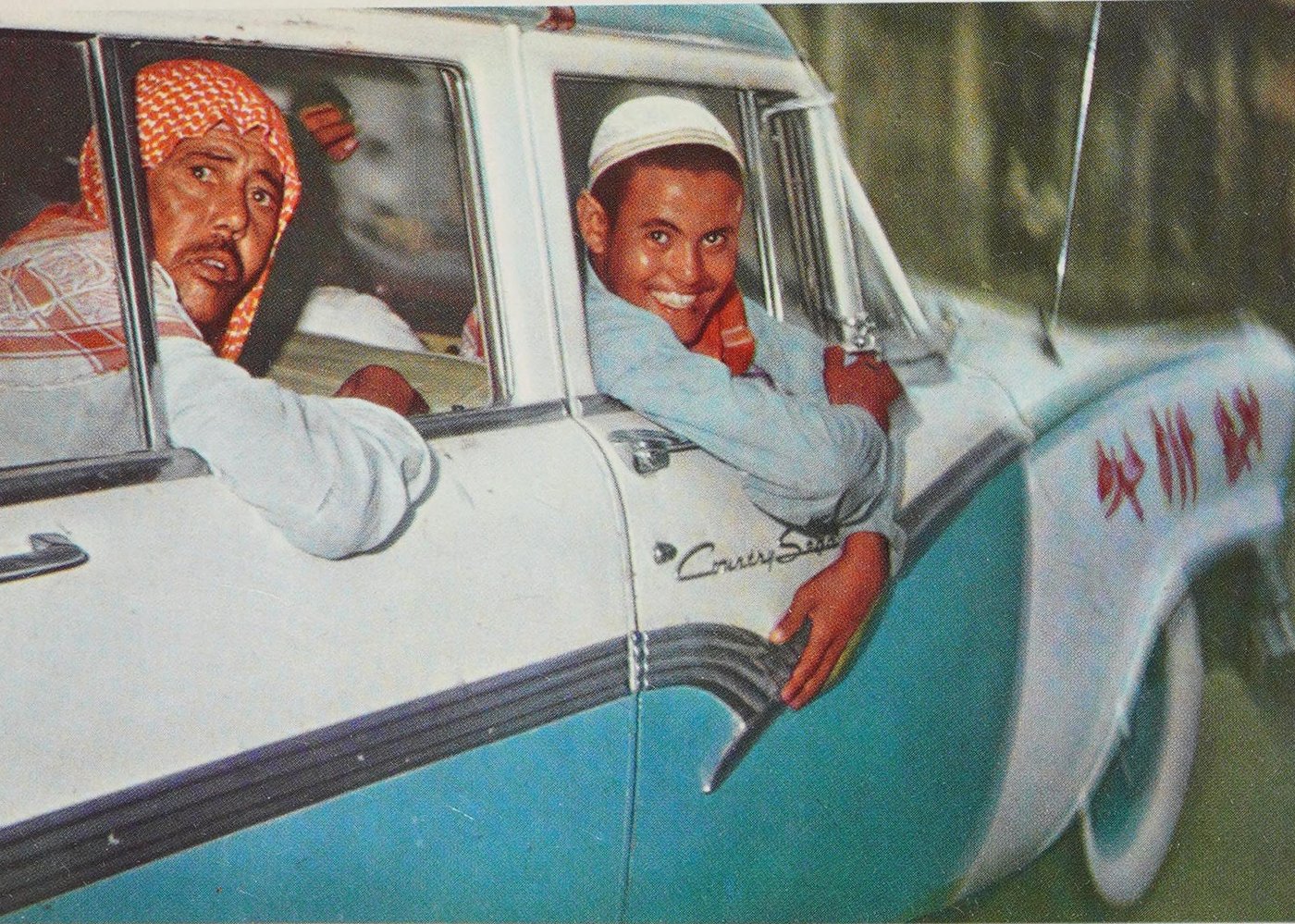
It is not out of simple charity that Salem gives money to beggars. Many of those whom he helps will in the future be willing to supply him with the numerous bits of information which together may complete the pattern of the web in which Salem is the spider.
As Salem sat there facing me in the courtyard I was a prey to changing sentiments. I had been told that the people who constantly came and went were pawns in his game. There were small, relatively inoffensive ‘agents’ among them, but there were also stooges of a more ruthless kind who would not shrink from murder if Salem should require it.
He has a pronounced poker face. There is no telling what goes on behind his smiling mask; his expression would be the same whether he were arranging a gift of charity to a poor widow, doing a deal of 100,000 rials, or ordering the murder of a man who stood in his way—between two cups of tea. Salem’s pale-blue eyes look so friendly that one almost believes in his amiability and is ready to suppose that the stories told about him must be lies and inventions on the part of envious rivals.
Salem seems to be an astonishing combination of criminal and idealist—idealist in the case of the school which he has created, and which benefits many of his countrymen. Perhaps this idealism isanaive expression of his paternal pride—when he speaks of his little daughter his eyes light up with pride—or perhaps he is seeking remittance for his sins? I can understand many people letting him bluff them. He is a mystery to me, too.
His amiability knew no limits when at length I took my leave. He assured me that if I ran into any trouble while in the country I was not to rely on any Saudi Arabian but to go to him! He would do anything for me: procure transport for me through the desert, Government permits of any kind, whisky, a little girl for my pleasure. Anything...
When I returned to Friis after my visit, I told him where I had been and that Salem had offered to help me. At this news Friis jumped up from the sofa where he had been nursing his lumbago. The generally so cool-headed Jutlander was quite beside himself.
‘Salem! Salem! You don’t mean to say you’ve told him you’re going to write about slavery in your book, or that you’re going off to get Hedendal free?’
I reassured him.
‘If you had done, you’d be the most starry-eyed tripper that ever was. It’s Salem who runs most of the sales: black girls, white girls, all the girls he can lay his hands on.
‘As a matter of fact,’ Friis went on, ‘Salem has actually helped me many a time, but that’s because he’s interested in refrigerating and wants a finger in the pie when the fish-canning industry gets going. He needs me. He once got me out of the soup when my visa expired. But afterwards he sent me a bill for 5,000 rials. I might have managed on my own for half that by bribing an official, but I was brainless enough to accept Salem’s help.
‘If you meet him again, don’t for Heaven’s sake mention the word “slave”. You might just as well sign your own death warrant.’
It was Friday, the Moslem holiday, and the occasion for carrying out corporal punishments in the town square, in full view of the inquisitive public who on that day have plenty of time to be edified by the show.
I had expressed a wish to see whether the barbarity reached such heights as was alleged, and Olaf Friis had offered to take me to the big square in Jedda where the punishments were administered. Mrs Friis had never witnessed it before and insisted on going with us. Her husband’s objections were of no avail; surely it was not all that bad, she said; and anyway she was a grown woman, who wanted to know what went on in the town where she had lived for so long.
‘Have it your own way, Friis said. “But remember that you asked for it if you’re taken bad.’
We arrived at the square about half-past twelve and forced our way through the large crowd of expectant onlookers who had already taken up their positions. There were six prisoners for the lash that day. Most of them were flogged once a week. They seemed to have got used to it, people said, for it was extremely rare for them to utter a murmur during their ordeal. If the convicted man, or one of his friends, could have afforded to bribe the flogger the blows would not have been so hard. On the other hand, the chastisement must not be so lenient as to give offence to the spectators; should that happen, the flogger would have to put more force into his arm so as not to bring justice into bad odour. Incidentally, it is said that these lashes are considerably more gentle than those given by the police when interrogating, even though the person concerned may be suspected of only having stolen an egg. The whip used in such interrogations is devised with such refinement that doctors who have seen it allege that seven strokes of it would make a saint plead guilty of infanticide.
The gendarmes had now dragged the first of the six waiting prisoners out into a cleared area in the middle of the square; there he was flung on the ground, and soon the lashes were swishing on to his body. The flogger tackled the job systematically. Beginning by directing the lash on the victim’s shoulder-blades, he moved it slowly down towards the loins and then just as methodically up towards the shoulders again. The victim did not utter a sound, and when the castigator had administered the due number of lashes the man rose and went, quietly though weakly, and sat down on the bench with the rest.
They were tough customers, those Arab prisoners. Even while a fellow-prisoner was being flogged, they sat talking together without betraying by the slightest sign that they would shortly be undergoing the same treatment.
When the six floggings were over, we naively assumed that it was all over for the day and were about to go home. But we were mistaken. The most horrible part was to come.
Suddenly a gendarme appeared with a little trembling man beside him, dressed in black. At their heels marched two soldiers. The man had been convicted of theft, and for this crime there is in Arabia—according to the letter of the Koran—only one punishment. The thief has his right hand cut off, a penalty he incurs whether he steals a few rials or a million. If he is caught thieving again he loses his left hand, and should he be convicted of the same offence a third time he has to part with both his feet. The last provision is mainly of theoretical interest. Even Arab thieves find it hard to do a good job of work without their hands.
When we realized what was was coming we would rather have fled, but we were in the middle of a large crowd and nobody felt inclined to budge one inch for our sakes. Almost paralysed we saw the black-clad figure forced to his knees, whereupon a cord was tied round a finger of his right hand. One of the soldiers then gave a sharp tug at the cord, pulling the man flat on his face. While the cord was kept taut, the other soldier ensured that the man lay where he had fallen; and then the executioner appeared, holding a sharp knife not much bigger than an ordinary table knife but with a very broad blade.
The prisoner’s hand was hardly cut but rather filed off. I have no idea how long it took. I had lost all count of time. The prisoner’s moaning and screaming seemed to last an eternity, but when that eternity was over one of the soldiers stood with the condemned man’s hand dangling at the end of the cord. The hand was then hung up on a beam as a warning and an example, and remained there for some hours. Severed hands are only removed at six in the evening.
When the hand had been filed off, the wretch’s stump was dipped in boiling oil and he was taken to hospital. This last was only because we happened to be in a ‘civilized’ town. In the interior the culprits are left to their own resources and many bleed to death. In the ‘civilized’ towns they also give the victim an injection against tetanus—another of the things which distinguish ‘pioneer’ centres from the backward areas.
‘Oh, let’s go,’ Mrs Friis whispered at my side. There was nothing I wanted to do more, and we finally managed to elbow our way out of the throng. But nobody else seemed to want to gohome yet. They had not had enough. They were hoping for more blood. From the square we entered aside street. Then Mrs Friis could no longer help herself. She was sick by a house wall...
When the punishment for simple theft issobestial, what happens to a man who commits a serious crime? Murder, for example?
He can consider himself lucky if it‘only’costs him his head. The sword normally employed by the executioner is as sharp as a razor and can relieve a man of his head at one stroke. But if the misdeed has been of a particularly revolting character, or a pilgrim was the victim (though in this case he was merely robbed), the culprit may be sentenced to the loss of his head in three stages. The first stroke is at the back of the neck, the second across the throat, and the third finally separates the head from the body.
Severed heads are also exposed in the square, either on a pole or suspended with a ‘butcher’s hook’ through one ear. It is estimated that there are annually a score of sentences passed in Jedda which call for the malefactor’s head. Frequently the criminal only learns of his sentence when he is taken from his cell to the place of execution. Incidentally, it is fairly common for an arrested man or woman to vanish out of hand. The next of kin are not informed, and indeed no one takes any trouble to find out who the next of kin are.
Not much food is served in the prisons. If, therefore, a person is detained for long and cannot procure food from outside it is not unusual for him to starve to death. Each prisoner receives the equivalent of two shillings in maintenance allowance; but, as my Yugoslav friend had told me, he has to persuade the gaolers to make his purchases and they reckon fifty per cent errand money.
Bribes can work wonders, and by their means prisoners often succeed not only in procuring necessaries, but also in escaping the final sentence. Even a murderer has a fairly good prospect of getting off if he can drop the right sum in the right pockets. It costs about 1,800 rials (about a hundred and twenty-five pounds) for having killed somebody, even if it is the result of a traffic accident. It follows that no one should take out a driving licence without possessing that amount of capital. ‘Compensation’ will usually be accepted, but if not, or if the ‘murderer’ is without ready means, he must pay with his head. For the same reason it is advisable for motorists driving into Saudi Arabia to give a guarantee of 1,800 rials on arrival.
Up to a few years ago the punishment for a woman unfaithful to her husband was to be thrown to the sharks in the Red Sea. To make sure that there were sharks around a dog would be thrown in first. The smell of it would summon the killers at once and it would then be the woman’s turn. This method of punishment the progressive Crown Prince Feisal has prohibited; and thanks to this man’s humanity, the customary punishment for adultery is now stoning. I do not know which the women prefer. They will scarcely have been asked.
I heard an account of a divorced woman who had remarried. She had a child from her first marriage, and one day this child was so indiscreet as to tell its stepfather that ‘when you are away my first father often comes to see my mother’.
A few days later the man told his wife that he had unfortunately to go away for a few days; but that evening he stole back to the house and surprised her and her first husband in a delicate situation. The upshot was a fight, in which the wife actively intervened and in a passion smashed an earthenware pitcher on her second, deceived husband’s head, with such force that he died. She sewed up his body in one of the large sofa cushions that are common in the Orient, and the first husband undertook to carry his dead rival down to the sea and throw him to the sharks. But on the way some of the stitching burst open and a policeman saw a leg sticking out. The man was immediately gaoled. There was only one appropriate punishment: beheading. The woman, who was arrested soon after, was sentenced to stoning.
Before the sentence was carried out she had to watch her first husband’s execution, and she was then given eighty lashes. Finally, a cartload of stones was driven up; the public helped themselves and began to stone her. Thirteen times she was struck down, but each time she got up again. At the fourteenth time she lay still, and the doctor declared her dead.
When they were about to bury her, however, they found that her heart was still beating. This was without precedent. What did they do then? They sent a message to the king, who at once replied that it must be the will of Allah that this woman, despite her crime, should be allowed to live. She was therefore taken, at the king’s expense, to hospital, where all that was humanly possible was done to save her life. The woman actually survived the maltreatment and lives to this day in Jedda—over ten years after the ghastly events took place.
Time and again one hears of the most bestial punishments, but if one tells people outside Arabia about them one is invariably disbelieved and accused either of credulity or mendacity. It is rare, indeed, for anyone to be able to provide proof of such medieval barbarity; but a French-born doctor, who had completed his medical studies at a hospital in Alexandria in 1940, recently succeeded in doing this. The doctor was offered a two-year contract at King Ibn Saud’s own hospital. At the end of the period he started his own practice and stayed in the country until the end of 1958. This doctor wrote an article in the American magazine True, about slave trading and about methods of punishment so cruel that if the article had not been accompanied by photographs, showing among other things the various stages of cutting off a hand, he too would not have been believed.
For many years he practised in a number of towns in the interior regions where few non-Arabs have been allowed to go, and he maintains that in no other part of the world is there such a combination of cruelty and ignorance. He accompanied rich oil sheikhs to slave markets in order to buy fifteen-year-old girls who ‘could tempt the gentlemen into their beds’. He also attended at the public removal of hands and stonings. ‘I have had,’ he says, ‘to make out death certificates for women who, buried in the sand up to their necks, had been killed by stoning.’
This punishment for unfaithfulness is the most barbarian of all Arab punishments. ‘I have seen such a punishment carried out,’ the doctor says, ‘and it was more than my professional callousness could take.’ A woman who had been taken in adultery had all her clothes torn off, and was dragged at the end of a rope stark naked through the town, so that all could see her. At an open place a hole had been dug in the ground. There she was buried with only her head sticking out. A cart full of stones drove up, and the many spectators who had arrived on the scene armed themselves. They then took up positions in a circle round the victim, and at a signal from a police officer they began to stone the helpless woman. The bombardment of her head went on until only a bleeding mass remained. Thereupon they extended the grave a little and the woman found her resting place in the ground where she had been killed. The man who had been her accomplice escaped with fifty lashes.
Not only adultery but all extra-marital intercourse is prohibited and is punishable at least with flogging—always excepting, of course, the relations between a man and his slave girl. These have the same legal status as the relation of man and wife.
It will be understood that there is a lively trade in these women slaves. As I mentioned, an Arab may not have more than four wives, but there are no limits to the number of slave girls he may keep. Thanks to this arrangement, the rich sheikhs can provide themselves with as many women as they like. The much-married King Ibn Saud has ninety female slaves in his service.
When the Friis family and I had returned, in a rather shattered condition, to the house at “Hell’s Gate’ we sat for a while discussing the day’s events.
‘I know yovw’re in a hurry to start looking for Helge Hedendal,’ Friis said; ‘and in agreeing to go to the square with you today I had my reasons. I wanted you to know what’s in store for you here in Arabia if in any way you break the commandments of the Koran or get into the clutches of people who take your interest in certain things amiss. But I suppose you still want to go into the desert?’
‘Yes,Friis, you won’t talk me out of it. I’ve set my heart on making this Helge Hedendal’s acquaintance.’
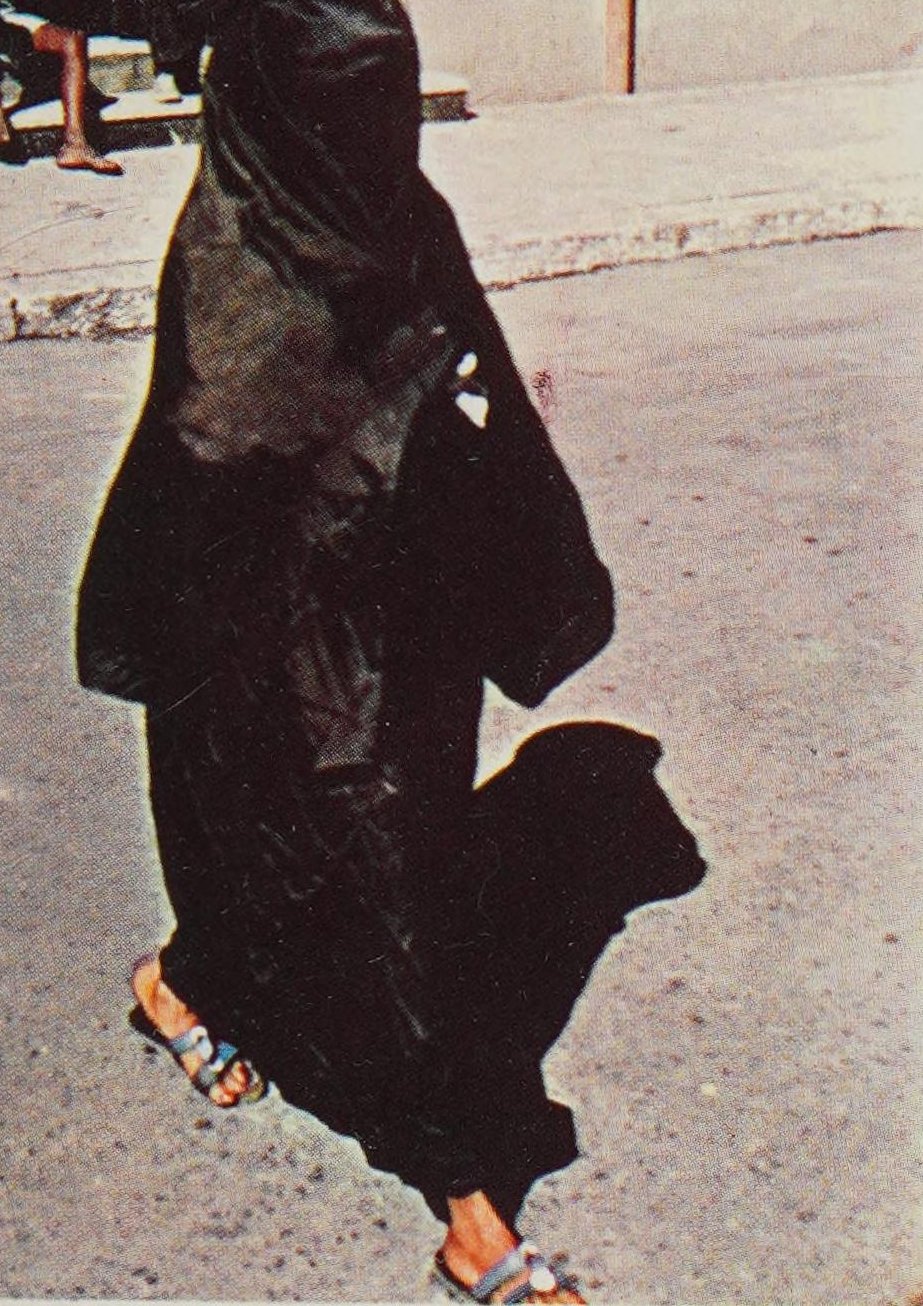
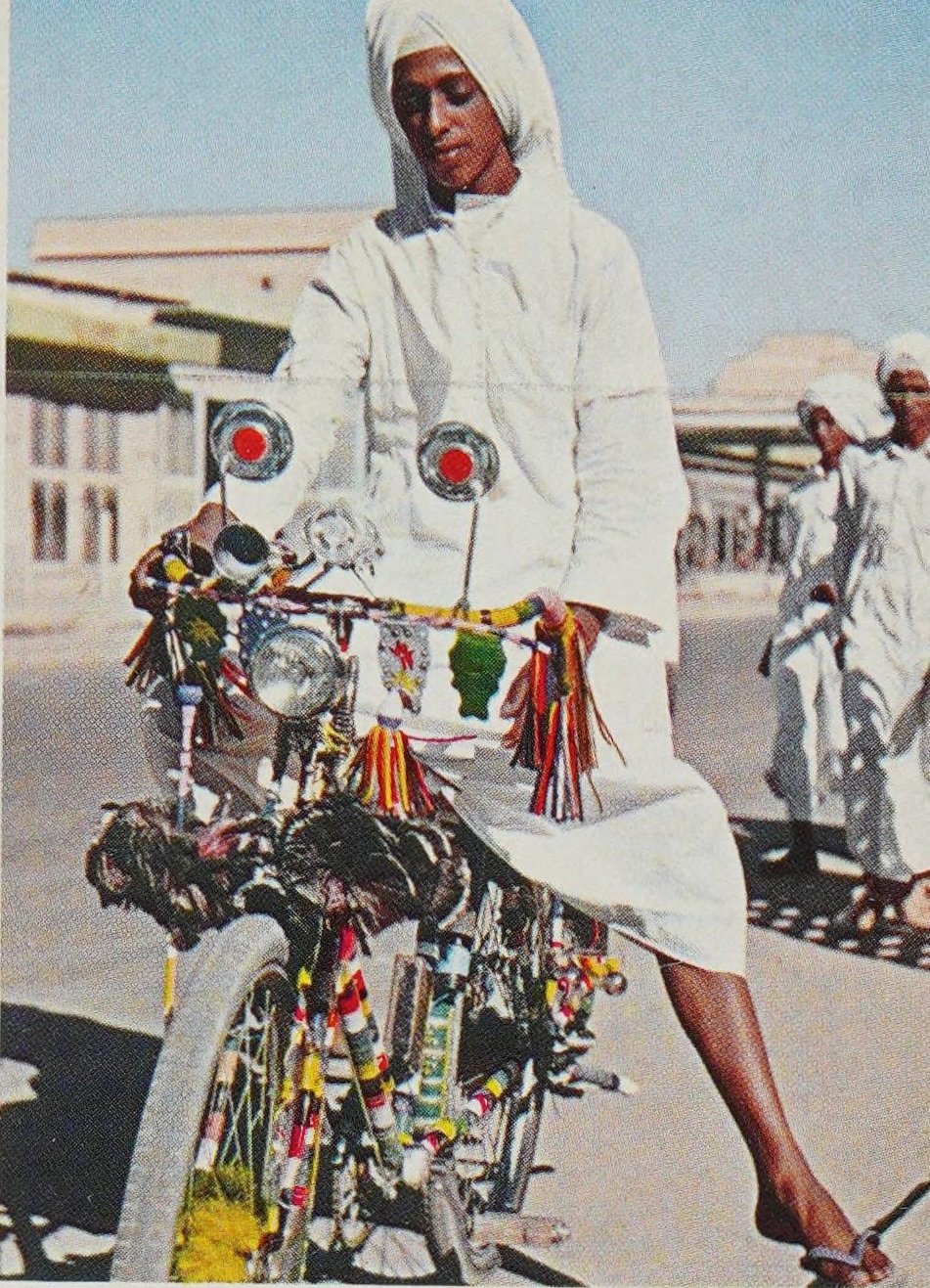
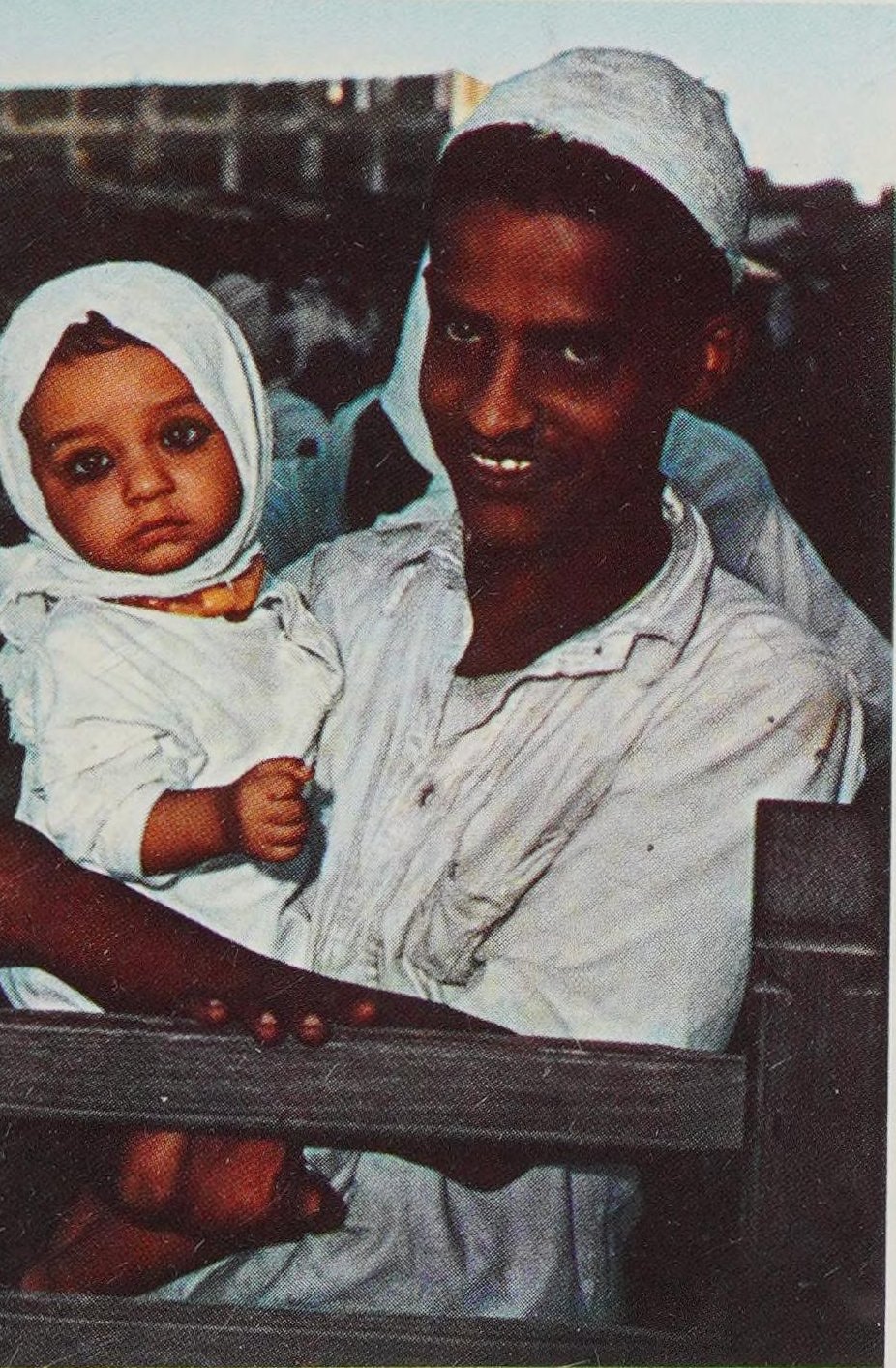
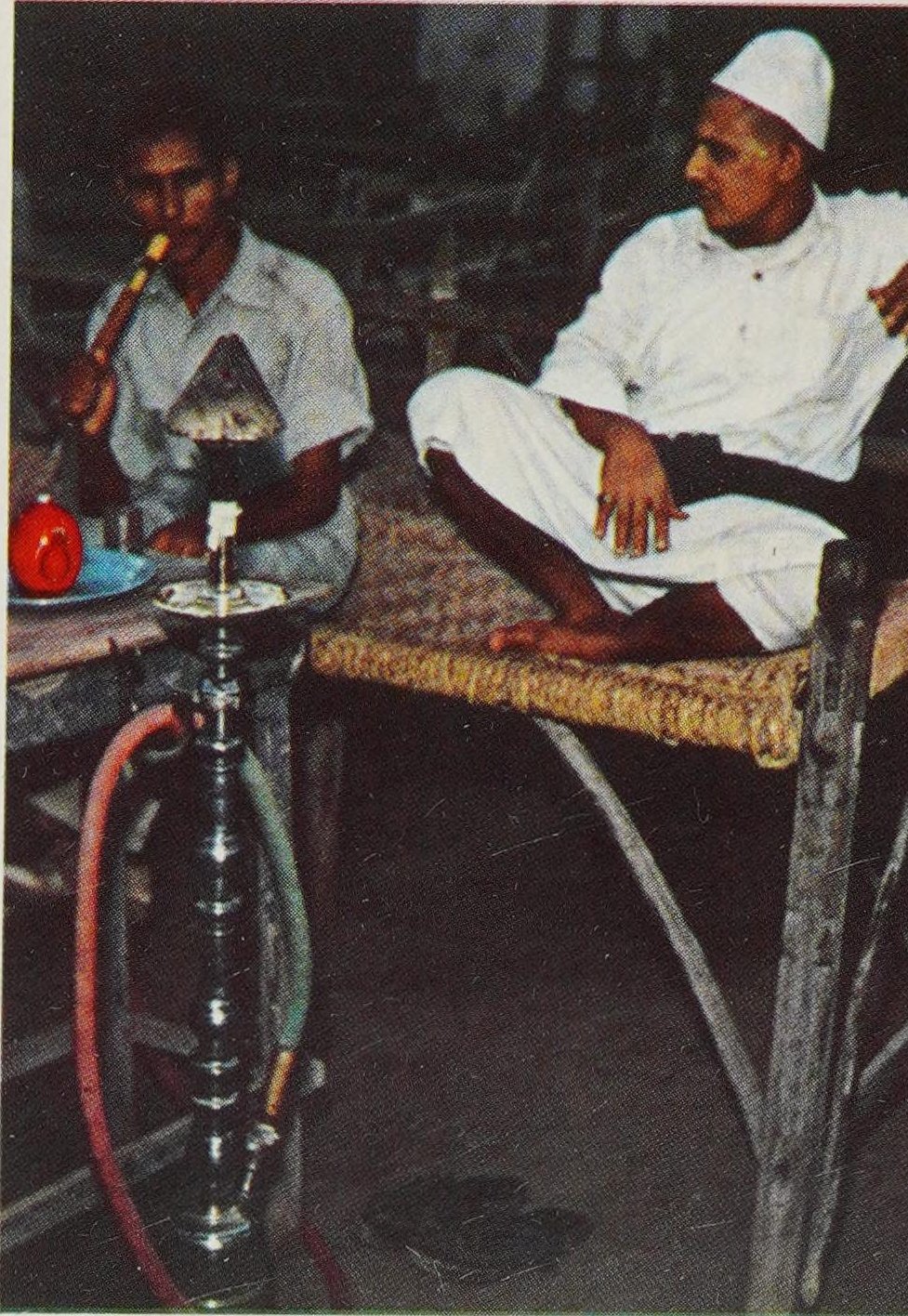
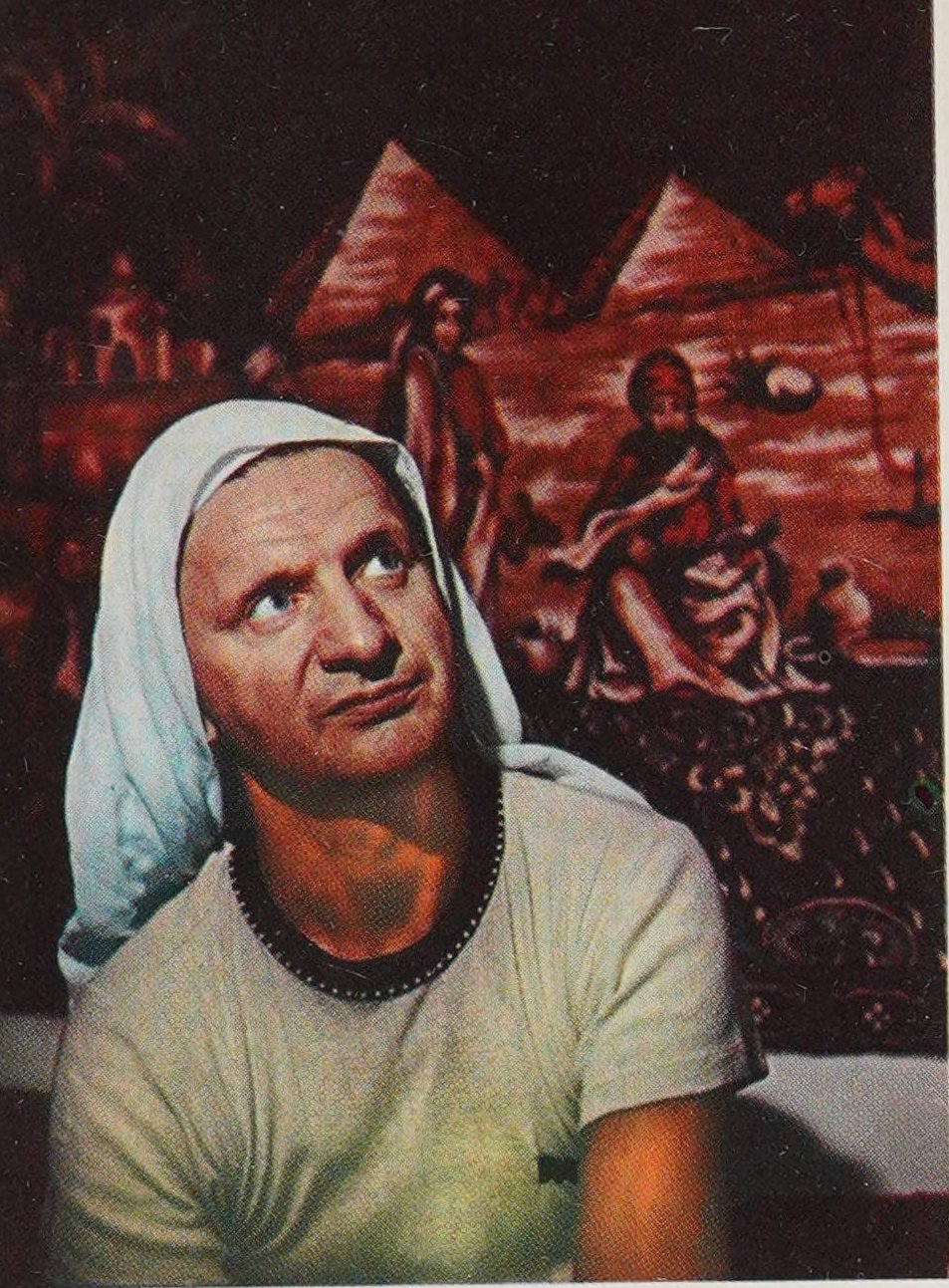
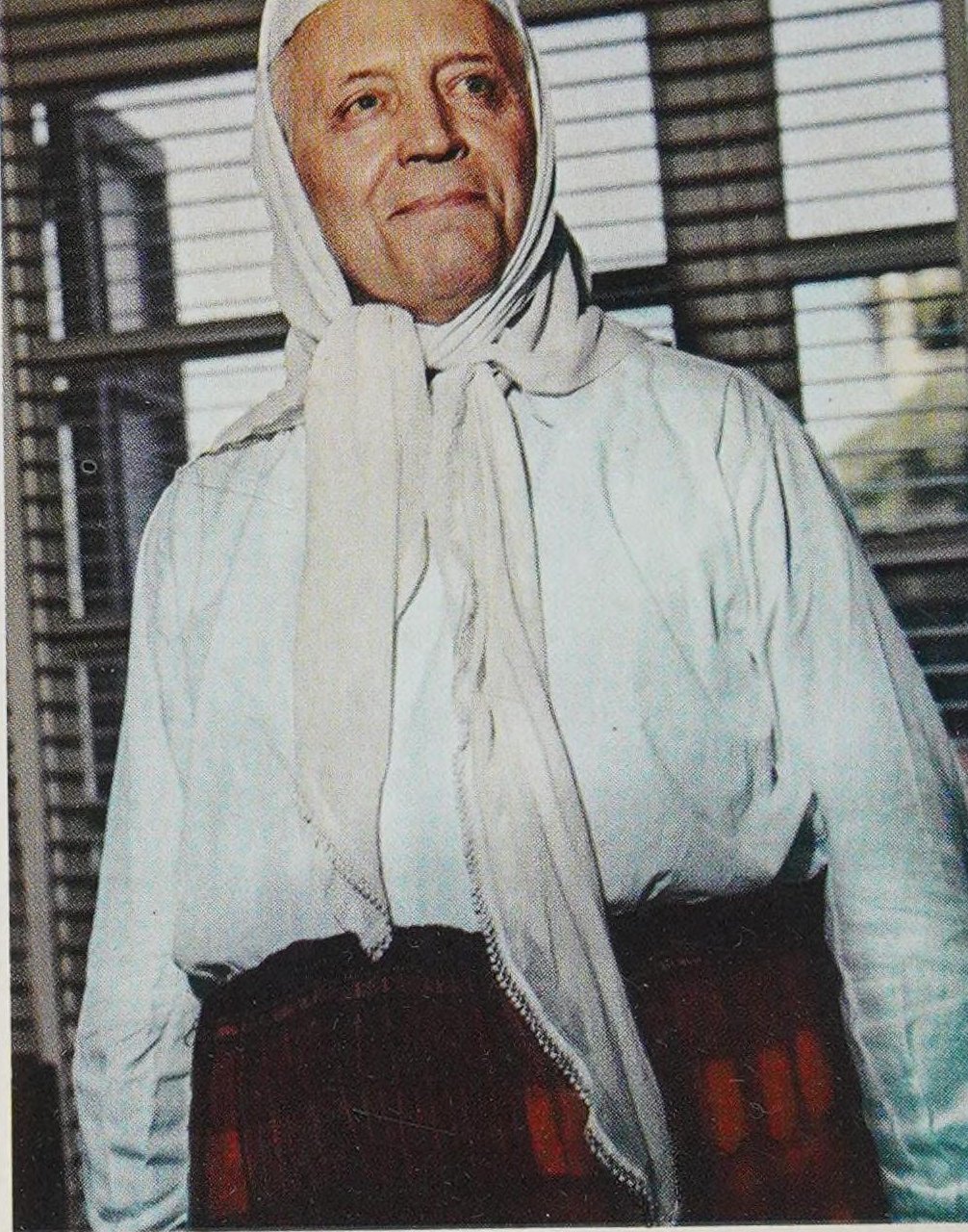
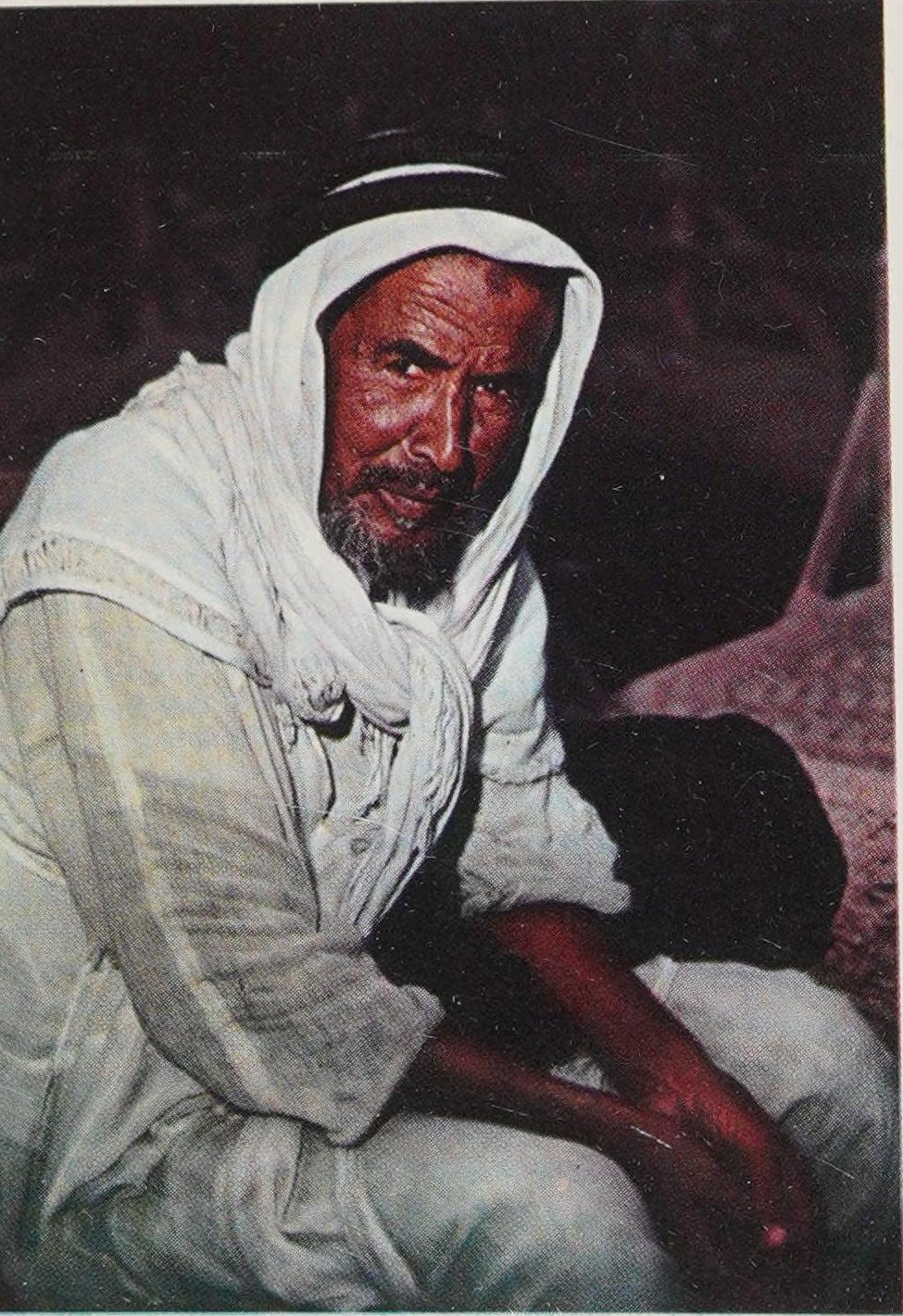
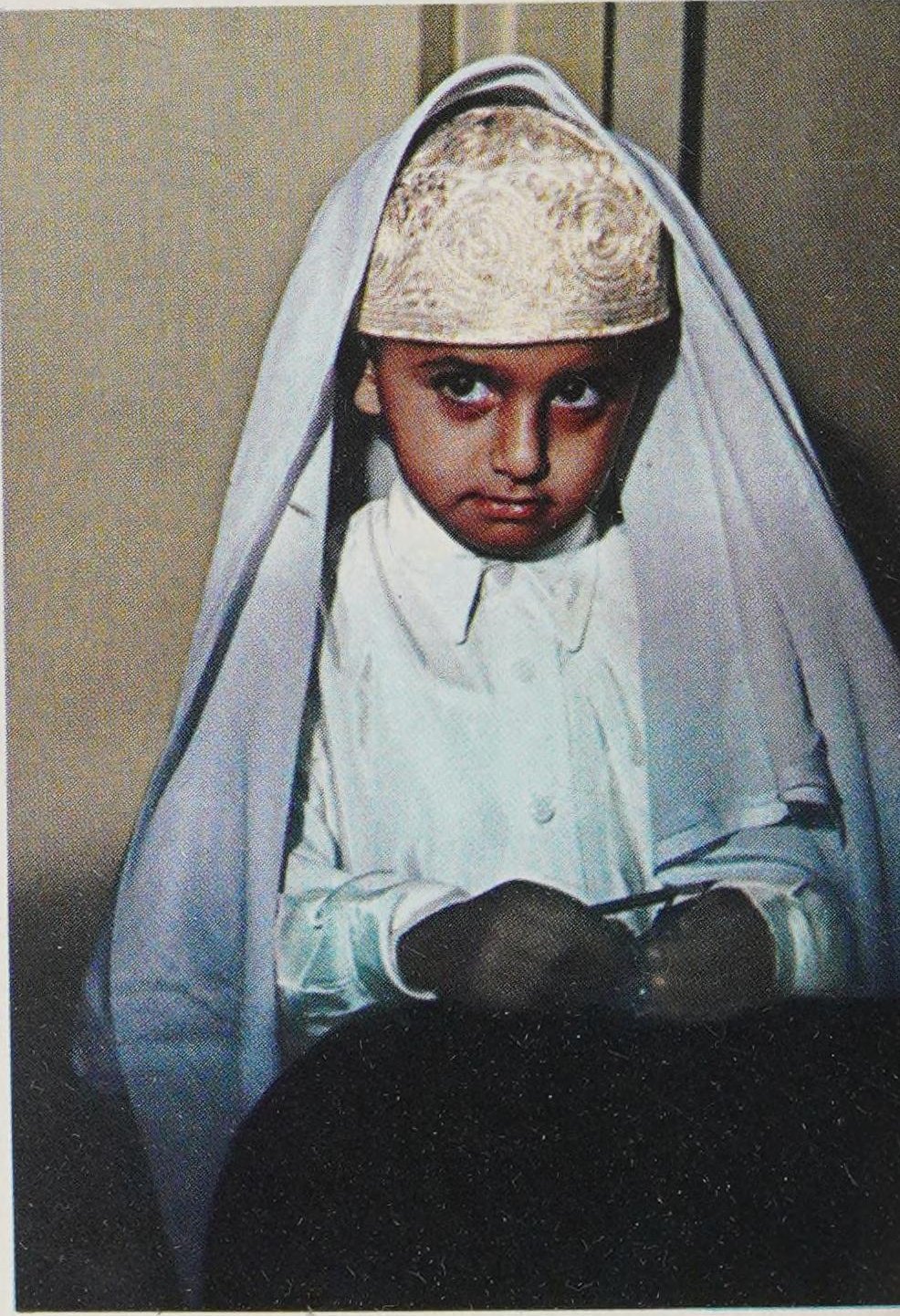
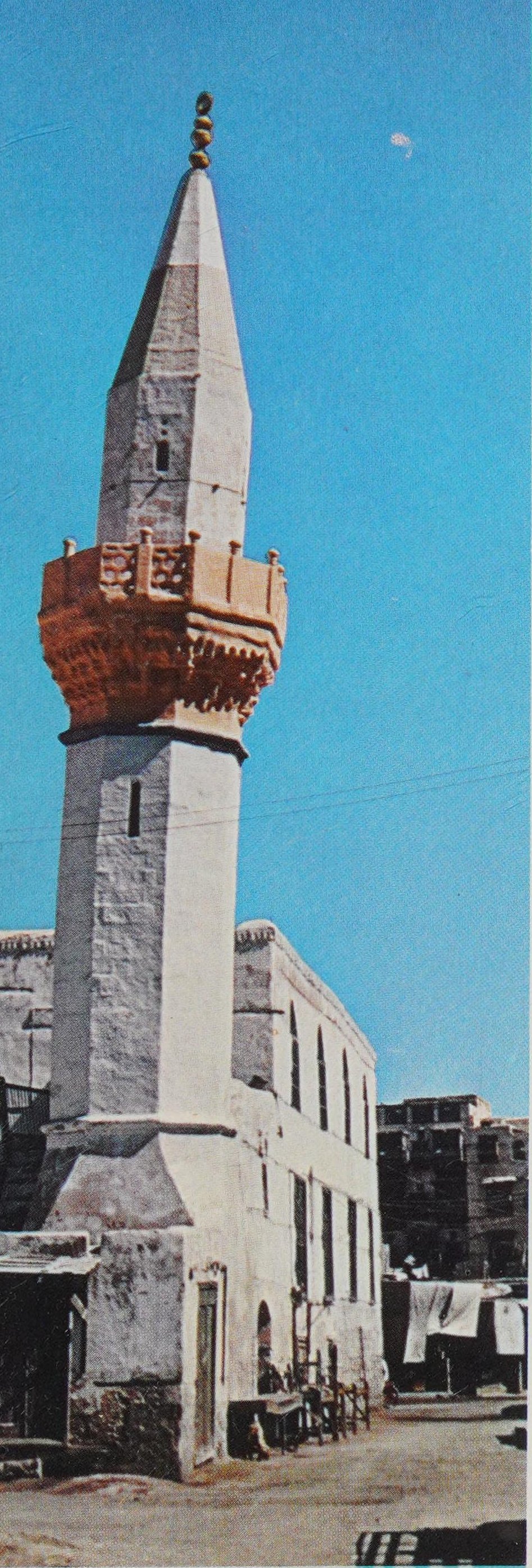
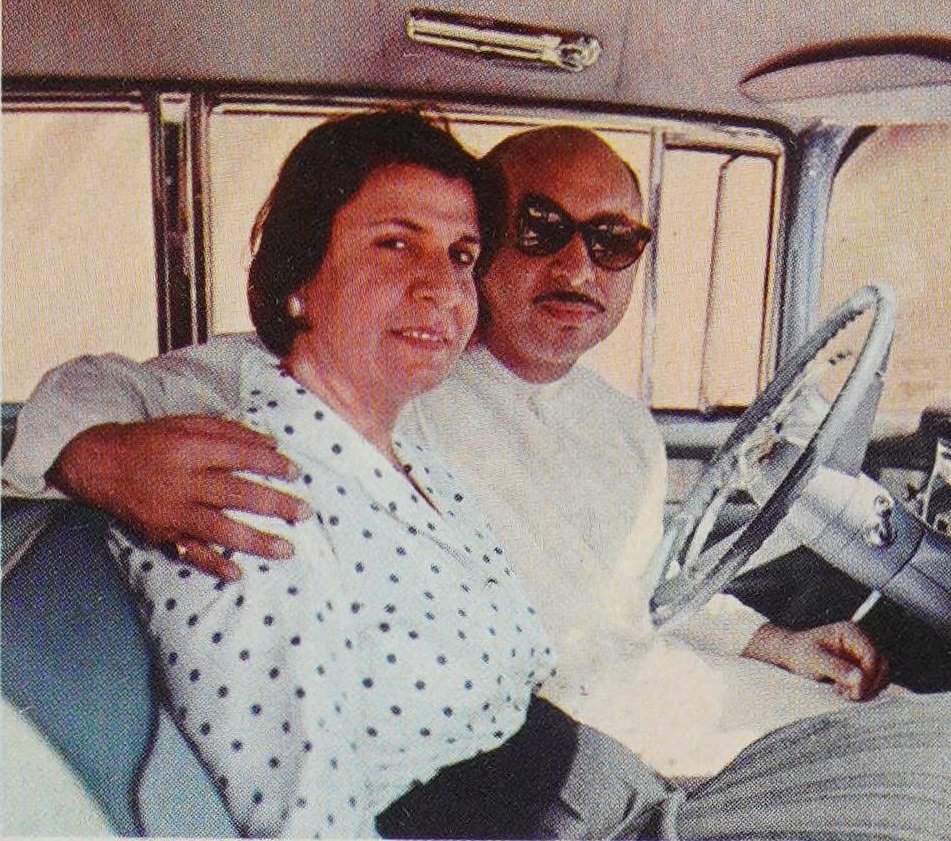
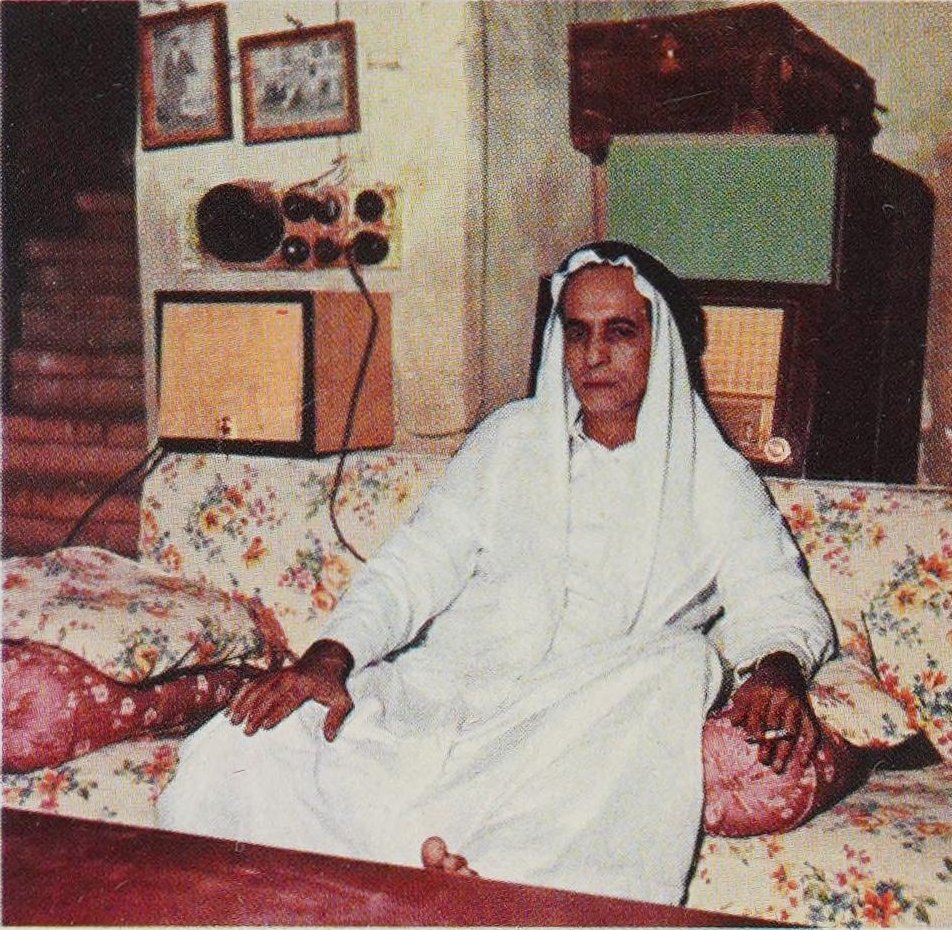
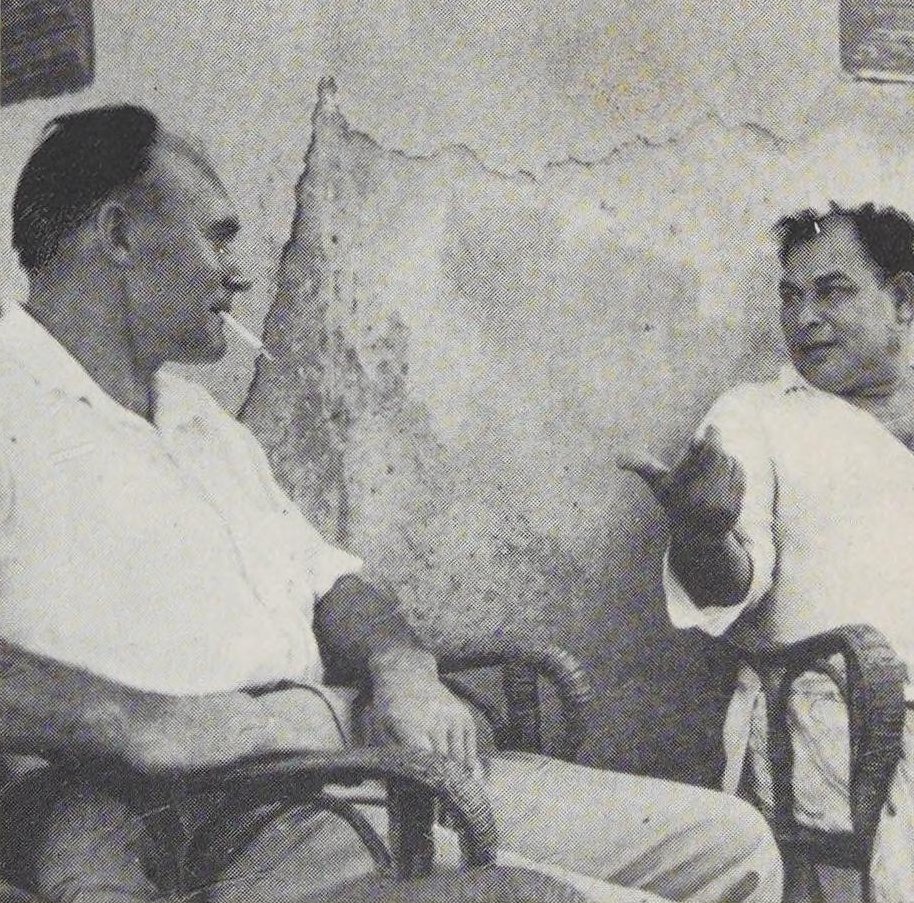
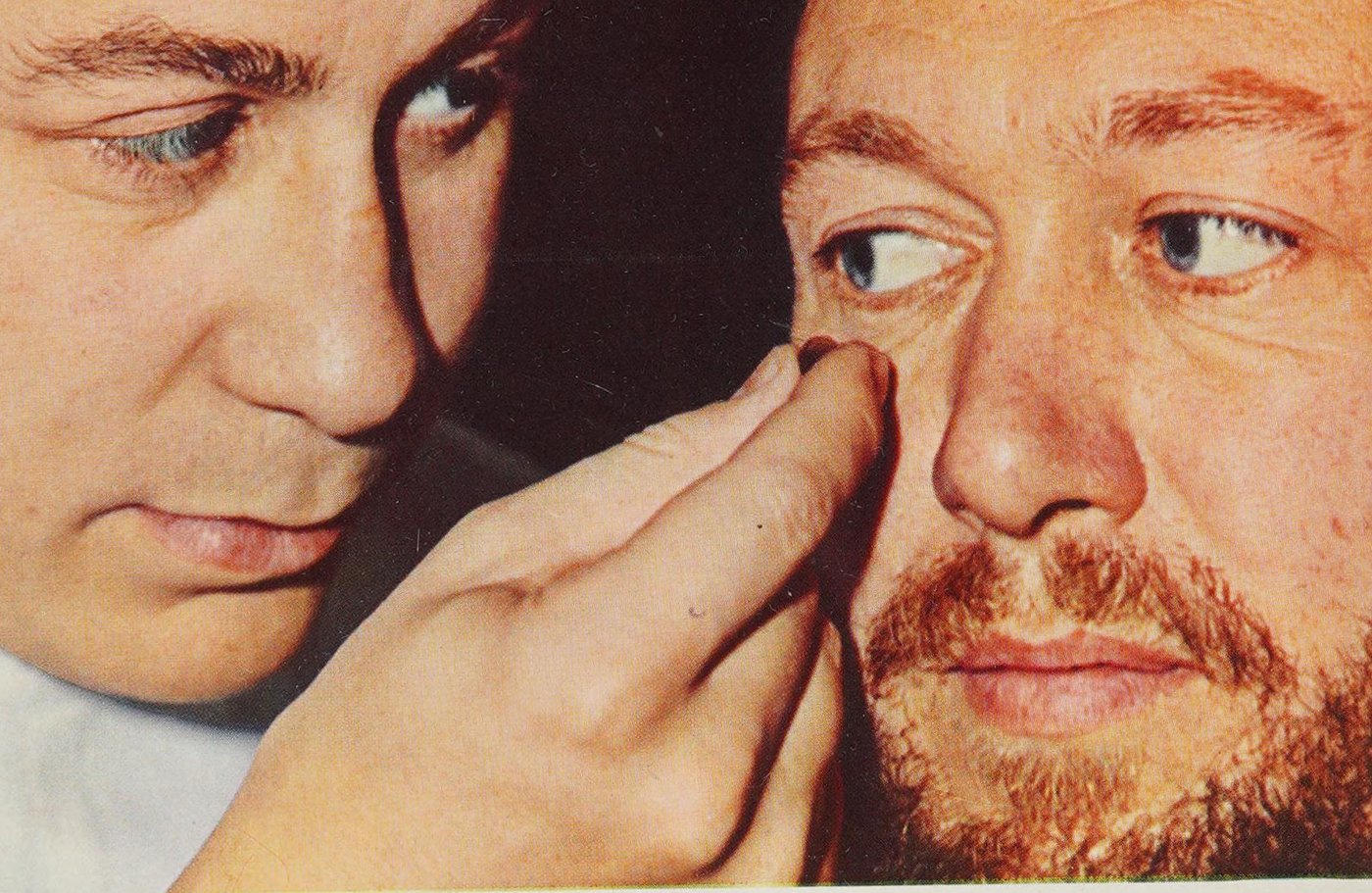
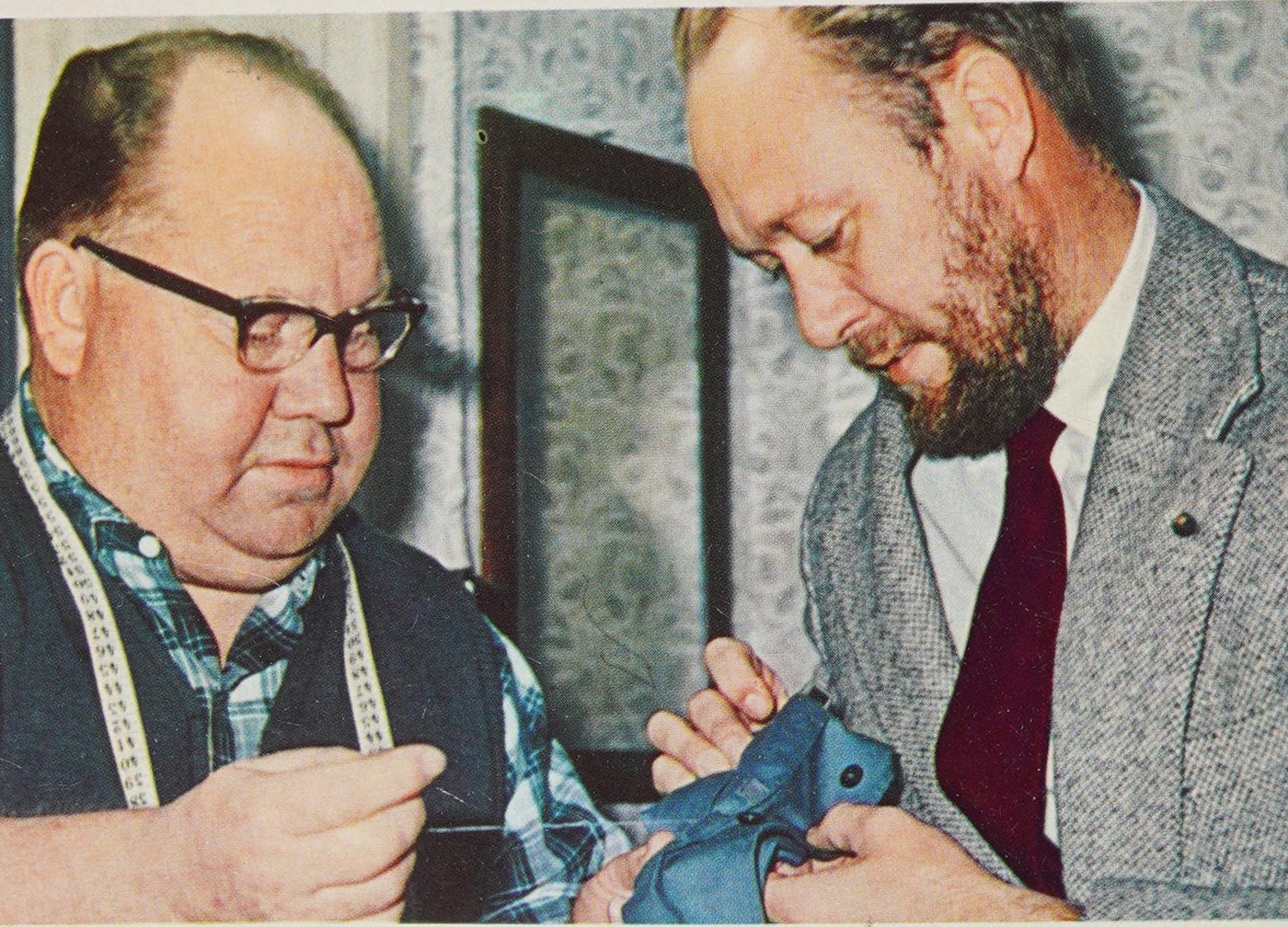
There was a lot to arrange before starting my desert expedition to Taif. Clearly, I had to be careful not to fall out with the Arab authorities who were interested in exploiting Hedendal’s desperate situation. Friis had misgivings.
“You’ll never get out of this business alive,’ he observed.
‘Surely I can disguise myself,’ I said.
‘Disguise yourself? You’re too blue-eyed, man!’
“What are you getting at?’ I asked, bridling.
“What I mean is, your disguise won’t deceive a cat, unless you can disguise your blue eyes.’
“Oh, those! Is that all? That’s easy. Just a minute.’
I went into my room, rummaged in my baggage, and found what I was looking for. When I re-entered the room I had the most beautiful brown Oriental eyes.
“Well, I...! Friis said.
I then told him that already before leaving Denmark I had foreseen that I might have to disguise myself in order to study Arab life at close quarters. From former journeys I had brought home a real Arab costume: not one of those worn by the rich, but an ordinary poor man’s costume. There is always a risk of attracting attention and even of being addressed in the street if one wears a fine dress of choice wool, with gold threads and other signs of wealth. In that case one can easily make a fool of oneself, especially when one does not master the language. But if one looks like an ordinary ragamuffin one has a far greater chance of remaining one of the crowd.
My hair and beard would be no trouble. They are by nature reddish, like many Arabs’. (I had noted with pride that red was considered ‘masculine’ in Arabia!) My blue eyes were thus the biggest problem, and I this had been solved for me by.a specialist in contact lenses, Golf Iversen in Copenhagen. When I had asked him if he could make me brown-eyed, he had replied that it was the easiest thing in the world. ‘I have to appear as an Arab,’ I explained. ‘At the Royal?’ he inquired. ‘No,’I said, in deadly earnest. ‘Unless I make myself convincing enough I run bigger risks than an actor. My audience aren’t likely to stop at rotten eggs and tomatoes.’ Golf Iversen knew his job and supplied me with the pair of lifelike brown eyes I have mentioned.
There were other things which remained to be arranged, and not the least important of them! I calculated that I might want to take photographs in places where a camera, to put it mildly, would be unwelcome. I had therefore to supplement my photographic equipment with a small German Minox, the smallest camera in the world. It had to be disposed on my person so that I could take my shots quickly and unseen, and it was necessary, therefore, to have it “built in’ to my clothes—both my ordinary European clothes and my Arab ones. The latter was not difficult, for the many folds of the dress provide ample opportunities for concealing such an unobtrusive camera.
I gave the job to a Danish tailor, P. Christensen. It was the first time he had received such an unusual order; but the plump and pleasant little man set to work with a will and an interest as though, he himself had been going into the world to spy. He made holes in the breast pocket and the trousers at the belt, and did it so admirably that it was impossible for anyone to see that the lens of a miniature camera was concealed behind. So skilful was he, indeed, that I was able to take a series of pictures of him when he had finished the shirt pocket and was working on the trousers without his noticing. When I showed him the pictures afterwards he was so thrilled he refused to accept any money. It was sufficient payment to have shared in something so exciting.
As an extra he also made holes in a couple of handkerchiefs; and the following days it was noticeably often that I held one of them to my nose and mouth and coughed and sneezed all I could. In the end my wife anxiously suggested that I should go to bed with my cold. Each time I had taken a picture; but she only became aware of it when I produced a series of portrait studies of her.
It remained for me to re-read the Koran, chiefly in order to find out how to behave when praying. It was necessary to be able to follow the involved gymnastic ritual and remember to turn my nose in the right direction. Suppose I were to show my contempt for Allah by turning my back on Mecca when making my obeisance!
Finally, I set about increasing my Arab vocabulary to such a degree that I gave myself a sore throat and blistered my tongue. Which, for that matter, rendered my pronunciation more natural: there is something rather rasping about the Arab language anyway.
After all these preparations I felt, as I also told Friis, that I could risk a journey into dangerous parts where few Europeans had been—and where I hoped they would be unaware that the Arab burnous I wore concealed one of the hated infidels.
“Yes, but you can’t go off on your own,’ he objected.
‘No,’ I replied, “but I have already secured a companion.’
“Who?”
‘Elmagary, my Hungarian friend. He promised to go with me, and now he has the chance to stick to his word.’
Elmagary did. Together we got busy assembling the necessary equipment for the journey, and we also had a dress rehearsal of my disguise. We went to the sukh, where I took a lot of pictures of shopkeepers bartering, smokers absorbed in the enjoyment of their indispensable hookahs; and a beggar woman who seemed rooted to her place, sitting on the same spot and in the same position each time I passed her.
One day the woman had a small boy for company. She was, I thought, blind; her expression was vacant and stony, and she did not turn her head when she called the boy, who was playing with a couple of the many kids who ran loose about the street. When the little fellow went up to the woman—who may have been his grandmother—he changed character entirely, His cheerful smile, his lithe motions when he ran after the kids, were now gone. Instead he stood in his skimpy, earthen-coloured shirt with a strangely dead expression on his face, as if infected by the old woman’s misery. But probably this transformation was a deliberate ploy, for in Arabia it pays rather well to be pitiable. The religion commands the giving of alms to the poor, and many are orthodox enough to obey the commandment.
Holding out a dirty little hand, the little boy began to sing “The beggar boy’s song’:
Money comes, money goes;
You cannot take it with you.
Rely on me, and I’ll rely on you.
You will be happy; I will be happy.
Give me a coin,
For my mother died the day before yesterday.
I could not help but admire the excellent ‘sales psychology’ in the song. First, any miserly tendencies are broken down—money is vanity of
JI* vanities. Then social feelings are played upon—it is fine and useful to help one another. Finally, the trump of forcing the warmhearted to surrender—‘my mother died the day before yesterday’. Doubtless she will have done it every day for years; but the boy sang his pathetic final line sotouchingly that I nevertheless had to give him a coin. The sales psychology had worked.
In the sukh I also took pictures of a ‘bed’ restaurant. During the day such an establishment is full of talking and smoking guests who sit on low beds enjoying their tea, an acrid beverage drunk from tiny glasses. It is hardly a restaurant in the Western sense; rather a tea-shop with service. In the evening the shop is turned into an hotel. The beds are hoisted into the air to prevent the town dogs, considered ‘unclean’ but which nonetheless exist in large numbers, from jumping up on to the sleepers. Each bed was a stout piece of wickerwork in a frame. It had neither mattress nor pillow; but the ankle-length Arab cloaks make good sheets and one can make oneself very comfortable for the night.
One evening Elmagary and I decided to sleep at one of these bed restaurants, which are reserved for Arabs, and in so doing put our disguises to the test. Ipretended to be dumb, leaving Elmagary, who spoke fluent Arabic, to do the talking when arranging payment. No one bothered to look in our direction. After that we were ready to start for Taif.
I was again on a desert expedition—this time in an ageing, but spirited, jeep. For the first part of the journey we took the straight road from Jedda to Mecca, but at some distance from the holy city we turned off. Mecca lay half-way along a straight line between Jedda and our destination at Taif, and we were at pains to make a wide detour. We were not interested in being observed by too many of the travellers to and from the town, and so we kept away from it, up on the high ground.
Although we had an awning over the jeep, it was so hot by day as to be almost unbearable. Not a breeze stirred, and the speed of the jeep gave no puff of air. Occasionally we had to turn back to the desert road owing to difficult ground, and one night we were forced to pitch our tent not far from it. I slept rather restlessly, and in my half-waking state suddenly felt as if somebody was throttling me. I quickly realized that it was not just a bad dream. A hand was clamped over my mouth and at the same moment a voice whispered into my ear: “Be quiet. There’s a police patrol.’
It was Elmagary’s voice. When he had removed his hand he told me that he had been unable to sleep and so had sat down outside the tent. All at once he had caught sight of a couple of cars in the distance; as far as he could make out, it was a police patrol. I had ‘been snoring, he declared, and so he had crawled back into the tent to stop the noise at once. A desert patrol can be rather searching in its questions, and if they began to examine my ‘pockets’ they might find the one where my camera was hidden.
Mechanically, I reached for my new eyes, which I usually took out before sleeping, and placed them in position again. Then we both got cautiously out of the tent again and lowered the tent poles. Elmagary’s suspicions proved to be right. But what we saw surprised us nevertheless.
We could discern the outlines of a police jeep, which appeared to be of an oldish model. The extraordinary thing was that we could also make out two men who sat on the front mudguards holding a couple of objects. It was a moonlit night; but it was impossible to be sure whether they were not holding tommy-guns. It certainly looked like it. Soon after, the two cars disappeared inthe direction ofJedda, and we retired to our tent again and forgot what we had seen. We were later to be reminded of ih iers Bic
Once or twice we had to drive through small oasis towns, but that we took to be fairly safe; they were primitive people who lived there, remote from frequented districts, and our disguises had proved to be convincing. They were friendly tribes we came across. One cannot always rely on a friendly reception—not even if one happens to be an Arab oneself—for it is a well-known fact that the mood of desert people often fluctuates from one extreme to the other, without any apparent reason.
One might think that such a drive, when for days on end one sees nothing but sand, would feel terribly monotonous. It can; but one may find on the other hand that the landscape changes rather wonderfully in colour and character. The sand has an infinite number of shades, and the desert forms range from small, abrupt hillocks to large sandhills, from a firm ‘wash-board’ foundation to areas of quicksand, where you have to be on your guard lest you sink in hopelessly, unable to save either your vehicle or yourself.
Also, there are wonderful mirages. Many a time on such a desert drive you get the impression of large, beautiful lakes outstretched before you. But the lakes are only haze. Mirages are especially numerous in places where there are depressions with stagnant, heated air. One can see just the same phenomenon on a European asphalted road on a hot day, but here in the desert it is on a vastly greater scale.
On the fifth day a town suddenly appeared ahead of us; we could clearly see its tall houses, minarets, and palm groves. The only unusual thing about it was that it was suspended high above the horizon. From that we shrewdly concluded that it must be a mirage!
‘But I know that town,’ Elmagary said. “‘There’s no doubt about it, it’s Taif already. I can recognize some of the buildings, including the two big white merchants’ houses. There’s no mistaking those.’
The mirage held for a few minutes. Then the outlines became blurred, and soon after we again had only the empty desert face before us. At that time we were thirty miles from Taif. We speeded up in order to get there before evening.
Taif is popularly known as the Riviera of Saudi Arabia: which may seem illogical, seeing that there is no semblance of sea anywhere near it. But the town stands high up in a mountain range and the air is wonderfully fresh. The situation also gives it a comfortable temperature, and it is not surprising that well-to-do families from both Jedda and Mecca, as well as other large Saudi Arabian towns, spend their holidays here in the hottest time of the year, from June to September. There are also several hundred large, substantial buildings which testify to the prosperity of their owners.
The arrival at this town seems even more refreshing because at the end of a desert drive you have a throat which feels full of sand and a thick, leathery lump in place of a tongue. We located a lodging house and got accommodation. Elmagary arranged everything, while I still acted the part of a poor, dumb companion.
The next morning we began—I with Elmagary as my tireless spokesman—to inquire cautiously after Hedendal. We pretended to be very interested inthe water supplies round the town, but had to be careful not to seem too interested. That might have been interpreted by the local authorities as attempted spying.
Elmagary first asked the owner of the lodgitig house. He admitted to knowing a little about a stranger who was looking for water round Taif, but declined to pursue the matter. We also tried at one or two bed restaurants, where they also seemed to know something, though we could get no concrete information. We were to arrive at the solution of the mystery in quite another way.
One day we stopped the jeep to watch some boys who were playing football. They were bare-legged, except for one boy who had one shoe—on his right foot. By virtue of this grand piece of equipment—well-suited to football too—he was the group leader. We got into conversation with him and praised his good play. He was a smart lad to look at, and he also had the gift of the gab. Elmagary decided to find out what this boy knew about Hedendal, and asked him the way to the nearest well.
‘Go two streets on—and then a bit towards the Mecca road. It’s where the Nazrani used to work.’
Elmagary gave a start, and I myself almost forgot that Allah had struck me dumb.
‘A Christian?’ Elmagary said. ‘Isn’t he there any longer?’
‘I don’t think so. I dare say they’re thrown him in the well,’ the boy said indifferently. “‘He’sgot water for us now.’
We left him and took the way he had pointed out, and it was not long before we arrived at the well. There was a busy traffic to and from it. But of the man we sought there was no trace.
On the edge of the well sat a seedy old Arab, selling eggs. Elmagary started to bargain with him, and after some arguing about the price bought a score of them. I looked at him in astonishment. Why did he want so many?
‘Just wait and see: half of them will be rotten,’ he said laconically.
I soon had proof of it, for I was ravenous; but when I broke the shell of one of them to eat a raw yoke, I found an evil-smelling foetus inside. The seller had not managed to make himself scarce, and Elmagary began to abuse him for having cheated us, threatening him with the punishment of Allah because he had tried to impose on two of Mohammed’s own people!
The hapless salesman excused. himself with great eloquence, and in the midst of it all said a few words which made us prick up our ears. For the second time that day we were really surprised.
‘The eggs weren’t meant for you at all; I usually pass that kind off on to the infidel who has been working here. It’s all he’s worth.’
“Which infidel?’
‘The Nazrani who gets water.’
‘Do you know him?’
‘T’ve sold him eggs nearly every other day. I didn’t spit on him like the rest; that’s why he dealt with me.’
“Where is he now?’
‘Gone. When I came one day he wasn’t here. That’s a few days ago. He hasn’t turned up since. They say he’s been chased into the desert. Maybe he’s dead. Maybe he’s been killed; he was a Nazrani. But it’s all the same. We don’t need him any more. He had got water for us.’
This was rather a shock to us. Still, we did not give up hope of hearing more of Hedendal yet; there could be no doubt that he was the one the old man had referred to. We also found others who had known the white slave, but all they could tell us was that he was no longer at Taif. No one knew anything for certain about his fate—and no one was interested in it.
We stayed another couple of days at Taif; by then we had realized that all further search there would be in vain, and, disappointed and discouraged, we started our return journey to Jedda, making a large detour of Mecca.
I was rather depressed when I rang the bell again outside Friis’s house. He opened the gate himself.
“Well, how’d you get on?’ he asked, with a grin which I found misplaced.
‘Tm afraid Hedendal’s dead,’ I replied curtly.
‘I shouldn’t worry about that if I were you,’ Friis said. “As a matter of fact he very nearly did die—however, come inside. There’s somebody I’d like to introduce you to.’
The man in the room was none other than Helge Hedendal. He was powerfully built; his arms bulged with muscles and it was obvious that he had toiled with them. But he had a remarkably thin, birdlike neck and his cheeks were hollow. His gaze wandered uneasily and he spoke in a faint voice which often quivered or broke. His face had a nervous twitch. It was clear that here sat a man who had suffered from heat and starvation, but above all from toil and drudgery and inhuman treatment. The days when the Arabs had not spat on him had been few; the days on which he had got enough to eat, still fewer.
Hedendal had flopped into the most comfortable chair in the room; his gaze passed inquiringly from one to another. Clearly he was not yet quite used to the idea that he was once more a free man.
Td given up all hope of ever getting back to civilization when Eek suddenly turned up a week or two ago,’ he said. And he went on to tell of his flight from Taif—a flight as eventful as his well-digging had been monotonous.
‘I had begun to think that I should spend the rest of my days among desert Arabs; among people who regarded me as an enemy, though I had worked entirely in their interest. It was all so hopeless. I was well aware that there was no more water to be found, yet I had to bore and bore so that the Arabs would think there were still a chance—otherwise they might have killed me. I thought Eek had let me down—and I had nobody I could talk to. I got no money, though I knew I had a lot due to me. Nor had I been able to get a new contract out of the authorities. The only reason I managed to keep alive was that certain well-to-do Arabs were anxious that I should go on working. So at least they saw that I didn’t starve to death.’
Hedendal had sunk deeper into his chair. Clearly, he found talking a strain.
‘Rest a bit now, Hedendal,’ Mrs Friis said.
‘No, let me get it over,’ he replied, drawing himself up a little. “You’ll just have to remember that it’s a year or two since I’ve talked so much. I won’t deny I got more and more bitter about Eek. He’d been connected with the company that had got me into the job and persuaded me I’d get rich. I didn’t know he no longer had anything to do with the company, that he’d been “worked” out of it, and I couldn’t understand why I never heard from him. I’d sent him a lot of letters, and some of them must have reached him. Anyway, I hoped they had.
‘Then, the day before yesterday, there he was! I thought I was seeing things. I stopped in the middle of boring and just stood and stared at him. I could have hugged him! But you don’t fall on the neck of a man like Eek; there’s always been something rather distinguished about him, whatever the situation you meet him in.
‘But that’s just what impresses the Arabs, and gradually he managed to make the local authorities understand that I was to gowith him to Jedda. He negotiated with them for several days—I’ve never in my life been in such a suspense.’
Hedendal’s gaze again wandered about the room, and his lips quivered as he relived the anxious days when so much had been at stake. He was back in thought at Taif among his enemies and tormentors. There was deep silence for a couple of minutes; then he went on.
“When the Arabs argued that I still hadn’t found enough water, Eek asked to see the contract that bound me to the place. There were good reasons for not being able to find it!
‘“So there was nothing more to argue about,” Eek said.’
Hedendal smiled, and continued his story. ~
‘Eek had arrived in a flimsy little military plane, and it was his intention to fly back in it. We had to abandon that plan because one of the many princes of Taif was just going away. He claimed priority and demanded that the plane should be put at his disposal. We had to manage some other way.
‘After Eek had nosed round the town he at length found a driver of an old hire-car—cars soon grow old in the desert—and the man was persuaded to drive us at any rate part of the way to Jedda, to a point where we could get other conveyance. I was all of a tremble while waiting for the decision. The hours dragged. I was so bent on getting away in a hurry that I’m afraid I pestered my rescuer into hiring the old car. I think he was more in favour of trying to get some other air lift, but that might have taken weeks. And Eck must have understood how I felt about it. At any rate, he gave way.
‘Early one morning we left Taif in our wreck of a car. It was like a dream—I can’t remember ever having been so happy. I was to do no more boring for water in the scorching sun—and the car was taking me farther and farther away from all those who had tormented me for two long years.
‘The highway from Taif to Jedda—or what the Arabs call a highway—passes straight through Mecca, where strangers are not allowed. But round about Mecca there is a rather large area where nothing grows but stunted desert shrubs. We tried to drive round that. It wasn’t as simple as it sounds. The wheel tracks that take the place of a road round the scrub disappear altogether after a storm in sand-drifts. There are other places besides this where the same small shrubs grow in the desert, and if you arrive at the outskirts of Mecca after nightfall it’s practically impossible to find your way.
“We had constant trouble with the car, and I was so worn out by the sun and emotional strain that I’d fallen into a deep sleep,’ Hedendal went on, ‘but I was suddenly restored to consciousness by somebody shouting. I sat up with a start. In front of us was a high wall, and it was guarded by police.
‘ “Are we right for Jedda?”’ the driver asked.
‘“Yes, this way; drive straight through the town!”
‘“Then this must be Mecca?”
‘“Yes.”
‘““Then I can’t drive here,” the driver said. “I’ve two Nazranis as passengers. I meant to go round.”
‘You passed that road along way back. It’s almost blocked by sand-drifts. But you’ll have to manage as best you can; turn round and see you get clear of here as sharp as possible!’
‘The driver didn’t wait to be told twice, and we drove back in the direction we had come.
‘So we thought! But it soon turned out that the driver was completely lost, and suddenly we stuck fast in the loose sand. That wasn’t the worst of it; the awful thing was that we found we’d been driving in a circle, and were close to the approach road to Mecca. And all at once we were surrounded by a throng of people, who very soon realized that Eek and I weren’t Moslems.
‘It was the middle of the pilgrim season, so the roads to Mecca were pretty busy, and in no time we had a terrific crowd surrounding the car. However, we were fairly safe inside, we thought. But then there was a sudden crash and broken glass showered down on us. Somebody had thrown a stone through the front window, so now the situation began to get critical. Eek resolutely jumped out of the car and shouted:
‘“Don’t touch me. I’m King Ibn Saud’s emissary. If anything happens to me and my companions you’ll incur the displeasure ofthe king and of Allah as well!”
‘He’d placed himself with his back to the car and didn’t seem to realize how dangerous it all was. He was amazingly calm. The driver was trembling like a leaf, and I myself felt anything but easy about our position.
‘But Eek only tossed his head and stretched out his hand to the crowd as if to hold them at a distance as he looked down his nose at them. He’s the devil of a fellow! It wasn’t all that easy for him to get a hearing. They shouted the most awful things at him, and for every minute that passed looked more and more threatening. Eek’s self-assurance and invocation of both Allah and King Saud had worked for the time being, but how long could he hold out?
‘For a time the Arabs were flabbergasted that an infidel dared to defy them. But I doubt if we could have held them off much longer if we hadn’t been rescued by a small police force that had been alarmed by all the crying and shouting and had forced its way through to us. The driver and I got out of the car and I heard Eek again shout that he was King Saud’s personal emissary and declare that both the police and the rest would get a taste of the royal affection if they interfered with us.
‘The end of it all was that the police officers chalked a large ring round the car and announced that anybody who crossed it would be shot. That sort of laid a damper on the gathering. The constables then started to argue among themselves; they obviously couldn’t agree what to do with us. Some just wanted to take us to the diversion and put us on the right road for Jedda; but others thought that no matter who we were, we had tried to force our way into Mecca and so should be taken before a judge and given the punishment that was due to us. The officers who took this view prevailed. We were ordered to get into the car again and the driver was told to start up: which, strangely enough, he managed to do, though he was so terrified he could hardly stand up.
“We must have formed a rather grand procession—though we hadn’t really the heart for itat the time. On each of our front mudguards sat a policeman with a tommy-gun, and a police jeep drove behind us to cover our rear and flanks. Last came all the screeching Arabs, who luckily were armed only with sticks. They had no difficulty in keeping up with us, as we still drove on through the rough desert sand, and it was slow progress.
‘On the way into Mecca Eek and I didn’t exchange many words. We were both too busy guessing what sort of fate awaited us. The few Christians who have entered Mecca at one time and another have had a bad time. It isn’t so many years since an inquisitive American slipped in behind the town wall. He was discovered and literally torn to pieces.
“After a good half hour’s drive we again arrived at the town wall where we had been before, but this time we didn’t stop at the outside. We drove in, and just as the sun was rising we were dragged out of the car and pushed through the door of a big, dirty building. We found ourselves in one of Mecca’s prisons, and the door slammed behind us.
‘T’d never been in prison before, but I don’t think there can be very many who have felt such a relief on hearing the prison door bang to behind them. Because outside we could still hear the Arabs shouting and screaming—and their sticks hammering away at the door.
“We weren’t taken before any judge. For four days we sat pondering our sins in one of those filthy dungeons where it gets literally lower from floor to ceiling from one day to the next, because there aren’t any toilets. During the time we were there nobody came to muck us out, and it looked as if it hadn’t been done for ages. I don’t know what sort of food it was we got. But there wasn’t much of it, and the little there was tasted like an emetic.
‘But we weren’t quite forgotten—as so many prisoners are. I expect that no judge cared to commit himself in our case. No doubt King Saud’s name had taken effect; because when we had been in the dungeon for four days we were told we were going to Jedda. We couldn’t believe our ears. Were we really going to get off so lightly? We had profaned Mecca; the town would now have to be ‘cleansed’ daily both with water and with prayers. We had brought near disaster to it.
“With a police escort that was armed to the teeth we were taken outside the town wall, where we found our car which had been driven there; to our astonishment-not a scrap of our baggage had been touched. Two constables sat in the car with us, and, as before, two others seated themselves on the front mudguards with tommy-guns. It looked very dramatic. This time there was a police jeep with us as well, but now it drove on ahead...’
‘Now I understand,’ I broke in. ‘It was you we saw that night when we were on our way to Taif to find you. It might have saved us a lot of trouble if we’d only guessed who was coming.’
I told him briefly what we had seen, and Hedendal then continued his narrative:
‘Our course was now set for Jedda—and this time we stuck to it. We were relieved when we saw the town ahead of us. But we had rejoiced too soon.
‘Our own policemen handed us over to the Jedda police, and again we saw the inside of an Arab prison. But here they did us proud. They gave us a room with bath and toilet! Or rather, we had a cell which had once been a bathroom. The prison is the big, six-storey building diagonally opposite the Red Sea Hotel, and at the time that the house was converted to its present purpose it wasn’t considered worth the trouble of removing the lavatory basin and bath. It must have been rather nice for the prisoners—at first. Until the basin got clogged up. That must have happened long ago, because now it was heaped up; and the bath had been put to the same use as the lavatory and was half full. The temperature was somewhere between 100 and 120 degrees, so you can imagine how enjoyable it was. Before handing us over to their colleagues in Jedda, the police made our driver pay them 600 rials—because they had been so courteous as to accompany us all the way.
‘We spent six days in Jedda gaol, but apart from the disagreeable uncertainty regarding our future fate, we gradually felt better—thanks to Eek’s exceptional ability to adjust himself to the conditions. He managed to get a message to his Saudi Arabian servant, Gaba, and every day Gaba brought us some food that had been cooked in Eek’s own kitchen. Not wanting to use the half-filled bath, Eek told Gaba to bring in some big packing cases. We used these asa lavatory, and Gaba changed them when he came.
‘No matter what happened, Eek took it all in excellent humour. He’s a queer chap in many ways, but many of his bright ideas came in useful. One of them is to carry a disinfector wherever he goes. He can’t stand flies and mosquitoes, and when he’s nothing else to do he gets busy disinfecting. He had his disinfector with him both in the prison at Mecca and in Jedda, and as soon as he spotted a fly he would give it the dose it asked for, even it it happened to be sitting on the gaoler himself. There were masses of dead flies in our “luxury”’ cell before we left it.
‘Eek made many attempts to get into touch with King Saud. It took a week before he succeeded, as the king happened to be in one of his harems and had given instructions that he wasn’t to be disturbed. But at long last sometiing happened. The prison authorities were ordered to release the two Europeans and their Arab driver at once, and at the same time Eek received a personal message from the king, saying that he was surprised that “his old friend Eek” had “accidentally” got inside the walls of Mecca after so many years in Saudi Arabia. This time the king could help us, but Eek was told never to repeat the jest.
‘At the same time we were informed that the policemen who had insisted on our arrest and taken us into Mecca had been gaoled themselves. They had made a blunder in taking us into Mecca instead of sending us as far as possible away from the sacred city. The ones who had wanted to lead us away, but had failed to get their will, escaped with three months without pay.
‘And now,’ Hedendal concluded, ‘here I am. For two long years I’ve struggled to find water for the Arabs. Now I’m going to have just as hard a struggle with the authorities. They allege that I haven’t finished my job. I have to go and find some water, they say. If not, I shan’t get what’s owing to me. I’ve been extremely well received by Mr and Mrs Friis, but I think there are limits to what I can accept, and I wouldn’t like to get my friends a bad name by visiting them too often—it won’t be good for their reputation to mix with an ex-prisoner. You can’t help me out of the country,’ he said, turning to me, ‘not if you staked your life on it. My passport was confiscated when the visa expired while I was working at Taif. And you, Friis, have your own problems to contend with.
‘Can you tell me what I really ought to have done in Taif—to escape, I mean? I couldn’t even read what it said in my passport; and even if I had known Arabic I shouldn’t have succeeded in getting my residence permit renewed, because at Taif there’s nobody with the authority to do it. I couldn’t leave Taif because I had no money for the journey. I had a return ticket to Sweden from Jedda when I arrived, but it was out-of-date long ago. So that money’s wasted as well.’
Hedendal had got quite animated during his long narrative, but the thought of the troubles which still lay ahead exhausted him anew, and soon after he took leave of us and went to bed.
I did not see him again. A few days later I left Arabia.
When I returned to Denmark I wrote repeatedly to Hedendal at Jedda, to ask how his case stood. Two months after my return I received a reply. He explained that in the hope of getting at least some of his earnings paid out to him and his passport and visa regularized, he had agreed to work for a few months for the Saudi Arabian Government—though under greater security than before. Lars Eek had applied his influence to procure for him an extremely favourable contract with the Government, so that from being a ‘slave’ he had now advanced to the position of ‘State-employed’ water expert. He can end up as the Minister for Water Supplies—or he can land in the dry desert again. For it was rather alarmingly evident from the same letter that he was on the point of leaving on official business—for the interior! He would be back in Jedda in a few weeks’ time, he wrote.
At the time of writing—January 1961—it is some months since I received his letter. I am still waiting for a sign of life from Hedendal.
My Arab disguise had been finally packed into my trunk and with the aid of a couple of open-minded Saudi Arabian princes I had succeeded in getting my film trunks unopened through the airport controls. In the plane I could still feel the sand of Arabia in my shoes, and I would come across it weeks later in cameras and other gear.
In other ways also I took back with me the strange country I had visited. I could not help wondering what the future held in store for Arabia: how it would manage the leap from an obsolete Oriental social order into a modern, Western-style civilization.
When blowing the sand out of the delicate mechanism of my cameras I also thought of my beautiful princesses. I saw before me the anxious looks behind their black veils. And I thought of the good friends I had made in Saudi Arabia. Would they be annoyed with me when they read what I had written about the slave trade and the barbarous judicial system of their country? Would they think they were reaping ingratitude for the risks they had run in helping me to look behind the veil of Arabia? I do not think so. I feel sure they will understand that it can bea positive factor in their country’s development if the rest of the world becomes familiar with the Arabia it has to deal with.
In Arabia the transition from dark Middle Ages to modern democracy cannot be gradual, as it has been in Europe. In many parts barbarism exists today as it has done since time immemorial, but at the same time much good work is being done to transform Arabia into a civilized state, and valuable results have already been achieved.
For thousands of years the country has isolated itself, forming a closed world where everything has stood still. With fanatical hatred the soldiers of Allah have fought people of other faiths, and with its scorching deserts and arid mountains Nature itself has raised barriers against foreign intrusion. Technical advance has played its part in breaking down these barriers, and the surmounting of geographical obstacles will also mean the breaking down of cultural isolation. The ‘Chinese wall’ of Saudi Arabia has been breached; the country has found a new direction. The history of Arabia was formerly a bare record. of war and bloodshed; in the future it will also tell of efforts to fertilize a barren country and better the conditions of a neglected population.
In 1910 King Abdul Rahman al Feisal Aal Saud returned to Arabia from his exile in the sultanate of Kuwait, where he had fled after an earlier attempt to reconquer the country from the Turks had failed. That was the beginning of a new era in Arabian history. He was accompanied by a modest force of forty supporters! One morning he stood before the gates of Riyad, and the town was his after an efficiently carried-out attack. Later he assembled a large army and led it from victory to victory until the Saudi Arabian flag flew over nearly the whole peninsula.
The history of the Aal Sauds is the story of the birth of present-day Arabia. The world first heard of Aal Saud in the year 1737, when the Arabs were still an unregarded people; but this first AalSaud was a great conqueror and prince of the faith, whose appearance in the political and religious arena was to have extraordinary importance both in Arabia and the outside world. Bad times followed, in which Turkey—the Ottoman Empire—jealous of the great new realm, launched an attack and conquered one province after the other in spite of fierce resistance by the people. With the year 1910 and the return of Abdul Rahman al Feisal Aal Saud from Kuwait came the turning point.
Of his successors, King Abdul-Aziz united the provinces of Najd, al-Ihsaa, Hejaz, and Assir, as confirmed in a decree of the 22nd of September 1932. Abdul Aziz made a considerable effort to improve the health, educational, and social standards of his people. On the 27th of August 1951 he appointed his eldest son, the present King Saud, as Crown Prince. The latter succeeded to the throne after his father’s death on the gth of November 1953, and at the same time his brother, Prince Feisal, was made Crown Prince and given in addition the post of Prime Minister and Foreign Minister.
King Saud was born on the 15th of January 1901. His full title is King Saud ibn Abdul-Azizibn Abdul-Rahman ibn Feisal ibn Turgi ibn Abdullah ibn Muhamed ibn Saud the Great ibn Mugrin ibn Farhan ibn Mugqrin, King of Saudi Arabia. As ibn means ‘son of,’ his whole genealogical table can be read in his title. In 1919 he followed in his father’s footsteps asa commander when he led a campaign that ended in the subjection of the 146 BEHIND THE VEIL OF ARABIA Turba tribe, who had aided his father’s enemies. In 1921 he commanded an expedition to Hail in the north, on which he displayed great gallantry and sagacity in the bitter battle for the town. The years which followed brought him many other commands, as in 1934, when Saudi Arabia was at war with the Yemen.
When he had become king and with it ‘defender of the shrines of Islam,’ he made the following declaration of policy: ‘As my father’s reign was marked by conquests, so shall mine be marked by war against poverty, ignorance, and disease.’
King Saud is the first king in the history of Saudi Arabia to have visited every part of his extensive country—with the laudable intention of really studying the lives of his people and afterwards endeavouring to create ordered conditions. In the years that have passed since the succession, many of the aims he set himself have indeed been achieved—but whether this has been due to King Saud is an open question. Time and again the hand of Crown Prince Feisal has been evident. In 1958 the giant, half-blind King Saud, heavily in debt in spite of the country’s great wealth of oil, and harassed by Nasser’s efforts to win influence in his kingdom, had to ask his more virile—and more cultivated—brother to see to the country, promote its finances, and re-establish its prestige in the Arab world. Feisal actually succeeded in putting Saudi Arabia back on its feet, and the throne escaped being drawn into the intrigues of Pan-Arab politics—at least until May 1960 when King Saud, after many years of indifference to Government affairs, began once more to interfere in domestic politics and inspired the Arab newspapers to demand elections, so that ‘the people can feel they get their rights in the same way as other people’. This was a well-meant move against the growing popular enthusiasm for Gamal Nasser.
The king’s new programme was exactly contrary to the policy of Crown Prince Feisal. True, the latter had always thought Saudi Arabia should go forward to a great future as an ordered state, but that the transition would have to be gradual, as the kingdom was not ripe for drastic upheavals in a democratic direction. Conditions would have to be changed slowly and in step with the educational advancement.
Crown Prince Feisal therefore felt himself outmanoeuvred, passed over, and degraded; and as a consequence of his disappointments he became seriously ill and had to go to Switzerland for his health. He, and several of his progressive brothers, feared that if the people were given unrestricted self-government the result would be a dissolution of the monarchy; and what would happen to the country if an uneducated population, unaccustomed to shouldering responsibility, suddenly obtained full power? History is rich in awful examples.
In Saudi Arabia the pioneers are few; but it is hoped that in time they will succeed in convincing the people that the millions accruing from oil, when supported by intelligent rule, can transform the desert into a fruitful country—and also that influence abroad cannot be reckoned merely in dollars and sterling.
The development which took place under the auspices of the crown prince at least made increasingly larger circles aware of the failure of isolationism. They began to understand that Arabia today can no longer hide behind the veil. But in December 1960 a new phase set in: the conservative King Saud suddenly deposed his progressive brother—on the pretext, moreover, that he was not progressive enough! In order to strengthen his position among the desert tribes the king, in the course of the previous year, had married over a hundred daughters of Bedouin chiefs. Of course he at once had to divorce them again, but the girls—or rather, their fathers—received, asaconsolation in their distress, an annual pension of nine hundred pounds sterling.
Feisal has had supporters among educated Saudi Arabians, but the corrupt officials and the innumerable money-grubbing members of Saud’s royal household form the majority. The latter were incensed with Feisal, among other things because he imposed a six-months’ ban on the import of Cadillacs, cut King Saud’s ‘pocket money’ to ten million pounds a year, and generally placed obstacles in the way of the household’s extravagance. For all the king’s lip-service to democracy his latest manoeuvre will undoubtedly mean a step backward. Modern ideas will once more be frowned upon. Probably a sharper policy will be adopted towards the American oil companies and the West in general; there may even be renewed isolation from Egypt and other Arab countries. The tender shoot of democracy is in great danger of wilting after Crown Prince Feisal’s departure as Prime Minister.
On my journey I caught a glimpse of the face of progressive Arabia. Now, Arabia seems to have lowered her veil once more.
Denmark. January 1961.
During my visit to the two princesses at Jedda, described in Chapter 11, I had to solemnly promise that I would never publish a single photograph I took of them. As the jacket of the book nevertheless bears the portrait of the younger princess, it might bethought that I had broken my word to the Arab beauty and exposed her to a risk she herself believed might be disastrous. Fortunately, this is not so.
The pictures of her seemed to me so fine and so very Oriental that the desire to show my readers at least one of them gave me no peace; I would wake up in the night and see those wonderful eyes before me. I wrote several letters to Arabia, but dared not hope for a change of attitude, or that a portrait of a high-born young girl, who had to live concealed in her family’s palace, could ever be publicly reproduced. Shortly before the book was due to go to press, however, I received a telegram giving permission to use precisely the picture I liked best.
The reason why permission was granted was that the picture was taken before the princess had laid aside her veil.
THE END