
Bali
In Bali, they sell cheap tours that cover all the pretty spots at once. You can go around the whole island for $30 per person. The trip includes absolutely everything: mountains, temples, rice terraces, coffee farms, feeding goldfish, riding giant swings, lunch at a hanging restaurant, taking Instagram photos, bathing in a waterfall, ritual washing at a Hindu temple, and God knows what else.
Heaven’s Gate
The epicenter of Bali’s Instagram tours. Huge lines form from six in the morning.

The trick is that the photographer holds a little mirror under the lens.

So it looks as if the gate stands in the middle of a lake, with a mountain in the background. Pretty, huh.

In reality, in front of the gate there’s just grass and a stone floor.

The gate is actually in a Hindu temple, so tourists are also handed a wrap to cover their legs. Walking around a temple in shorts is haram, but raking in cash is always welcome.

By the way, the view from the temple is great even without any gate. That’s Mount Batur; there are tours there too.

Goldfish
The place is called the Tirta Gangga Water Palace. The level of cuteness here would make a glucose meter explode. A path of hexagonal stepping stones runs across the pool.

Goldfish swim in the pool.

At the entrance, tourists are given a bag of fish food. The carp swim up in anticipation and open their mouths. If fish could talk, they’d say, “Pour it in.”

Tourists are brought here in droves. The fish are stuffed to bursting. Fat as penguins. How long can you live when you’re fed fifty times a day? Your liver would burst. They must keep a fish restaurant next door.

Still, it’s a beautiful place, no doubt about it.

As always, some crazy Hindu statues.

Through a gap in the fence you can see a rice field where people work for pennies.

I bet that with the money tourists blow here, instead of feeding carp, you could feed every beggar in the area.

Waterfall
Bali is full of caves with small waterfalls. Tourists are taken to one of them to swim. You put on flip-flops and swim trunks and go down a staircase.

And down there is a cave like this, with wet women walking around.


Sunbeams break through the thickets from above. Another great spot for vanilla photos.


At the end of the cave is a waterfall.
There’s a line of about ten people. Some come with a personal photographer, who wades knee-deep into the water, sets up a tripod, and shoots a long exposure so that the waterfall comes out silky smooth.

Hanging Restaurant
In the middle of the day, tourists are driven to eat at a pre-arranged restaurant that feeds the tour organizers for free. You can’t fool me: I always order the cheapest food, just to throw some fuel into the bioreactor.

The restaurant is “hanging” because it’s built on wooden stilts and runs between the trees. Below is a cliff.

Coffee Tasting
This is the coolest part of the whole tour. They take you to a coffee plantation, where you can taste a dozen kinds of coffee and several teas for free.

All the cups are neatly arranged on a tasting card.

The highlight of the collection is a coffee called luwak. It’s the best thing Indonesia has given the world after palm oil. The coffee beans are fed to a civet — a local animal resembling a marten, called a luwak.

The civet, being no fool, passes the beans through itself and shits them out.

This shit is then washed and sorted into individual beans.

After which they are roasted by hand.

The result is kopi luwak. It’s supposedly considered the most expensive coffee in the world. It tastes like ordinary strong coffee, but at the tasting they let you compare it with ordinary strong coffee. And it turns out that luwak has absolutely no sourness at all. Supposedly, the civet’s stomach has a special enzyme that removes all the acid from the beans.
Interestingly, you can’t drink luwak with sugar. Add just half a spoonful and it instantly turns sour.
Rice Fields
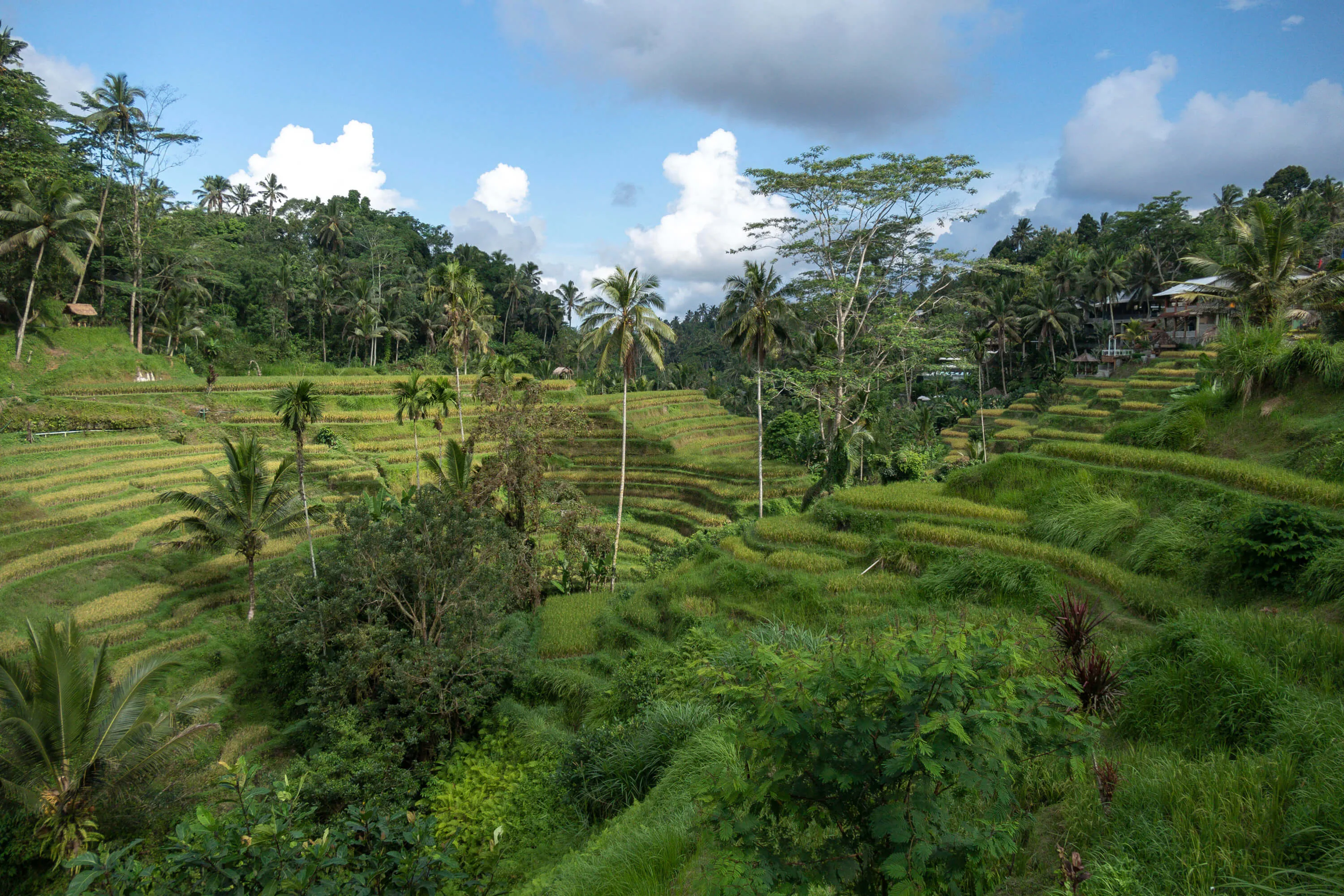
They take you to the rice terraces. The views here are just as polished as everywhere else in Bali.

The field workers harvest rice by hand. They are paid mostly in rice, too. They eat only rice. And they dream only of rice.
When asked how premium rice differs from ordinary rice, they answer: “Premium rice grows here, and ordinary rice grows over there.”

The rice terraces lie on both sides of a ravine with a river running through it.

To get quickly from one side to the other, the planters came up with a bicycle path over the ravine.

That’s usually where the tour ends, at the rice, and by evening they drive you back to your hotel before the tourist gets hungry again.