
Kuala Lumpur
Malaysia is the first on my route and one of only two affluent, civilized, modern countries in the whole region.
The capital of the country is the amorphous city of Kuala Lumpur, which is far from being Singapore, but it feels like a breath of fresh air after a two-week run through the Khmer-Vietnamese slums.
Let’s check into the hotel, take the first refreshing shower, and hit the road.
⁂
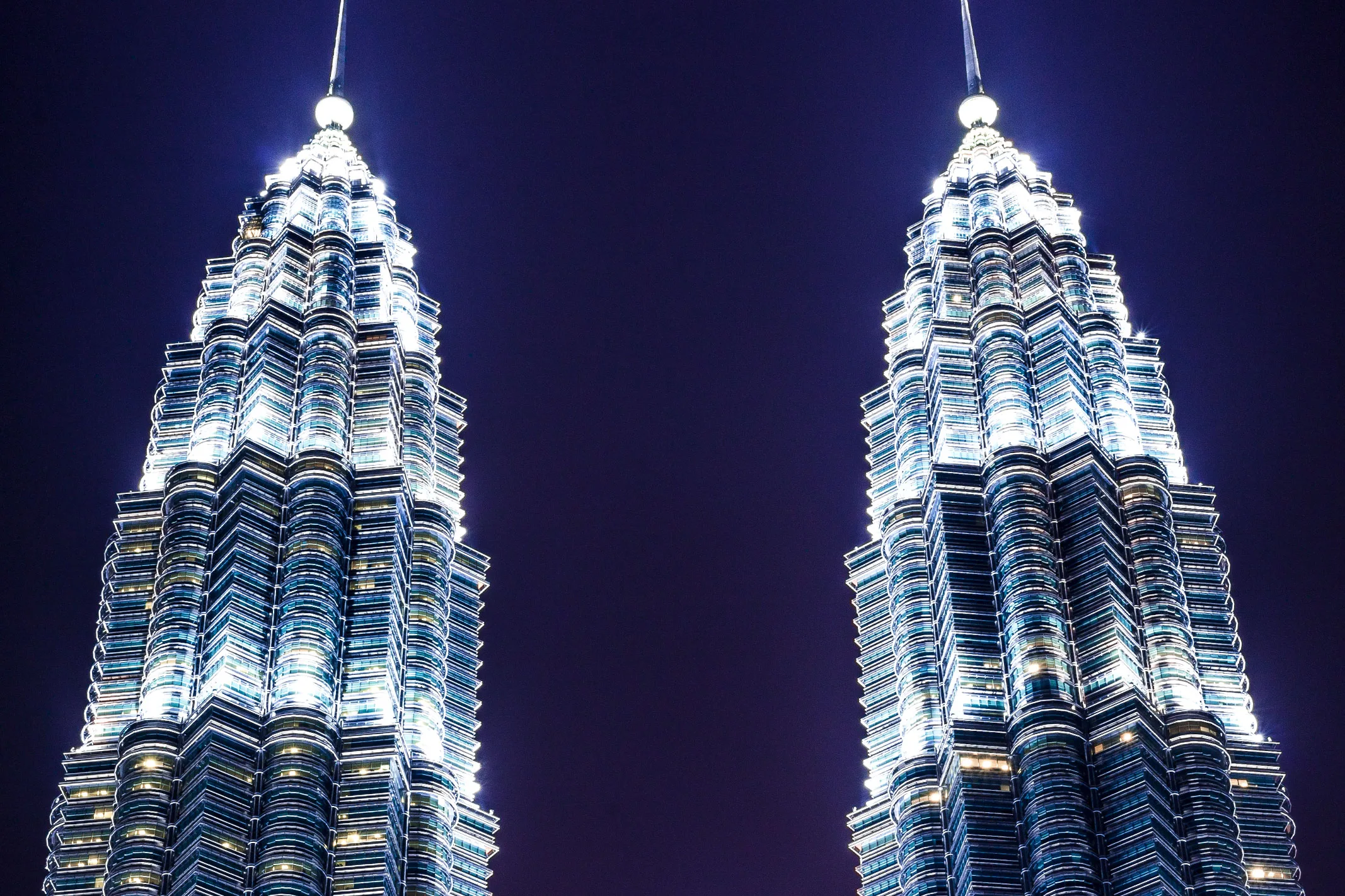
Everyone has seen the Petronas Towers.

Everyone has seen them, but no one knows where they are.

For some reason, everyone first thinks of Europe. Mentally listing European countries that have at least some skyscrapers, they come to the conclusion that the towers are most likely in the United Kingdom. Or somewhere in the USA.

When they try to recall the city, they draw a complete blank. Tropical places, Africa, Japan... come to mind. All wrong: the towers are in the capital of Malaysia, Kuala Lumpur.


Each of the two towers is a colossal block of glass and metal cladding.

All the other skyscrapers in Malaysia are lower and cheaper.

It feels like Dubai with an Asian touch.

There are singing fountains too. Modest ones, no comparison.

High-rise residential buildings.

Single-story construction.


Interestingly, apart from the Petronas Towers, there’s not much to say about Kuala Lumpur. There is simply nothing else here. The only nearby attraction is the Batu Caves. By the way, the story is the same with the caves: everyone has seen them too, but no one knows which country they are in.

So, the caves are also in Malaysia. And the coolest thing is that the golden Murugan statue is right next to the metro. So when you exit the station, you almost immediately see the giant statue and the staircase to the sky.

The caves are utterly uninteresting. Gangs of monkeys snatch bananas from tourists, you can see the sky through a hole in the rock, stalactites hang from the ceiling, and souvenir shops sell water at triple the price.

Malaysia is a wealthy country. Skyscrapers, business centers, and luxury hotels abound here.


Even DIY add-ons here look like penthouses. Albania would envy such fashionable “additions” to buildings.

Streets in the city center.


Expensive cars.

Television tower.

Kuala Lumpur is a city with modern infrastructure. The capital has well-developed transportation, especially the metro. Kuala Lumpur is intertwined with a system of metro, monorail, and suburban trains.

One line is driverless, like in Dubai. Several new lines will go driverless soon.

The cars are bright and cooled by air conditioning. The seats are painted in beautiful vibrant colors. There are separate carriages for women, as in any Asian and Muslim country.


A piece of the colonial city with British architecture has survived in Kuala Lumpur. There is a splendid late 19th-century golf club building.

Former administrative building. Moorish style. Nowadays, races and fairs are often held here.

The old town in Kuala Lumpur is small, but that’s what makes it beautiful.


The modest history of the country is squeezed between skyscrapers.

On this small patch of land, it seems that all the mosques, churches, and temples in the country have gathered. Curiously, there are almost none in the business districts; all the places of worship are crowded into the old town.
Street.

Chinatown.

Taoist temple.


Hindu temple.

The oldest mosque in the city.

⁂
Of course, Malaysia can’t be compared to Vietnam, Cambodia, Laos, or even Thailand. It is a completely different world, a civilization almost like America.
However, Malaysia is far from reaching its full glory. Kuala Lumpur has its fair share of polluted streets.


There are plenty of old panel buildings.

And plenty of monstrous pedestrian overpasses.

And there are probably slums in other parts of the country as well. The reader will ask: is there anywhere without all this? And we’ll answer: in Singapore!