
The Order of Malta
So, in the center of Rome lies the smallest country in the world, and it’s not the Vatican.
The country is called the Order of Malta. Don’t confuse it with Malta. Malta is a completely different country, on an island south of Italy. Still, the names are similar for a reason: Malta was once part of the Order of Malta...
Allow me to add a little intrigue to this story. In fact, “the Order of Malta” is not the full name of the country. I’ll now briefly tell its history, and I suggest the reader keep an eye on the colored words.
It all started in 1048, when a bunch of knights got together and decided to build a military hospital in Israel. They named the hospital after Saint John, and themselves the Hospitallers.
In those days, knights often formed communities that are usually called “knightly orders.” The reader has surely heard of the Templars and the Teutonic Order in history class. The Hospitallers were the same kind of knightly order.
A knightly order is a sort of medieval PMC, a private military company. The knights mostly defended Christian lands, protected pilgrims, and went on crusades against the Muslims. Usually, that was the original reason an order was founded.
The Hospitallers were different. It’s no accident that their name sounds like “hospital.” Originally, this order was created to care for poor and sick Christians and to treat wounded pilgrims. It became a military order only fifty years later, when the First Crusade began.
As a result of the crusade, the knights took Jerusalem from the Muslims, but not for long. Just a hundred years later, the holy city was back in the hands of Islam. The Hospitallers then fled first to Cyprus and then to Rhodes.
At that time, the Mediterranean was teeming with pirates, so the crusaders had to quickly retrain as builders. They covered the tiny island of Rhodes with so many fortresses that for 200 years not only pirates but also Muslim armies broke their teeth on it.

And yet Rhodes fell too. A new, incredible power had matured in the Mediterranean — the Ottoman Empire under Sultan Suleiman the Magnificent. Wanting to show the full might of Islam and, at the same time, take revenge on the hated crusaders, Suleiman decided to crush Rhodes at any cost. He gathered an armada of 150,000 soldiers and led it against the unfortunate island, which was defended by only 6,000 men.
The siege lasted half a year. The fortress withstood more than a thousand cannon shots a day, but the Turkish forces were too great. Having lost about 40,000 men, they finally took Rhodes and drove out the Hospitallers, who soon found a new home on the island of Malta.
When he learned of this, Suleiman the Magnificent once again tried to destroy the knights and gathered a new army, a smaller one this time: only 40,000 men. After besieging Malta for four months and losing 35,000 soldiers, Suleiman’s army for the first time in many years met a force it couldn’t overcome. The belief in the invincibility of the Ottoman Empire was shaken.
And now it’s time to learn the full name of the country. Here it is:
The Sovereign Military Hospitaller Order of Saint John of Jerusalem, of Rhodes, and of Malta.
The name of the country simply lists all the places where the knights of the Hospitaller order once lived. So the Order of Malta is a kind of nomadic state that rolled around the whole Mediterranean like a tumbleweed. And as it rolled, it lost all its territories.
The last of them, the island of Malta, was taken from the Order by Napoleon on his way to Egypt. After that, the Order of Malta had no territory left at all, except for two mansions in Rome. And these are what now count as the territory of the country!
No, seriously. In the center of Rome stands a perfectly unremarkable house.

Its facade is crowned with red flags bearing a white cross.

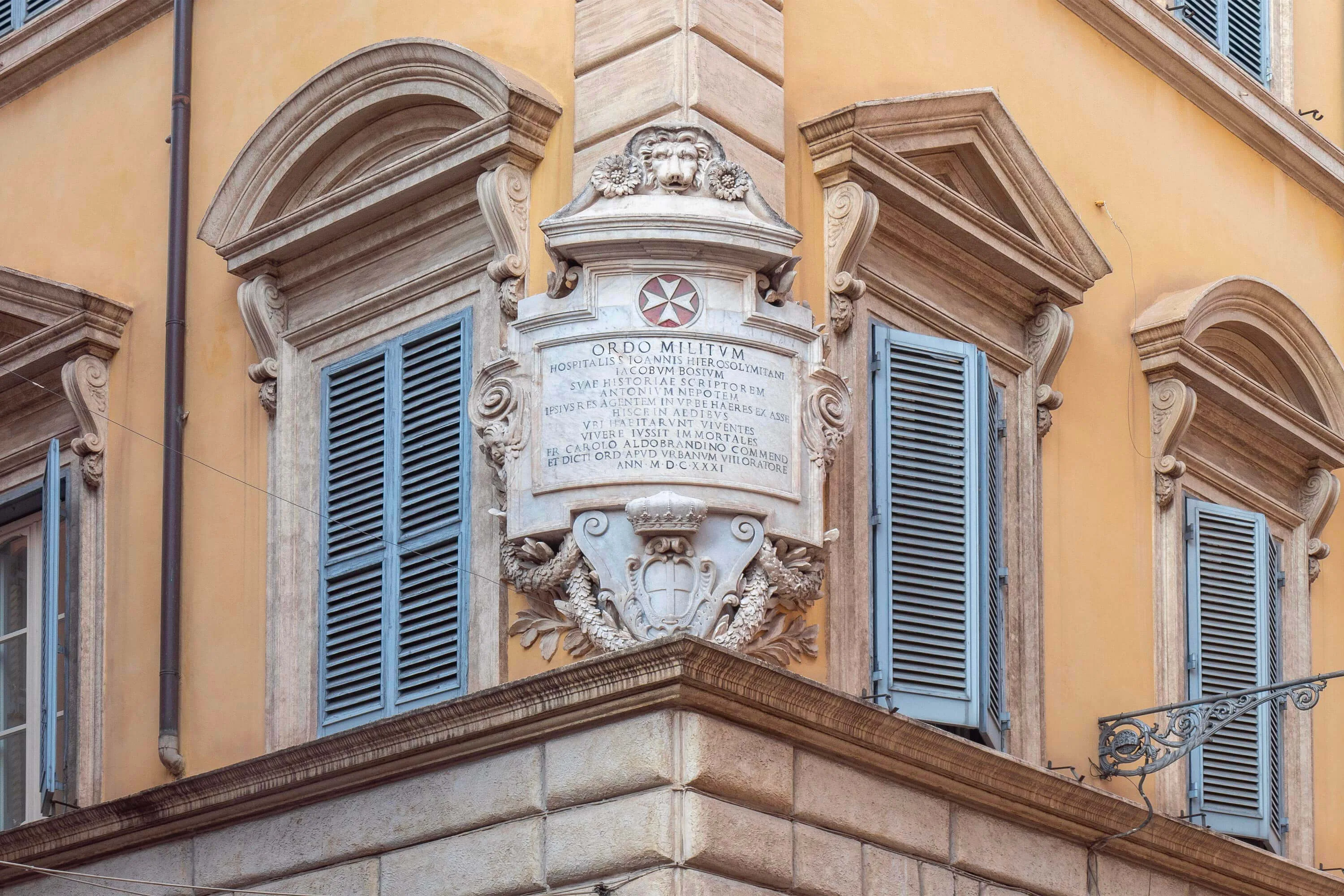
On the corner hangs a magnificent bas-relief with a Maltese cross and a carved inscription: this is where the Order of Malta is.

A plaque on the front door states that this is not just a house but an extraterritorial property of the Order of Malta. This means that the mansion is not part of Italy. And yes, Italy knows.

You can’t get into the mansion: there’s a gate at the entrance. If you have a good reason for a visit, you can ring the bell, and a Hospitaller will open the door. I had no such reason, but the archway also counts as the Order’s territory, so technically I have visited the country.

By the way, the mansion is called the Magistral Palace. That’s because the head of the Order of Malta is called the Grand Master, and this mansion is exactly where he sits.

Judging by photos on the internet, there’s nothing interesting in there. Behind the gate is a small courtyard with haphazard parking.

With its meager interior, the palace itself is reminiscent of the Lenin Museum in Ulyanovsk.

That’s the first mansion. The second one is a little farther away, on the Aventine Hill. It’s called the Magistral Villa, because the Grand Master has his dacha there.

Like the palace, the villa is officially not Italian territory.
In general, the Order of Malta only seems like some kind of sham. If you look into it, it’s actually a full-fledged country, no worse than the Vatican. The Order has territory, albeit a tiny one. It has its own currency, the scudo, and its own postage stamps. It even has its own passport, which is recognized by as many as 113 countries!

One Italian architect once realized this and came up with an interesting project. The thing is, the garden of the Magistral Villa faces straight toward the Vatican. The architect suggested making a peephole in the villa’s door. If you look through this hole, which resembles a keyhole, you can see three countries at once: Italy, the Vatican, and the Order of Malta!
That’s why there’s always a line of tourists at the villa.

Everyone wants to look through the keyhole.

A rare stroke of luck. A car with some important person pulled up to the villa, and the doors swung open right in front of me.

Behind the doors was a tunnel of bushes leading somewhere into the garden. Right in the middle of the tunnel stood the dome of St. Peter’s Basilica in the Vatican.

Exceptionally precise calculation!
By the way, I lied a little. Besides the two mansions in Rome, the Order of Malta has one more property. In 1998, the Order leased for 99 years an old fort that the Hospitallers themselves had once built to defend against the Ottoman Empire.
Although this fort isn’t recognized as fully independent territory of the Order, the Order of Malta can do with it almost as it pleases. It’s called Fort St. Angelo, and it’s located... in Malta, in the city of Valletta.
And that’s exactly where we’re headed now.