
Rome. Part Three. The Fascist Quarter
At the bottom of the Rome metro map, three strange stations catch the eye: their names all begin with the word EUR.

You might think these names have something to do with Europe. Actually, they don’t.
These metro stations serve a special district of Rome that few people have heard of. It was built on the orders of the Italian dictator Benito Mussolini in 1935–1943 to host a world exhibition of the achievements of Fascist Italy.
“The World Exhibition of Rome” in Italian is Esposizione Universale di Roma. Hence the abbreviation: E.U.R.

The Square Colosseum
So, on the outskirts of Rome there is a huge district covering 5 square kilometers, with dozens of government buildings, museums, and monuments that the Fascists built to show off the achievements of the Fascist economy.
How is that possible? I don’t know myself. Here’s what I managed to find out.
One day, the Great Duce and Founder of the Empire, the leader and chief of Italy Benito Mussolini, decided that he had already reached the greatness of Emperor Vespasian. That’s when a brilliant idea came to him: if so, he needed to build a Colosseum of his own — and of course one with blackjack and hookers with a senate and parties.
However, Mussolini couldn’t make such decisions on his own, so he turned to his lady of the time, Margherita Sarfatti. And she advised him:
“Benya, you’re so good at combining a wife and a mistress. Try combining ancient Roman architecture with modern technology.”
“And how would I do that, my dear Margo?”
“Well, remember how Vespasian built the Colosseum?”
“Yes, I vaguely remember something like that. Didn’t they burn down half of Rome for it, together with Nero?”
“Exactly. So you need to build a Colosseum too!”
“My dear Margo, what are you saying? There already is a Colosseum, one and only!”
“Benya, you’re so silly! Build your own Colosseum — the same, only different. I don’t know how. Say, the Colosseum is round. So build a square one.”
“A square Colosseum... wait, what? But that’s... brilliant!”
And so a second Colosseum appeared in Rome. A square one.

Written sources don’t mention what psychoactive substances Margherita Sarfatti was on. In principle, in those wonderful times coughs were treated with heroin and cocaine was taken for headaches, so anything is possible. What is known for sure is that the style was called Novecento.

All in all, a very strange story. One of the pillars of fascism was the cult of tradition. The Fascists called modern art degenerate and called for a return to ancient roots. So, in theory, they should have been building in the Oldecento style.
One way or another, the Square Colosseum was conceived as the Palace of Italian Civilization. It opened in 1940 and was meant to be the centerpiece of the exhibition. But then the acute phase of World War II suddenly began (and who did tha-a-at?), and first the exhibition was postponed, and then Mussolini was hanged.

In the arches of the Square Colosseum stand classical statues, every other one of which seems to suffer from Graves’ disease.

The building itself is a surprisingly cool piece of architecture. It looks like some kind of avant-garde with an Italian twist.

An inscription is carved at the top of the Colosseum on every side: “A people of poets, artists, heroes, saints, thinkers, scientists, navigators, and migrants.”

Today the Colosseum houses the Fendi fashion house, and a very wide avenue leads to it across the whole district. Hmm, somehow this whole fascist neighborhood reminds me of Washington. Oops, I mean... I just mean the architecture is similar.

At the other end of the avenue stands the Palace of Congresses. It wasn’t finished before the war, so construction was frozen. When the war was over, the palace was completed and opened in 1954. Later it hosted competitions and even the 1960 Olympics.

Not bad, huh? Italy had been free of fascism for just 10 years, and then they went and finished Mussolini’s palace in the fascist quarter, and the whole world came there for the Olympics. And you say the sanctions against Russia will never be lifted. Yeah, right.

Today the palace looks half-abandoned. I couldn’t get inside, but through the glass you can see a clumsy mosaic of Roman legionaries that looks like it was drawn by a child with cerebral palsy.

The Fascists built very sensibly. There’s plenty of parking, and every building is easy to reach by car.

The buildings themselves are pure functionality. Perfect, straight walls. Only occasionally do you see some simple stucco to break up the monotony.

Almost all the buildings are still in use. For example, this semicircular building houses INPS, the National Social Security Institute.

An identical building across the road houses Enpam, a pension fund for doctors and dentists. The dried-up fountain suggests it’s not the most popular place to work.

If you look closely, you can see that the quality of construction falls short of Ancient Rome. Under Vespasian, they could at least lay tiles straight.

But on the whole, it leaves a pleasant impression. If fascism hadn’t fallen, this is what all new architecture in Italy might have looked like.

Maybe it’s not too late to bring it all back? Look at the wonderful buildings the Fascists built!
Another beautiful building. It was supposed to house the exhibition management, but in the end it was occupied by the German military command.

Above the portico is a quote from a speech by Mussolini:
“The Third Rome will spread over other hills along the banks of the sacred river all the way to the shores of the Tyrrhenian Sea.”
Today it houses the offices of EUR SpA, a state-owned construction company.

On the wall of this fascist office there are beautiful bas-reliefs: workers and soldiers building a new country together. It looks very much like Soviet art. Er, I mean... purely stylistically!

Surprisingly, the Fascists even managed to build a church in that Novecento of theirs.

But the most luxurious building went to the Museum of Roman Civilization. A huge building with two wings and a colonnade between them.

The museum itself is of no interest. It mostly has ordinary exhibits and copies of famous works of art. But if you dig around, in a nook between the columns you can find a bas-relief of three fascist eagles.

But that’s nothing. After all, you can find an eagle on the coat of arms of any country, and who knows what it stands for.
The cherry on top of the fascist quarter... ready? Taken a deep breath?
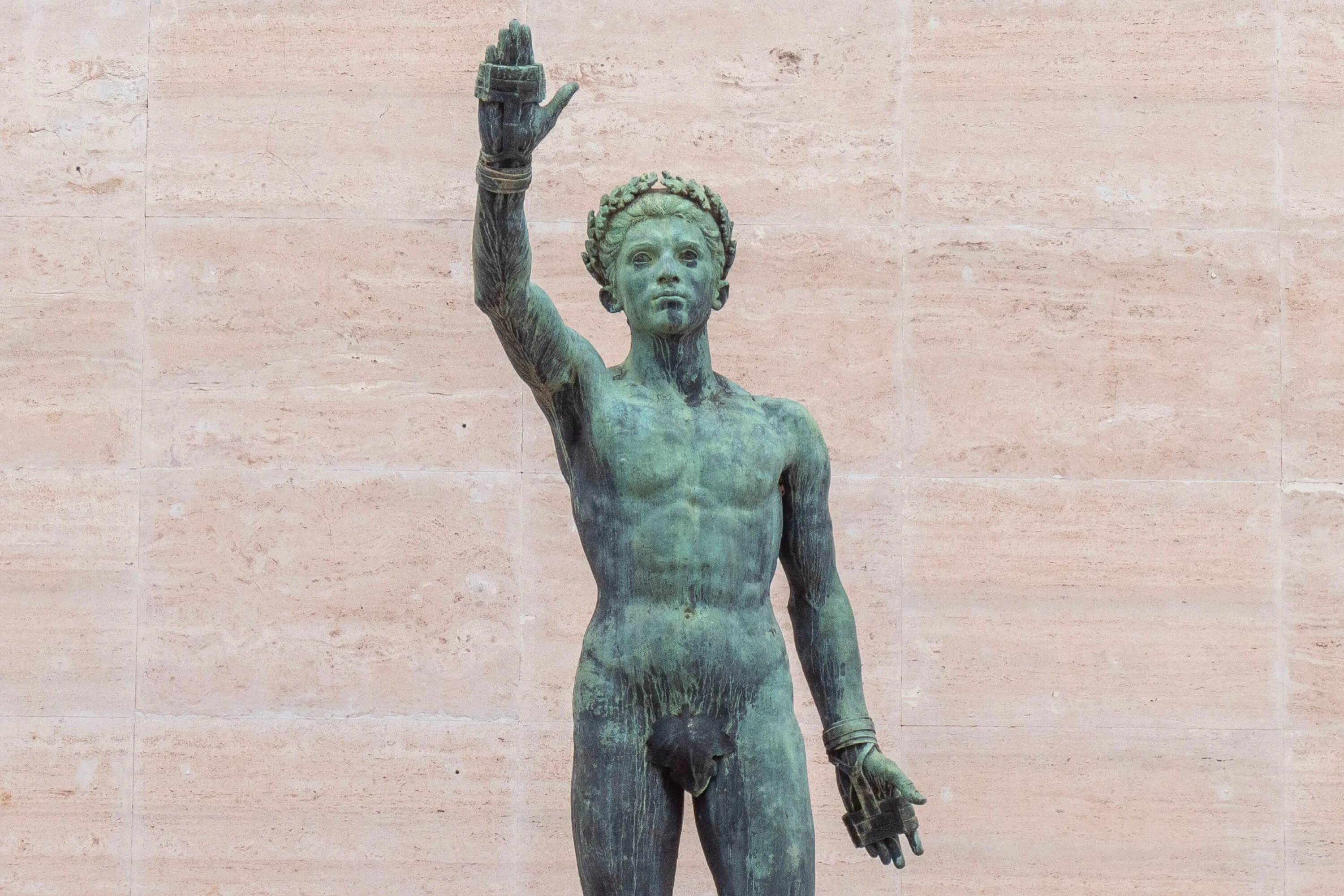
A boy giving a Nazi salute!

No, this isn’t a gesture that just “looks like” a Nazi salute. It is a Nazi salute.
The statue was originally called “The Genius of Fascism” — Genio del Fascismo. It was made by 1942 for the 20th anniversary of the National Fascist Party.

After the fall of fascism, they decided to keep the statue. Those were the times, you know. What if everything went back to how it was, and whoever broke the statue got hanged by the neck?
Still, the fascism had to be covered up somehow. So if you look really... really closely, you can see that boxing gloves have been put on the boy’s hands.
The statue itself is now called “The Genius of Sport” — Il Genio dello Sport.

⁂
Friends! I really liked the fascist quarter. The Fascists did make a mess of things, but just look at the architecture under Mussolini!
And what, is it better now? What good did Berlusconi ever do? He covered Rome with some concrete crap. Ceilings 2.5 meters high. Where would you rather live: in those anthills or in a prestigious Mussolini-era building?
Mein Führer! Ich kann laufen!