
Pisa
Pisa is a provincial Italian town known all over the world for its leaning tower. Apart from the tower, there’s almost nothing interesting in Pisa. Only 88,000 people live here, and the town itself is rather dull and gray.

A river of an unpleasant, dirty color flows through Pisa. The river floods, so the town has no proper embankment.

Taking advantage of the floods, the city services turn a blind eye to the garbage that literally covers the riverbank. Spring will come and wash it all away.

Meanwhile, the alleys have trash bins — as many as six of them. I don’t even know that many kinds of trash. There’s a sticker on the bins saying that the area is under video surveillance. Sheer madness.

I wouldn’t say the town itself is in bad shape. The plaster has peeled off in a couple of places, that’s all.

In some places, this has even done Pisa good. Under the fresh paint lies a whole cultural layer, so there’s no shame in leaving a piece of a house unpainted.

The streets of this typical Italian town are narrow, winding, and nearly treeless.

Sometimes Pisa resembles Istanbul. There’s a kind of highly cultured casualness here. Right next to 13th-century architecture you might find a vegetable stall with a flowery oilcloth.

Or a father might calmly walk his child along the parapet by the river. In Berlin, he’d have lost his parental rights by now.

Wonderful doorbells.

A delightful door.

On one of the houses I found an analemma. It’s the curve traced by the position of the sun at noon over the course of a year. Above it is a plate with a hole through which a sunbeam passes. If the beam falls exactly on the curve, it’s noon. I’ve never seen such a perverse way of telling the time.

There were a couple of interesting buildings on the main square of Pisa. This palace was built for the Medici in 1564.

An absolutely incredible paint job.

Next to it stands an equally beautiful chapel from the same period.

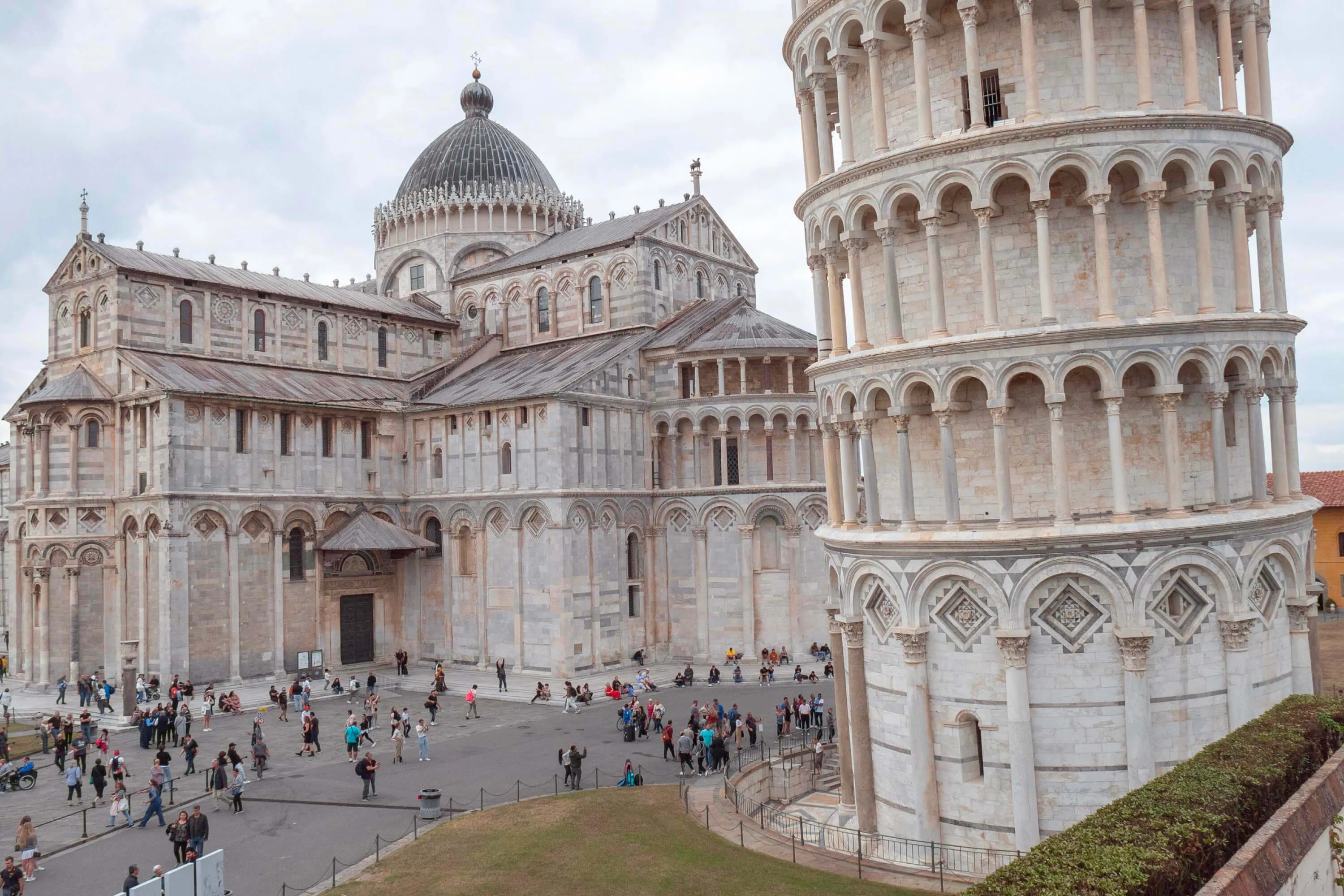
So, the tower. If you walk through the whole town, near the outskirts you’ll find a large field with the town’s main cathedral.

It’s simply called Pisa Cathedral. An absolutely gorgeous example of Italian architecture.
The cathedral was built as far back as 1092. There was no Italy yet. Its territory consisted of many separate city-states, one of which was the Republic of Pisa — a tiny country that formed around the city of Pisa.
Many textbooks call this era the “period of feudal fragmentation,” hinting at its backwardness. In fact, it was the heyday of small independent states, and the Republic of Pisa was one of them.
See for yourself: does this architecture look like the work of backward feudal lords?

Every self-respecting cathedral gets a bell tower — a tall tower with a bell at the top. At set times, the bell ringer climbs the tower and rings the bell, calling people to worship.
So a bell tower was being built for Pisa Cathedral too, but something went wrong: the soil under the tower turned out to have uneven density, and the tower began to lean.

At the time, the Republic of Pisa was at war with Florence, so construction was halted. That alone saved the tower from falling: during the pause, the soil had time to settle a little.
Eighty years later, construction resumed, and the builders came up with the idea of making the remaining floors taller on one side than on the other to compensate for the lean. In the end, they somehow finished it.
They decided to make the very top, where the bell hangs, vertical relative to the ground. To do this, they built it tilted by the same angle in the opposite direction. But that was in the 14th century, and the tower has kept slowly leaning ever since.
So now the tower leans at one angle and its top at another — the top that was perfectly straight 500 years ago.

So calling the Leaning Tower of Pisa “leaning” is inaccurate. Scientifically speaking, it’s all fucked up and crooked.


What’s more, the lean at the base looks ten times scarier.

By the way, Galileo never dropped anything from the tower. That’s a myth.

What is true is the crowds of idiots still taking photos of themselves “holding up the tower.”