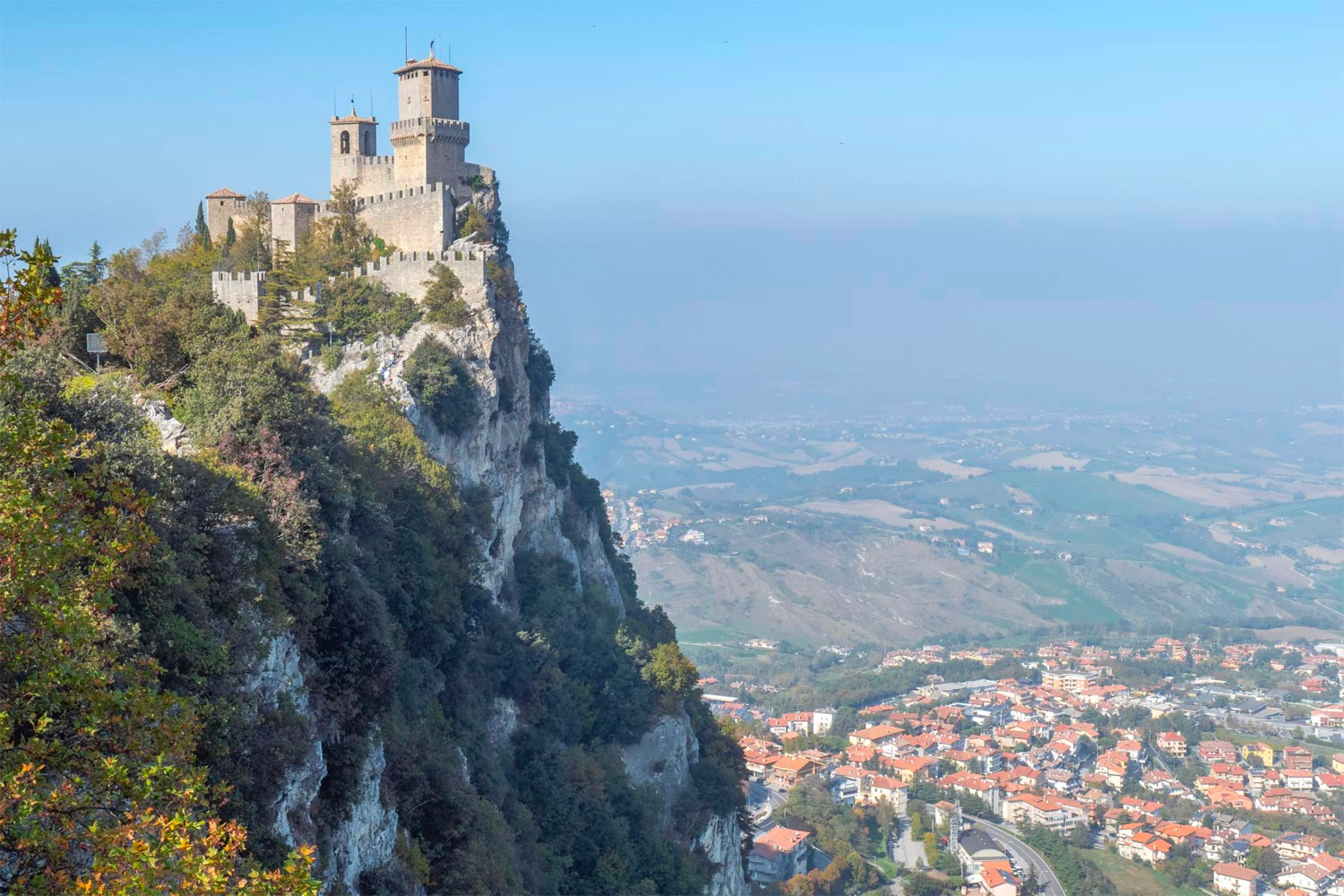

San Marino
Half an hour from the Italian city of Rimini lies the dwarf state of San Marino, which few people have heard of. The country is surrounded by Italy on all sides, and its capital (the city of San Marino) sits on the huge rock of Monte Titano.
Interestingly, this godforsaken place is the oldest continuously existing state in the world. One day in 301, a stonemason named Marinus fled persecution in the Roman Empire and climbed a high mountain so that no one would find him.
On this mountain, Marinus declared himself a saint, founded a Christian community, and proclaimed independence from Rome. Rome, of course, had no idea. Since then and to this day, no one has conquered San Marino, because nobody needed the damn place.

A regular bus runs from Rimini to San Marino. It climbs right up the mountain and parks at the most picturesque bus stop in the world.

In the center of the city stands the local Statue of Liberty.

Right behind the statue is San Marino’s town hall and government house in one building. It’s open to anyone, and on the balcony you might easily see a local official discussing affairs of state on the phone.

The main church of San Marino looks more like a theater.

The city itself has a lot of “castle-style” architecture: tall beige walls of large bricks with crenellated towers rising against them.

Parts of the fortress walls grow into residential houses.


Cafés, restaurants, shops, and taverns — in San Marino, everything fits naturally into the overall cityscape.

The roofs are mostly tiled.

The streets of a medieval town.

Of course, there’s absolutely nothing to do in San Marino. The city seems to have a cinema, a couple of museums, and that’s it. And one of the museums is about torture.

Out of boredom, the government of San Marino came up with a pastime. It introduces visa-free travel for every country whose citizens can’t enter Europe without a visa.
The thing is, San Marino is surrounded by Italy on all sides and has no airport. So you can only get here overland, and for that you first have to enter Italy on a Schengen visa.
So you could introduce visa-free travel even with Afghanistan — it means absolutely nothing. And so San Marino has abolished visas for Russia, China, Morocco, and Kenya. Just for fun.
Of course, there are no checkpoints at the entrance to San Marino anyway, and even citizens of “visa” countries can just hop on a bus and come. But there are collectors who gather visas in their passports. Especially for them, the local tourist office stamps souvenir visas for 5 euros.

So if San Marino is so boring and there’s nothing to do, why come here at all? Because the views from here are absolutely mind-blowing.

At the very top of Monte Titano, a fortress wall begins. Now that’s a real castle.

The castle consists of three towers. Loosely speaking, because the towers were actually built separately, long apart in time, and there is no single “castle” in San Marino.
The first tower was built in the 11th century to defend the country. It also used to house a prison.

A fortress wall runs from the first tower.

Along this wall there are many smaller towers that you can even go into and look at San Marino through a gun port.

The same wall doubles as a staircase and a walking path.

Below your feet is a view of the city from a height of 700 meters. That’s the height paratroopers jump from.

At the other end of the wall, you can see the second tower.

Although the towers are only 300 meters apart as the crow flies, getting there isn’t easy. The wall winds, turns into steps, and keeps changing the landscape around.


Suddenly, out of nowhere, a whole forest begins.

Out of it rises an absolutely fairy-tale ancient tower covered in ivy.

And the views here are such that every five minutes you stop and take a million photos from every angle.


The second tower was built in the 13th century, and now it houses some museum for those eccentrics who got bored with the mountain view.

From here you can also see the third tower — the smallest and youngest. It was built in the 14th century.

Nah, this is getting boring. What’s the 14th century by our standards? Practically yesterday!